
If you’ve ever stood in front of a cluttered closet wondering where everything went wrong, you’re not alone. Closets are one of the most overlooked spaces in a home, yet they carry a huge amount of daily weight — literally and figuratively. Coats, shoes, off-season clothing, linens, accessories, and “I’ll deal with it later” items all compete for the same few feet of space.
When homeowners finally decide to fix the problem, they almost always land on the same fork in the road: should I buy a closet organizer system, or invest in a custom closet? Both promise order. Both promise to make your mornings smoother. But they are not the same thing, and choosing the wrong one can leave you right back where you started in a year or two.
This guide breaks down exactly what separates the two, where each one shines, and how to decide which approach fits your space, your habits, and your long-term goals — without getting lost in price talk or sales pitches.
What Is a Closet Organizer System?
A closet organizer system is typically a pre-manufactured, modular storage solution. Think wire shelving kits, laminate cube systems, or the boxed kits you find at big-box home improvement stores. These systems come in standard sizes and configurations, and they’re designed to be installed relatively quickly using a fixed set of components — shelves, rods, drawers, and baskets that snap or bolt together in predetermined patterns.
The appeal is obvious. Organizer systems are widely available, easy to find, and don’t require much planning. You measure your closet, pick a kit that’s close to the right size, and install it yourself or with minimal help. For a renter, a starter home, or a closet that just needs basic structure instead of empty rod-and-shelf chaos, this can be a perfectly reasonable starting point.
But that convenience comes with real limitations. Standard kits are built for standard closets — and very few closets are actually standard. Awkward angles, sloped ceilings, oddly placed windows, HVAC returns, and varying wall lengths are the norm in real homes, especially older or custom-built properties. When a one-size-fits-most system meets a space that doesn’t fit the mold, you end up with wasted corners, shelves that stop short of the wall, or gaps that turn into junk-collecting dead zones.
What Is a Custom Closet?
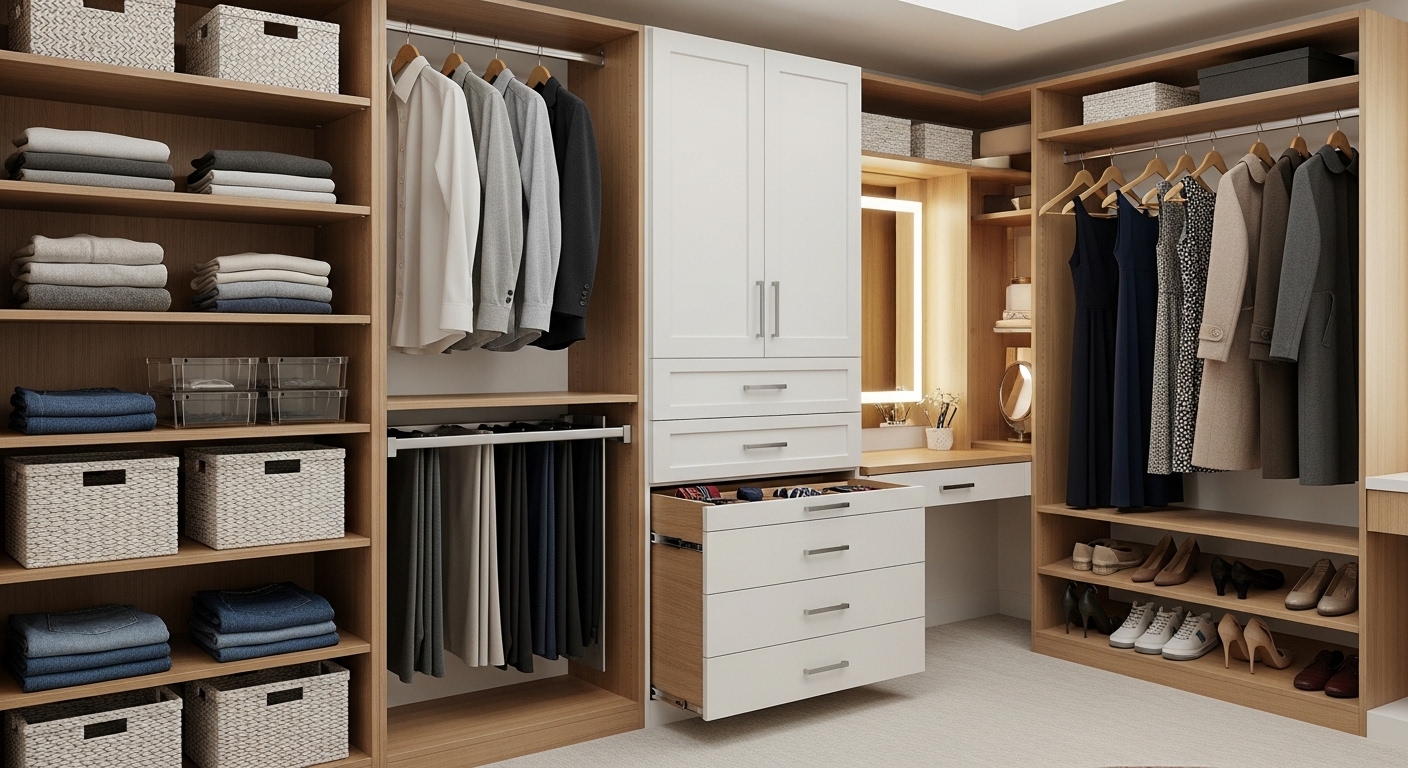
A custom closet, by contrast, is designed and built specifically for your space, your storage needs, and how you actually live. Instead of starting with a fixed kit and adapting your closet to it, the process works in reverse: the closet is measured, your storage priorities are discussed, and a layout is designed around your exact dimensions and habits.
This is where the conversation naturally connects to broader Custom Cabinetry & Built-Ins work, since a well-built custom closet uses many of the same construction principles as built-in cabinetry elsewhere in the home — solid construction, matched finishes, and joinery built to last rather than snap together.
A custom closet can account for:
- Double-hang sections for shirts and folded-length items
- Long-hang sections for dresses, coats, and robes
- Dedicated shoe shelving angled for visibility and airflow
- Built-in drawers for delicates, accessories, or jewelry
- Adjustable shelving for changing seasonal needs
- Specialty features like pull-out hampers, valet rods, or tie and belt racks
- Lighting integrated directly into the design
Because everything is planned around the room rather than forced into it, every inch of vertical and horizontal space gets used intentionally. There’s no leftover gap above a fixed shelf, no awkward six inches of unused wall — the design simply ends where your closet ends.
The Core Differences That Actually Matter
1. Fit and Use of Space
This is the single biggest differentiator. Organizer kits are built to general dimensions and then adapted to your closet as closely as possible. Custom closets are built to your closet’s exact dimensions from the start. If you have a walk-in with an angled ceiling, a reach-in with a narrow depth, or a closet that wraps around a corner, a custom design can follow that geometry precisely. A kit usually can’t.
2. Materials and Durability
Most off-the-shelf organizer systems use wire racking, particleboard, or thin laminate panels. These materials are lightweight and inexpensive to manufacture, but they also tend to show wear faster — sagging shelves under heavy sweaters, wire racks that leave indentation marks on knitwear, or laminate edges that chip over time. Custom closet builds typically use more substantial materials and construction methods, similar to what you’d expect from quality Solid Surface Countertops or built-in furniture — designed to hold up to daily use for years, not just survive the return window.
3. Personalization
An organizer kit gives you a menu of pre-set configurations. A custom closet gives you a blank canvas. If you have an unusually large shoe collection, a passion for handbags, a need for long hanging space for formalwear, or simply a strong preference for how you like to see your clothes organized, custom design can build around that specific need instead of asking you to compromise to fit a standard layout.
4. Integration With the Rest of the Room
Because custom closets are designed rather than installed from a box, they can be finished to match the rest of your home — matching trim, matching cabinet doors, coordinated hardware, and finishes that tie into adjoining rooms. This is especially relevant if your closet is visible from a bedroom or dressing area, where you want the space to feel like part of the home rather than a separate storage afterthought. This same attention to detail and finish-matching is also why so many homeowners pair a closet project with related upgrades like Custom Shelving in adjoining rooms, creating a consistent look throughout the house.
5. Installation Process
Closet organizer kits are usually designed for faster, more DIY-friendly installation, which is part of their appeal if you want a quick fix. Custom closets involve a more thorough process — measuring, design consultation, and professional installation — because the goal is a permanent, built-to-last result rather than a temporary fix.
When a Closet Organizer System Makes Sense
There are genuinely good reasons to choose a pre-made organizer system, and it’s not always about settling for “good enough.” A standard kit can be the right call when:
- You’re renting and can’t make permanent modifications
- The closet is a fairly standard rectangular shape with no unusual angles
- You need a quick improvement rather than a long-term renovation
- The space is low-traffic, like a guest room closet or seasonal storage area
- You want to test out an organizational style before committing to something built-in
For these situations, a well-chosen organizer kit can absolutely solve the immediate problem of bare rods and a single shelf.
When a Custom Closet Makes Sense
A custom build tends to be the better long-term investment when:
- You own your home and plan to stay for years
- Your closet has irregular dimensions, angled ceilings, or awkward corners
- You have specific storage needs that generic shelving doesn’t address (specialty hanging, drawers, shoe storage, etc.)
- You want the closet to match the design quality of the rest of the home
- You’re already planning other built-in storage, such as a Custom Storage Solutions project elsewhere in the house, and want a cohesive approach
- You want a space designed around your actual daily routine, not a generic template
In many homes throughout the Houston area, master closets and walk-ins in particular tend to have non-standard shapes — sloped ceilings under stairwells, closets carved out of bonus rooms, or walk-ins with multiple wall angles. These are exactly the situations where a kit-based system struggles and a custom design earns its keep.
A Hybrid Approach Is Also Worth Considering
It’s worth noting that the choice isn’t always binary. Some homeowners use a simpler organizer system in secondary closets — kids’ rooms, guest rooms, hall closets — while investing in a fully custom build for the primary closet or walk-in that gets daily use. This kind of mixed approach lets you prioritize where customization actually adds value, rather than applying the same solution to every closet in the house regardless of how it’s used.
Maintenance and Longevity: What to Expect Over Time
Another factor that often gets overlooked in the organizer-versus-custom debate is how each option ages. Wire and laminate organizer kits are functional, but components like plastic connectors, thin shelf brackets, and lightweight drawer slides tend to show their limitations after a few years of daily use — especially in closets that see heavy traffic, like a primary bedroom closet used by two people every morning.
Custom closets, built with sturdier materials and proper wall anchoring, are designed to handle that daily wear without the sagging, wobbling, or loosening that’s common with kit-based systems. Drawers glide smoothly because they’re built into a properly supported frame rather than hung on lightweight tracks. Shelves stay level because they’re installed to fit the actual wall, not adjusted after the fact to compensate for an imperfect fit.
This longevity matters even more if you’re the kind of homeowner who thinks in terms of long-term home value rather than short-term fixes. A closet that still looks and functions well a decade later contributes to the overall sense of quality in a home, the same way thoughtfully built custom cabinetry throughout a kitchen or living room does. Storage that’s built to last isn’t just a convenience — it’s part of how a home holds up over time.
Common Mistakes Homeowners Make When Choosing Between the Two
It’s easy to make a decision based on the wrong factor. Here are a few patterns worth avoiding:
- Choosing based on the closet’s current contents instead of future needs. A closet that feels “fine” today may not accommodate a growing wardrobe, a second person’s belongings, or a change in storage habits a few years from now.
- Assuming every closet in the house needs the same solution. As mentioned earlier, a hybrid approach often makes more sense than applying one system everywhere.
- Underestimating irregular dimensions. Homeowners sometimes assume a kit will “mostly fit” an angled or oddly shaped closet, only to discover gaps and unusable corners after installation.
- Overlooking how the closet connects to the rest of the room. If a closet is visible from the bedroom, mismatched finishes or visible hardware can stand out more than expected.
- Not thinking through specialty storage early. Items like shoes, accessories, or formalwear often need dedicated solutions that aren’t part of a standard kit’s layout, and retrofitting them later is more disruptive than planning for them up front.
Avoiding these missteps usually comes down to one thing: being clear about how the closet will actually be used, not just how it looks on day one.
How to Decide for Your Space
If you’re still on the fence, ask yourself a few honest questions:
- Is my closet a standard shape, or does it have angles, alcoves, or unusual dimensions? Irregular spaces favor custom builds.
- How long do I plan to stay in this home? Longer timelines make the investment in a built-to-last custom solution more worthwhile.
- Do I have specialty storage needs — extensive shoe collections, formalwear, accessories — that a generic shelf-and-rod layout can’t accommodate?
- Does the closet need to visually match the rest of the room, or is it a hidden, purely functional space?
- Am I solving a temporary problem or a permanent one?
There’s no universally “correct” answer — the right choice depends entirely on the specific closet, the household’s habits, and how long-term the solution needs to be. What matters most is being honest about which category your situation falls into before you start shopping for shelving or scheduling a design consultation.
Final Thoughts
A closet organizer system and a custom closet are both legitimate paths to a more organized home — they’re just built for different goals. Organizer kits offer speed and accessibility for straightforward spaces and shorter-term needs. Custom closets offer precision, durability, and a layout shaped entirely around how you actually live, which matters most in irregular spaces or homes where you’re planning to stay for the long haul.
If your closet has awkward angles, you’re tired of patching together generic shelving, or you simply want a space that’s been designed specifically for your wardrobe and your routine, exploring Custom Closet Solutions built around your exact space is worth the conversation. The right storage solution shouldn’t make you adapt to it — it should adapt to you.


Comments are closed