
How Much Does Custom Cabinet Installation Cost in Angleton, TX?
Here’s the thing about custom cabinets — nobody talks about the price until they’re already in love with the idea.
You’ve been running your business for a while. Maybe your office storage is a disaster. Maybe you’re finally renovating that break room or building out a space that actually looks like the brand you’ve built. And somewhere along the way, someone says “you should do custom cabinets” and suddenly you’re down a rabbit hole, trying to figure out what this is actually going to cost.
So let’s just talk about it. Honestly. No fluff, no vague ranges that could mean anything.
If you’re a small business owner in Angleton or anywhere around Brazoria County, this guide will walk you through what custom cabinet installation actually costs, what makes that number go up or down, and how to think about it as a real business investment — not just an expense.
What You’re Actually Getting Into (And Why It’s Worth It)
Before we get into numbers, let’s be clear about what “custom” means.
Custom cabinets aren’t the flat-pack stuff you’d grab from a big box store. They’re built to your exact specifications — your dimensions, your materials, your layout. That’s why they cost more. And it’s also why they last longer, look better, and actually work for your specific space.
For small business owners, this matters a lot. A waiting room with smart, built-in storage looks completely different from one that’s just… managed. Same with a back office. Same with a reception desk with built-in cabinets versus a freestanding unit that wobbles every time someone opens a drawer.
[IMAGE: Before/after comparison of a small business office with generic storage vs. custom built-in cabinets]
That said, custom doesn’t mean “unlimited budget.” There are real decisions that affect real dollars, and knowing them upfront makes you a better buyer.
Step 1: Understand the Real Cost Range (Not the Vague One)
Okay, let’s talk numbers.
For custom cabinet installation in the Angleton, TX area, you’re typically looking at:
- Basic custom cabinets (simpler designs, standard wood options): $300–$500 per linear foot installed
- Mid-range custom cabinets (more design complexity, better hardware, more finish options): $500–$900 per linear foot installed
- High-end/fully custom (premium materials, specialty finishes, complex builds): $900–$1,500+ per linear foot installed
So what does that look like in practice? A small office kitchenette or break room with around 15 linear feet of cabinetry could run you anywhere from $4,500 on the lower end to $15,000+ on the high end, depending on what you’re going with.
A full office with custom storage, a built-in reception desk, and cabinetry throughout? You’re probably budgeting $20,000–$60,000 depending on the scope.
I know, that’s still a wide range. That’s because there are a lot of levers, and we’re going to walk through each of them.
Step 2: Know What’s Driving Your Cost
Think of your cabinet quote like a menu — you’re choosing from a set of options, and each choice either adds or removes cost. Here’s what’s actually on that menu.
Materials
Wood species is one of the biggest drivers. Poplar and maple are solid, workable options on the more affordable end. Oak sits in the middle. Cherry and walnut start climbing. And if you want something exotic — zebrawood, teak, white oak with a live edge — that’s a very different conversation.
For most business owners, maple or a quality MDF with a painted finish hits the sweet spot. It looks sharp, holds up well, and doesn’t require a second mortgage.
Cabinet Construction Style
There are two main styles: face-frame and frameless.
Face-frame cabinets are the classic American look — the frame overlaps the box. Frameless (also called European-style) gives you that clean, modern look with full access to the cabinet interior. Frameless tends to cost a bit more because of tighter tolerances in manufacturing.
For contemporary office environments and commercial spaces, frameless is usually the preferred choice.
Hardware
This one surprises a lot of people. Hardware — hinges, drawer slides, pulls — can meaningfully change your total cost. Soft-close everything? Quality matters here. European hinges from Blum or Hettich are going to outlast cheaper alternatives by years, but they cost more upfront.
For a business, this is usually worth it. You don’t want a break room cabinet hinge failing every six months.
Finishing
Paint versus stain. Sprayed finish versus brushed. Custom color versus standard palette.
A sprayed, factory-quality finish adds cost but delivers a result you can’t replicate with brushwork. If this is a client-facing space — a reception area, a showroom, a conference room with built-in storage — a premium finish is visible every single day and probably worth it.
Installation Complexity
This is where location-specific factors come in. If your space requires removing old cabinets, working around existing plumbing, or dealing with an out-of-square room (and old Texas buildings can be very out of square), installation takes longer. Longer means more labor. More labor means more cost.
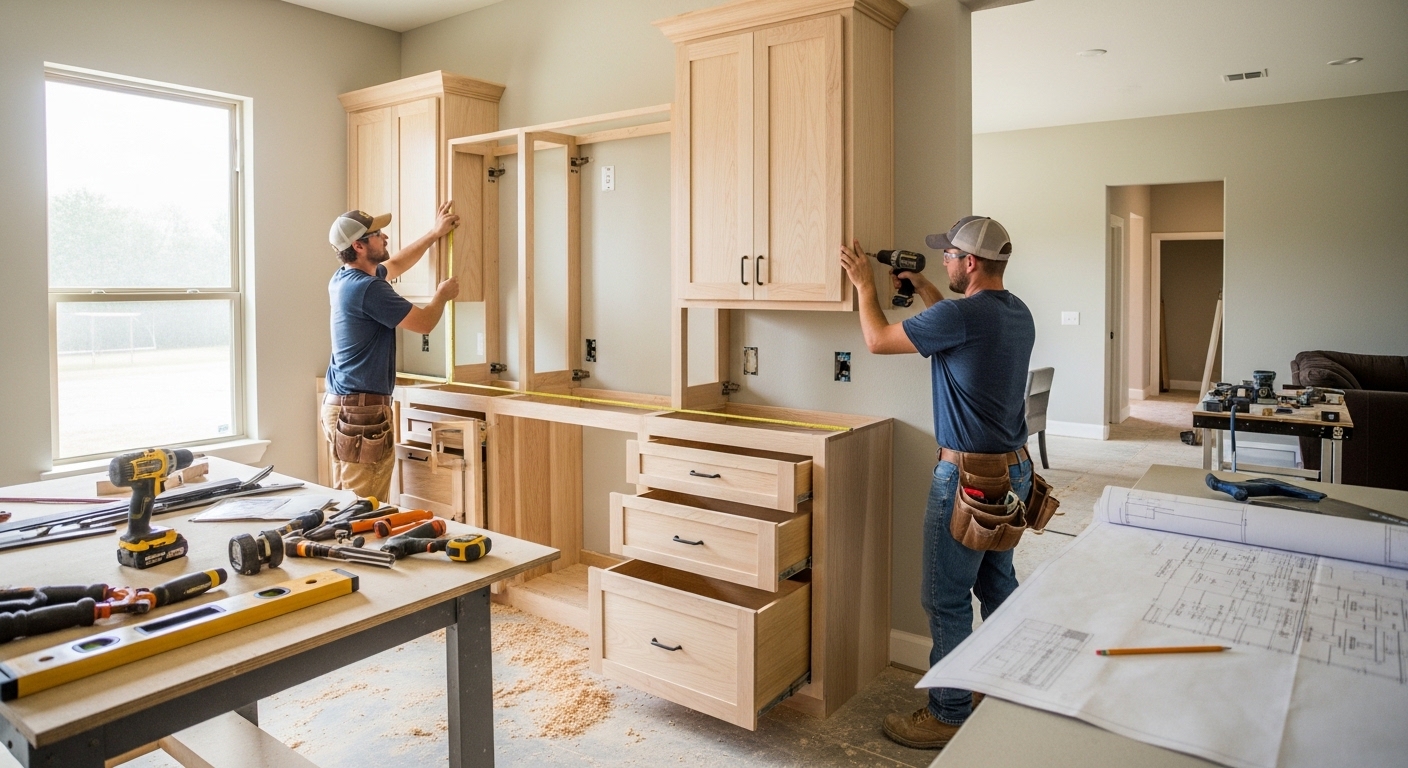
[IMAGE: Installer measuring and fitting custom cabinet panels in a commercial office space]
Step 3: Get the Right Quote — Here’s What to Actually Prepare
A lot of business owners go into the quoting process without the information they need, and then wonder why they get wildly different numbers from different shops.
Here’s what to have ready before you contact a cabinet maker:
Room dimensions. Measure every wall where cabinets will go. Height, width, and depth of the space. Note any windows, outlets, switches, or plumbing on those walls.
A rough function list. What are these cabinets actually for? Document storage? Displaying product? A functional kitchenette? Built-in reception desk? The more specific you are, the more accurate the quote.
Photos of the space. Seriously, just take photos. They save a thousand words and help the cabinet maker see what they’re working with.
Your general aesthetic direction. Modern and clean? Traditional and warm? Matching existing finishes? Even a rough idea helps.
Your budget range. I know, this feels counterintuitive — like you’re showing your hand. But a good cabinet maker will use your budget to help you get the most out of it, not just build to that number. Giving them nothing to work with often results in a quote that misses the mark completely.
The team at Ace Kustoms works with business owners in Angleton and across Brazoria County regularly, and having even a rough sketch of your needs makes that initial conversation a lot more productive.
Step 4: Factor In the Timeline (It Affects More Than You Think)
Custom means built from scratch. That takes time.
Typical lead times for custom cabinet orders run 6–12 weeks from design approval to installation. Add in design consultations, revisions, and scheduling the actual installation, and you could be looking at a 3–4 month process from “let’s do this” to done.
For a business, timing matters. If you’re planning around a grand opening, a lease renewal, or a specific busy season, you need to build this timeline into your planning.
The good news? A local shop in Angleton or Brazoria County — like Ace Kustoms — can often be more responsive and collaborative than a large manufacturer with a longer pipeline. Working local means real conversations, faster adjustments, and someone who’s accountable to the community they’re building in.
[IMAGE: Custom cabinet timeline diagram showing design, fabrication, and installation phases]
Step 5: Compare the Right Way (Not Just Price)
When you get multiple quotes, it’s tempting to just look at the bottom line. Don’t do that.
Look at what’s included. Is demo of existing cabinets included? What about haul-away? Is installation included in the per-linear-foot price, or is it a separate line item? What’s the warranty on materials and on labor?
A quote that’s $2,000 cheaper but doesn’t include removal and disposal of your existing storage, or doesn’t warranty the install, might actually cost you more in the long run.
Also look at the shop’s portfolio. Have they done commercial work? Office environments? Break rooms? A shop that primarily does residential kitchens can absolutely do great work, but their experience base matters for what you’re trying to accomplish.
Troubleshooting: Common Budget Surprises (And How to Avoid Them)
Surprise #1: The space is more complex than expected. Old buildings shift. Walls aren’t square. If you’re in an older building in Angleton, budget a small contingency (10–15%) for installation challenges. A good cabinet maker will flag this upfront if they do a proper site visit.
Surprise #2: Scope creep. You started with a break room and now you’re talking about cabinets in three offices and a custom reception desk. This is actually pretty common — once you see the quality, you want it everywhere. Know your initial scope and stick to it, or consciously decide to expand it.
Surprise #3: Permit requirements. For most standard cabinet installations, no permit is required. But if you’re doing structural changes, modifying plumbing, or electrical work as part of a larger renovation, that changes. Ask your cabinet maker and your contractor what the local requirements are in Angleton.
Surprise #4: The hardware upgrade. You spec’d simple pulls and then saw the premium options. It’s a real thing. Hardware is one of the last decisions but one of the most visible daily. Budget a small buffer for this from the start.
Expert Tips: What a Pro Would Tell You Over Coffee
A few things I’d share if we were just talking:
Don’t cut corners on drawer slides. You’ll open those drawers a thousand times. Soft-close, full-extension slides are worth every extra dollar.
Painted finish vs. stained — consider your maintenance reality. A painted finish shows dings and marks more easily but is easier to touch up. Stained wood hides wear but is harder to match if you need repairs later. For a high-traffic office environment, painted is often the smarter choice.
Think about what goes inside. Half the time people focus entirely on the cabinet exteriors and then realize they need pull-out shelves, drawer organizers, or file drawers. Talk through the interior organization during the design phase, not after.
Visit the shop if you can. Seeing how a cabinet maker works — the quality of their equipment, the care they take — tells you a lot. Any shop worth hiring will welcome a visit.
For Angleton-area business owners, Ace Kustoms does both cabinet work and trim, which means they can often handle the full install — cabinets, trim, finish details — without you managing multiple contractors. That coordination matters more than you’d think.
Summary: What You Actually Need to Know
Here’s the short version:
Custom cabinet installation in Angleton, TX typically runs $300–$1,500+ per linear foot installed, depending on materials, construction style, hardware, and complexity. Most small business cabinet projects — a break room, an office, a reception area — land in the $5,000–$40,000 range depending on scope.
What drives the cost:
- Materials (wood species, finish quality)
- Construction style (face-frame vs. frameless)
- Hardware selection
- Installation complexity
- Timeline and scope
What makes a project go well:
- Clear communication upfront
- A realistic budget with a small contingency
- Working with a local shop that does commercial work
- Not rushing the design phase
And what makes it worth it: a space that looks intentional, functions well, and reflects the business you’ve actually built.
Ready to Get a Real Number?
If you’re a small business owner in Angleton or Brazoria County and you’re ready to stop guessing and start planning, Ace Kustoms specializes in custom cabinets and trim for exactly this kind of project.
Reach out with your dimensions, your space photos, and a rough idea of what you’re after. That first conversation is where the real numbers start to come together — and where a vague idea becomes a plan you can actually move forward with.
Your space should work as hard as you do. Custom cabinets, done right, make that happen.
Comments are closed