
The Real Custom Cabinet Guide for East Montgomery County Homeowners
My neighbor — let’s call her what she is, a very patient woman — spent two years living with kitchen cabinets that didn’t close right. One of the doors would drift open overnight. Every single morning, she’d walk into her kitchen and find it gaping at her like a question she didn’t want to answer.
She’d bought the house from a flipper. The cabinets were technically fine. New-ish. Inoffensive. But they weren’t hers, and they didn’t fit the space, and eventually she got tired enough of it to do something about it.
What she discovered — and what I want to save you from discovering the hard way — is that getting custom cabinetry is actually less complicated than most people assume. It’s the not-knowing that makes it feel big. Once you understand the process, it’s just decisions. Good ones, made in the right order.
If you’re a homeowner in New Caney, Roman Forest, Splendora, or anywhere else in East Montgomery County, this guide is written for where you actually live — the humidity, the housing stock, the specific quirks of homes out here. Let’s go.
The Part Nobody Talks About First: Why “Fine” Cabinets Make You Miserable
Here’s a thing I’ve noticed: homeowners don’t usually describe their cabinetry problems in terms of cabinetry. They describe them in terms of feeling.
“The kitchen just doesn’t work for us.”
“There’s never enough space, no matter how much we reorganize.”
“It feels dated, but I can’t put my finger on why.”
And underneath all of that is usually the cabinets. Wrong layout. Bad storage configuration. Builder-grade finishes that photograph fine but live poorly. Hinges that let doors drift.
The flip side is also true. When cabinets are right — built for your specific space, designed for how you actually cook and move and live — the kitchen stops being a problem you manage and starts being a room you enjoy. That’s not marketing. That’s just what happens.
Ace Kustoms works with homeowners across East Montgomery County on exactly this — not just building cabinets, but figuring out what the space actually needs. If you’re already wondering whether it’s worth a conversation, it probably is.
What Custom Cabinetry Actually Means (It’s Not What You Think)
There’s a misconception that “custom” means “wildly expensive” and “takes forever.” And I get where that comes from — the word does carry some weight.
But here’s what custom actually means: built to fit your specific space, your specific needs, and your specific taste. Not pulled from a catalog in standard sizes that approximate what you need. Not ordered in a box and assembled with Allen wrenches. Designed and built for your kitchen. Your bathroom. Your laundry room.
The three main tiers of cabinetry, laid out plainly:
Stock cabinets come pre-built in fixed sizes (usually 3-inch increments). You pick from what exists. They’re the fastest and cheapest option, and they show it. The quality varies, but the real limitation is fit — you’re adapting your space to the product, not the other way around.
Semi-custom cabinets give you more finish and size options but still work within a manufacturer’s system. Better than stock, more flexibility, but you’re still choosing from a menu rather than designing from scratch.
Full custom cabinetry is built to your exact dimensions, with your chosen materials, door styles, finishes, and interior features. Every inch is intentional. That’s the tier we’re mostly talking about here.
The other thing worth knowing: custom doesn’t always mean dramatically more expensive than semi-custom, especially when you factor in not needing filler strips, not losing space to non-standard sizes, and not replacing things again in five years.
East Montgomery County Specifics: Why Location Actually Matters for Cabinets
This section is for you specifically — New Caney, Roman Forest, Splendora, the broader East Montgomery County area — because where you live genuinely affects cabinetry decisions.
Humidity is real out here. We’re not Houston, but we’re close enough. The combination of heat and humidity puts stress on wood products in ways that matter for both material selection and finishing. Cabinets that weren’t finished properly for this climate will show it: swelling, paint that bubbles, face frames that warp slightly. A cabinetmaker who works in this region knows how to account for it. One who doesn’t… won’t.
The housing stock is varied. Roman Forest has older homes with real character — and ceiling heights and layouts that don’t conform to standard dimensions. New Caney has a mix of newer builds and established neighborhoods. Splendora has its own personality. Custom work that accounts for your specific house, rather than assuming standard dimensions, is how you get results that actually look intentional.
Driving to Houston for every meeting gets old fast. Honestly. When you’re working with a cabinetmaker based in East Montgomery County, you’re not coordinating with someone who’s squeezing you in between bigger projects in The Woodlands. You’re working with someone local, which means easier communication, faster site visits, and someone who has a reputation to maintain in your community.
The Process: What Happens Between “I Want New Cabinets” and “Done”
This is the part that demystifies everything. When you know the steps, the project stops feeling like a leap of faith.
Step One: The Conversation and Site Visit
This is where you talk through what you have, what’s not working, and what you want. A good cabinetmaker asks a lot of questions here — not just about aesthetics, but about how you use the space. Do you cook a lot? Bake? How many people are grabbing things from the kitchen at the same time? Do you have kids who open drawers like they’re trying to escape from them?
Measurements happen here too. Not just overall dimensions, but everything: ceiling height variations, window and door placements, appliance depths, outlet positions. In East Montgomery County homes especially, assuming standard dimensions is a mistake. Nothing is quite square, and ceilings have a way of not being where you expect them.
Step Two: Design
Based on the site visit and your conversation, you’ll get a design layout — usually a combination of elevation drawings and a floor plan — showing how the cabinet configuration will work in your specific space.
This is your chance to push back, ask questions, and make changes before anything gets built. Don’t hold back. The questions that feel “obvious” are often the most important ones to ask.
[IMAGE: A hand-drawn or CAD cabinet design layout next to a photo of the completed kitchen, showing how the plan translated to reality]
Things to think through at the design stage:
- Where do your most-used items live? Build storage around real habits, not imagined ones.
- Are there corners being wasted? Diagonal cabinets, lazy Susans, and pull-out systems can turn dead corners into the most useful space in your kitchen.
- Upper cabinet height — standard is 30-36 inches, but if your ceiling allows it, going taller gives you meaningful storage and makes the kitchen feel more substantial.
- Drawer base cabinets vs. door base cabinets. Drawers win on functionality almost every time. You can see everything, access is immediate, and they hold up better to daily use.
Step Three: Material and Finish Selection
You’ll choose your wood species or painted finish, door style, hardware, and interior features like soft-close hinges and drawer slides.
A few honest thoughts here:
For painted cabinets, MDF door faces often look better than solid wood because the surface is smoother and paint sits on it evenly. But the cabinet boxes should be plywood — it holds screws better long-term and handles humidity without warping.
For stained or natural wood finishes, species selection matters more. Maple is tight-grained and takes stain evenly. Hickory has dramatic natural variation — beautiful, but not subtle. Oak has visible grain even through paint. Cherry darkens significantly with time (which some people love and some people don’t). Talk it through with your cabinetmaker before committing.
On hardware: knobs vs. pulls is personal preference, but bar pulls tend to age better stylistically. And soft-close hinges and drawer slides are not a luxury — they’re the difference between cabinets that feel right and cabinets that feel cheap, every single day.
Step Four: Build and Installation
Once the design is approved and materials are selected, the build happens in the shop. Depending on the scope of the project, this typically takes a few weeks.
Installation day (or days) is when it gets real. For a full kitchen, plan for one to three days. For a bathroom vanity, sometimes half a day. A few things to know going in:
Clear your cabinets before the crew arrives. Don’t make them work around your stuff.
Have a temporary kitchen plan. Coffeemaker, microwave, grab-and-go snacks. You’ll thank yourself.
Level is everything. Good installation crews check it constantly. Floors and walls in older homes aren’t always where they should be — experienced installers know how to shim and scribe so cabinets look like they grew there.
[IMAGE: A craftsman installing upper cabinets in a kitchen, using a level to check alignment]
Expert Insights: What I’d Tell Every Homeowner Before They Start
These are the things that don’t always come up in the sales conversation but should.
Think about the triangle. The classic “kitchen work triangle” — the path between your fridge, stove, and sink — still matters. If your cabinet layout creates traffic jams in that zone, you’ll feel it every time you cook. Design around the flow, not just the storage.
Don’t match your cabinets to everything else. A lot of homeowners try to pick a cabinet color that goes with their existing countertops, floors, and backsplash. The problem is that if you’re doing a real renovation, some of those things are changing too. Pick your cabinets based on what you love, and build the rest of the room around that anchor.
The interior hardware matters as much as the exterior. The stuff you see — door style, finish, knobs — gets all the attention. But the drawer slides, the hinges, the shelf clips… those are what you interact with a hundred times a week. Cheap undermount slides fail. Quality ones feel like a different product category entirely.
Get the corner right. Seriously. I’ve seen more beautiful kitchens with one frustrating dead corner than I can count. Blind corner pull-outs, diagonal corner cabinets, magic corner systems — figure out which one works for your layout and make it part of the plan. Don’t let it be an afterthought.
Local craftsmanship handles local conditions. A cabinetmaker who’s installed kitchens in Roman Forest and Splendora knows what finishes hold up in East Montgomery County humidity. That’s not nothing.
Frequently Asked Questions
How long does a custom cabinet project take, start to finish?
From initial conversation to completed installation, most full kitchen projects run six to ten weeks. That includes the design process, material lead times, the build, and installation. Smaller projects — a bathroom vanity, a laundry room, a pantry — move faster.
Is custom really worth it over semi-custom from a big box store?
For most East Montgomery County homeowners, yes — especially if your space has any non-standard dimensions, which most older homes do. The price gap is often smaller than people expect, and the difference in fit, quality, and longevity is significant. You’re also not driving back to argue about a cabinet door that arrived cracked.
Do I need to have a countertop selected before starting the cabinet process?
Not necessarily. You’ll want to know what countertop material you’re planning — different materials have different overhang and support requirements that affect cabinet design. But the exact countertop templates get made after cabinets are installed, not before.
What’s the difference between framed and frameless cabinets?
Framed cabinets have a face frame attached to the front of the cabinet box — this is the traditional American style. Frameless (or “European style”) cabinets don’t have a face frame; the door covers the full front of the box. Frameless gives you slightly more interior access and a cleaner modern look. Framed is more traditional and arguably more forgiving in installation. Both are fine — it’s an aesthetic and personal preference call.
How do I know if a cabinetmaker is actually good?
Ask to see completed projects, especially in homes similar to yours. Ask about the materials they use for cabinet boxes (plywood = good, particleboard = a conversation worth having). Ask what hinges and drawer slides they use and why. A good craftsman will have clear, confident answers and won’t make you feel dumb for asking.
Wrap-Up: Your Kitchen Deserves to Be Intentional
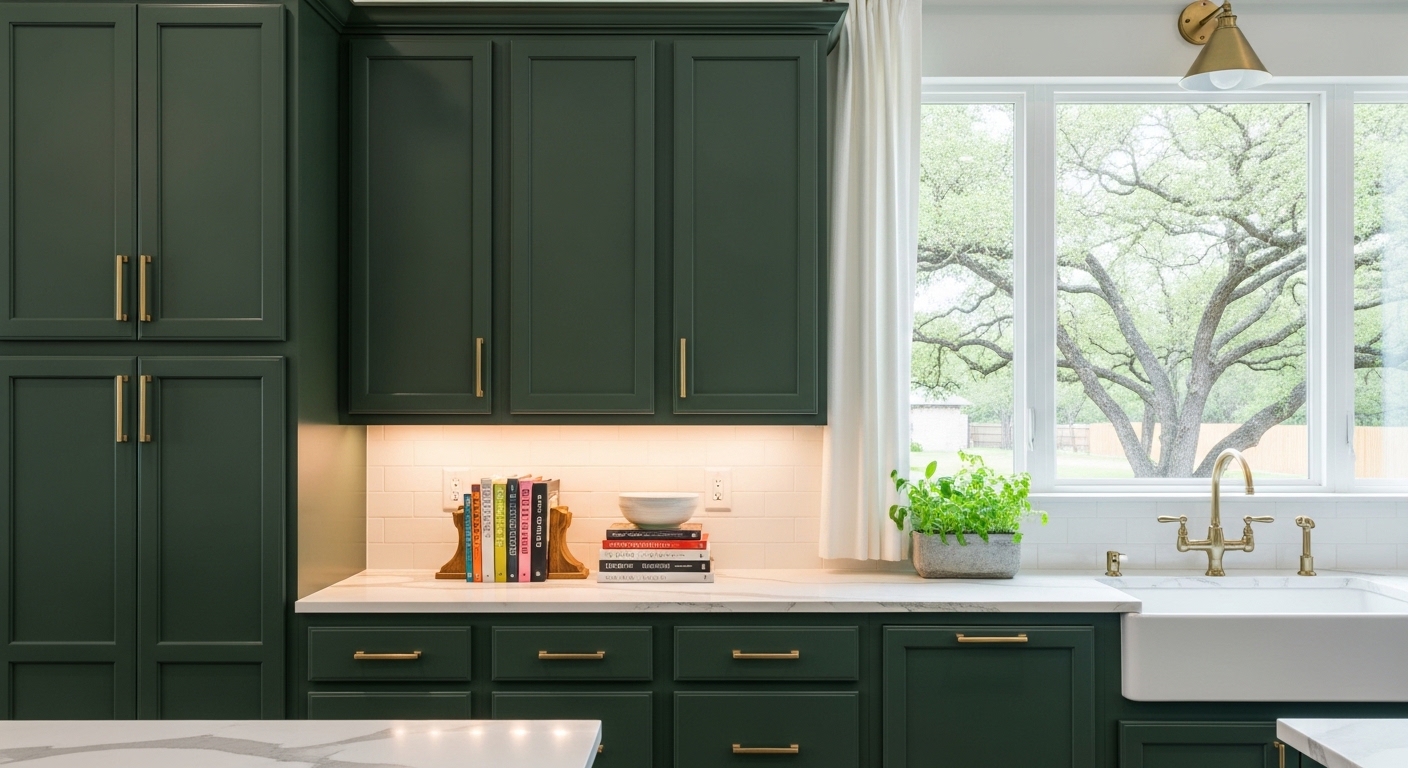
Back to my neighbor. She finally got her cabinets done — full custom, designed for how she actually cooks, finished in a warm sage green that she was nervous about but couldn’t be happier with now. The door that used to drift open every night is a memory.
She told me the thing she wished she’d done differently was started the conversation sooner. “I kept thinking it was going to be this whole ordeal,” she said. “It wasn’t.”
That’s kind of the whole point. Custom cabinetry sounds like a bigger deal than it usually is. You have a conversation, you make some decisions, you work with someone who knows what they’re doing, and then you have a kitchen that fits your life instead of one you’re apologizing for.
If you’re in New Caney, Roman Forest, Splendora, or anywhere nearby, Ace Kustoms does this work right here in East Montgomery County. Reach out, even just to ask questions. The conversation is free, and you’ll leave it knowing a lot more about what’s possible in your space than you do right now.
That feels like a pretty good place to start.
Word count: ~2,150 words

Comments are closed