
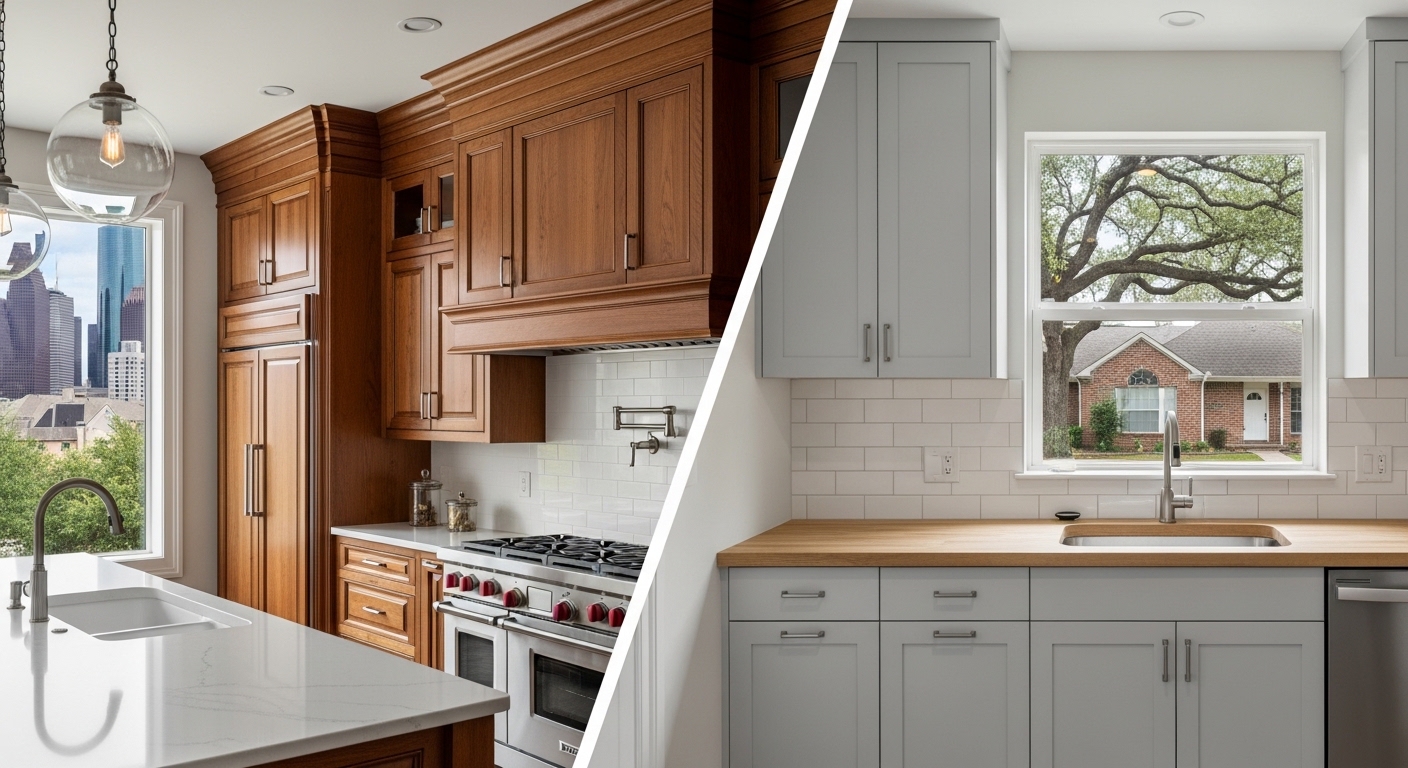
If you’ve started pricing out a kitchen renovation in Houston, you’ve probably landed on the same fork in the road every homeowner hits: do you save money upfront with IKEA cabinets, or do you spend more now on custom cabinetry and avoid headaches later? The marketing on both sides makes confident promises, but very few people actually walk through the real numbers — installation, materials, climate, longevity, and resale value — before they sign a contract or load up a flat-pack cart.
This guide breaks down what custom cabinets and IKEA cabinets actually cost in Houston once every line item is on the table, not just the sticker price.
The Sticker Price Illusion
IKEA’s SEKTION line looks like a steal at first glance. A modest kitchen might price out at $4,000–$7,000 in cabinet boxes and fronts alone, and that number is what gets repeated in every “IKEA vs custom” comparison online. But that figure only covers the cabinets themselves — not the parts that turn a pile of flat-pack boxes into a working kitchen.
Once you add delivery, professional assembly (most homeowners don’t have the weekend or the patience to assemble 20+ cabinet boxes), installation labor, and the inevitable filler panels and trim needed to make IKEA’s standard sizing fit a non-standard Houston floor plan, that “budget” kitchen routinely climbs by another $3,000–$6,000. Suddenly the gap between IKEA and entry-level custom kitchen cabinets isn’t nearly as wide as the in-store price tag suggested.
Custom cabinetry, by contrast, is quoted as one number that already includes design, material, fabrication, and installation. It’s a bigger number on day one — but it’s also the complete number, which matters when you’re budgeting a renovation in a market where contractor availability and material costs in the Houston area shift from month to month.
What You’re Actually Paying For
The price difference between IKEA and custom cabinets isn’t just markup — it reflects two genuinely different products.
Materials. IKEA cabinet boxes are made primarily from particleboard with a melamine foil wrap. It’s a perfectly functional material for a rental property or a starter home, but it’s also more vulnerable to swelling, chipping at edges, and water damage than solid plywood construction. Custom shops typically build boxes from cabinet-grade plywood with hardwood face frames, which holds up significantly better over a 15–20 year lifespan.
Hardware. Soft-close hinges and full-extension drawer slides are upgrades on IKEA cabinets; on most custom builds, they’re the baseline. Over years of daily use, hardware quality is the difference between drawers that still glide smoothly in year eight and drawers that have already been repaired twice.
Fit. This is the one people underestimate most. IKEA cabinets come in fixed width increments (15″, 18″, 24″, 30″, 36″). Houston homes — especially the older housing stock in neighborhoods inside Harris County and the ranch-style homes scattered across Galveston and Brazoria counties — rarely have kitchens built to those exact dimensions. The result is filler strips, awkward gaps, and corners that don’t get fully utilized. Custom cabinetry is built to your actual wall measurements, down to the quarter-inch, which means every inch of your kitchen is functional storage instead of wasted space.
Finishes and longevity of appearance. IKEA’s foil-wrapped fronts look clean on day one, but the foil is a thin laminate bonded to particleboard, and edges are where it tends to fail first — chipping, peeling, or bubbling around sinks, stovetops, and high-traffic handle areas. Custom cabinetry typically uses painted or stained hardwood, MDF panels with a catalyzed finish, or veneer over plywood, all of which age more gracefully and can usually be touched up or refinished rather than replaced outright when wear shows up.
Design flexibility. IKEA’s catalog is built around a finite set of door styles, finishes, and box configurations that have to work for millions of kitchens worldwide. Custom shops design around your kitchen specifically — appliance garages sized to your actual mixer, a spice pull-out that fits the exact gap next to your range, or upper cabinets that go all the way to a 9-foot ceiling instead of stopping short and leaving a dust-collecting gap on top. None of that is available off an IKEA showroom floor.
The Houston Climate Factor Nobody Mentions
This is the variable that almost never shows up in generic “custom vs IKEA” articles written for a national audience, but it matters enormously here. Houston’s humidity is some of the highest in the country for a major U.S. metro, and that moisture doesn’t stay outside — it works its way into kitchens and bathrooms year-round, especially in homes without consistently run dehumidification.
Particleboard is far more reactive to humidity swings than solid plywood. Over time, that can mean swollen panels, peeling laminate at seams, and warped doors — issues that show up faster in a Gulf Coast climate than they would in a drier region. Custom cabinet builders working in this market already account for that, selecting materials, sealants, and construction methods suited to Houston’s climate rather than a one-size-fits-all national spec. If you’ve ever wondered why some cabinets in coastal Texas homes hold up for decades while others start failing within a few years, material choice — not just brand — is usually the answer.
Total Cost of Ownership: The Numbers People Skip
Here’s a simplified side-by-side for an average Houston-area kitchen (10–12 linear feet of cabinetry):
| Factor | IKEA | Custom |
|---|---|---|
| Upfront cabinet cost | $4,000–$7,000 | $12,000–$25,000+ |
| Assembly + installation | $2,500–$5,000 | Included in quote |
| Modifications/fillers for fit | $500–$1,500 | Not needed (built to spec) |
| Expected lifespan | 8–12 years | 20+ years |
| Mid-life repairs (hinges, swelling, delamination) | Common after year 5–7 | Rare |
| Resale impact | Neutral to slightly negative | Often a selling point |
Run the math over a 20-year horizon and the picture changes. A homeowner who installs IKEA cabinets today may be replacing or heavily repairing them once, possibly twice, before a custom installation would need its first major service call. That replacement cycle — labor, disposal, new materials — often erases the upfront savings entirely.
Resale Value: The Part Realtors Actually Talk About
Houston’s resale market has gotten more competitive, and kitchens are consistently one of the top three rooms buyers scrutinize during a walkthrough. Builder-grade or visibly flat-pack cabinetry tends to read as a “needs updating” signal to buyers, even if the rest of the kitchen is in good shape. Custom cabinetry, on the other hand, photographs better, shows better in person, and is frequently called out specifically in listing descriptions.
This is one of the clearest financial arguments for spending more upfront: kitchens with quality, well-fitted cabinetry recoup a meaningfully higher share of their renovation cost at resale than kitchens furnished with budget flat-pack units. If you’re weighing this decision with an eventual sale in mind — even five or ten years out — it’s worth reading through how semi-custom and fully custom cabinets compare on long-term value before locking in a budget-only decision.
When IKEA Actually Makes Sense
To be fair, IKEA isn’t a bad choice in every situation. It tends to make sense when:
- You’re renovating a rental property and don’t need a 20-year lifespan
- You’re working with a hard, fixed budget under roughly $8,000 total
- Your kitchen footprint happens to align closely with IKEA’s standard module sizes
- You’re comfortable handling (or hiring out) assembly and installation separately
- This is a short-term home you plan to sell within a few years and aren’t prioritizing kitchen ROI
If none of those apply — particularly if you’re in a forever home, an older property with non-standard dimensions, or a house you intend to sell with the kitchen as a selling point — custom starts to look like the financially smarter call, not just the nicer-looking one.
When Custom Is the Better Investment
Custom cabinetry tends to win out when:
- Your kitchen has an unusual layout, angled walls, or non-standard ceiling heights (common in older Houston-area homes)
- You want soft-close hardware, full-extension drawers, and plywood construction as the standard, not an upsell
- You’re planning to stay in the home long-term and want to avoid a second renovation cycle
- You’re factoring resale value into the decision
- You want built-in features — pull-out trash bins, deep drawer organization, integrated lighting — designed around how you actually use the space, rather than retrofitted after the fact
If you’re already leaning custom but unsure whether to go full custom or a hybrid approach, it’s worth comparing the cost differences between cabinet refacing and full replacement — sometimes the existing cabinet boxes are still structurally sound, and only the doors, hardware, and finishes need to change. That can land you somewhere between IKEA pricing and a full custom rebuild.
A Local Perspective Matters More Than the Brand Name
One thing that gets lost in national cost-comparison articles is that “custom cabinets” isn’t a single product with a single price — it varies enormously based on who’s building them and how familiar they are with local conditions. A shop with deep experience across Harris, Fort Bend, Montgomery, and Galveston counties has already solved the humidity, foundation-shift, and non-standard-layout problems that are specific to this region. That experience shows up in the final product: doors that still close flush five years later, finishes that don’t peel in a humid summer, and cabinetry that was measured for your actual kitchen rather than assembled from a catalog of fixed sizes.
For homeowners who’ve gone through a full custom kitchen build, the long-term resale value research on custom cabinetry in Houston is worth a read — it lays out, with real comparisons, why the upfront premium tends to pay for itself well before the 20-year mark.
Frequently Asked Questions
Is it cheaper to install IKEA cabinets myself? DIY assembly removes the labor line item, but most homeowners still hire someone for final installation, leveling, and connecting plumbing or electrical around the cabinets. Even with DIY assembly, expect to spend on tools, hardware fixes when boxes don’t sit perfectly square, and the time investment of a multi-day project.
Do custom cabinets always cost more than IKEA? Almost always at the point of purchase, yes. But “cost” and “cost over time” are different questions. Once repairs, replacements, and resale value are factored in across a 15–20 year period, the gap narrows substantially and in many cases reverses.
Can I mix IKEA boxes with custom doors and trim to save money? This is a real hybrid option some homeowners pursue, and it can work for a tight budget. The trade-off is that you’re still building on particleboard boxes, so the structural lifespan and humidity resistance issues remain even if the surface looks more custom.
How long do custom cabinets actually last in a Houston climate? With plywood construction and finishes suited to high humidity, well-built custom cabinetry commonly lasts 20-plus years with normal use, compared to an 8–12 year practical lifespan for particleboard cabinetry in the same conditions.
Does cabinet quality really affect home resale price? Yes — kitchens are one of the top rooms buyers and appraisers focus on, and visibly low-cost or worn cabinetry is a common point of negotiation during a sale. Quality cabinetry doesn’t just look better; it tends to support a stronger asking price.
The Bottom Line
IKEA’s sticker price wins the first conversation. Custom cabinetry tends to win every conversation that comes after it — the assembly invoice, the installation labor, the five-year repair call, the humidity-related swelling, and the resale appraisal. The “real” cost of cabinetry in Houston isn’t what’s printed on the box; it’s the sum of everything that happens after the box gets opened.
If you’re trying to figure out which path makes sense for your specific kitchen, layout, and timeline, the most useful next step is usually a real walkthrough and quote rather than another spreadsheet comparison. A local team that’s measured hundreds of Houston-area kitchens can tell you within minutes whether your space is a good candidate for budget flat-pack units or whether the non-standard dimensions and humidity exposure in your home make custom the financially smarter call — not just the nicer one.


Comments are closed