
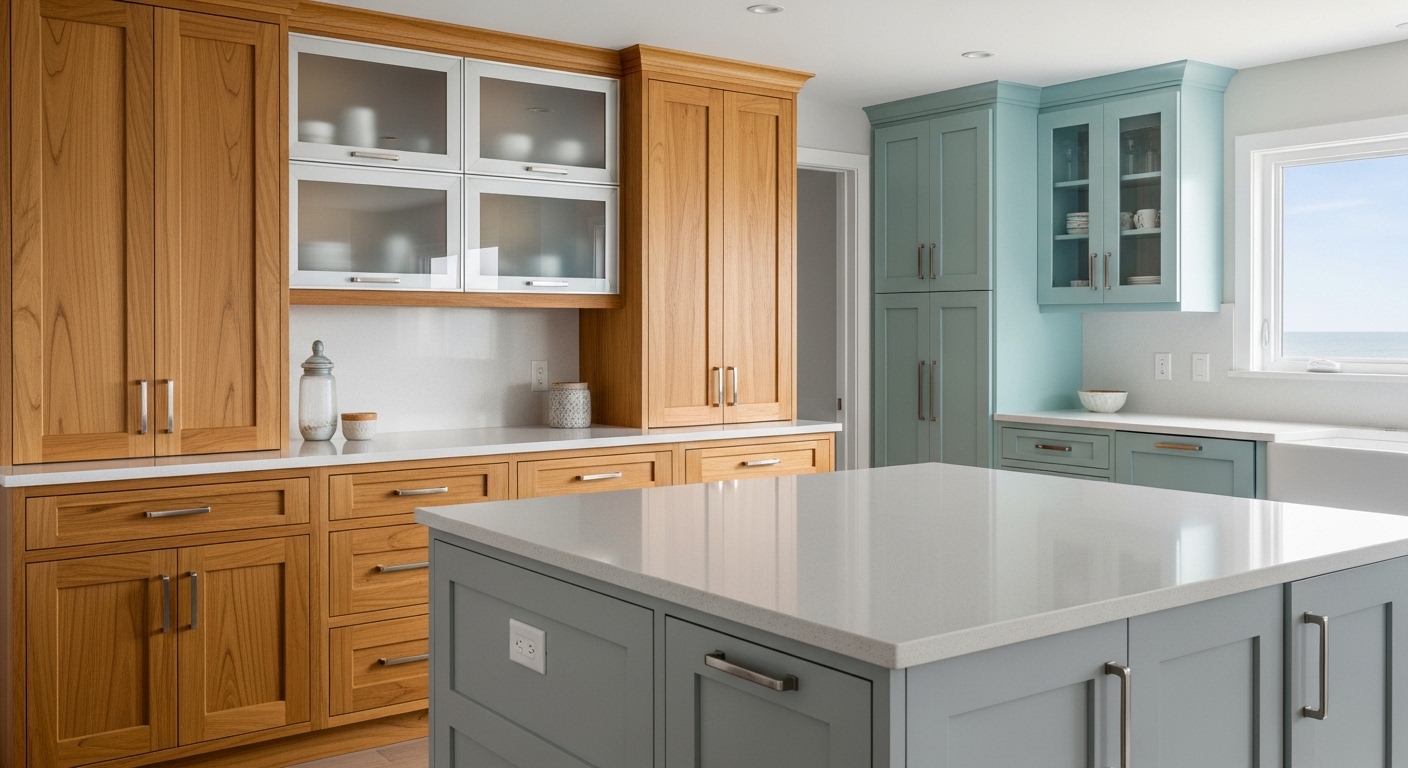
Living along the Gulf Coast is one of life’s great pleasures — the salt breeze, the open water, the laid-back pace that only a barrier island can offer. But ask any Galveston homeowner what their biggest home maintenance headache is, and you’ll get the same answer every time: moisture. Whether you live right on the seawall or a few miles inland in League City or Dickinson, the relentless combination of heat, salt air, and humidity creates an environment that’s genuinely punishing for interior finishes — especially cabinetry.
This isn’t a minor nuisance. Humidity that fluctuates between 70% and 90% on a regular basis causes wood to expand and contract in ways that can warp doors, buckle drawer fronts, swell frames, and destroy paint finishes over the course of just a few seasons. Cabinets that look flawless in a showroom in Dallas or Houston can begin to fail within a year or two once they’re installed in a Galveston kitchen. That’s why choosing the right materials from the very beginning isn’t just a preference — it’s a necessity.
At Ace Kustoms Cabinets & Trim, we work with Galveston County homeowners every day who’ve made the mistake of prioritizing aesthetics alone, only to find themselves dealing with delaminating cabinet doors, swollen frames, or rusting hardware a couple of years into ownership. This guide is designed to help you avoid those mistakes by understanding exactly which materials perform in coastal conditions — and which ones don’t.
Why Galveston’s Climate Is So Hard on Cabinets
Before we get into material recommendations, it helps to understand what you’re actually fighting. Galveston sits on a barrier island in the Gulf of Mexico, giving it one of the highest average relative humidity levels in Texas. Summer humidity routinely exceeds 85%, and even in the cooler months, moisture levels rarely drop to the dry ranges you’d find in Central or West Texas.
Salt air compounds the problem significantly. Unlike regular humidity, salt-laden coastal air accelerates the corrosion of metal hardware, eats away at certain finishes, and promotes a specific kind of moisture absorption in wood fibers that causes more aggressive swelling than freshwater humidity alone. Add in the temperature swings between air-conditioned interiors and the outdoor heat, and you have a cycle of expansion and contraction that tests the integrity of every joint, hinge, and glue line in your cabinetry.
The result? Standard builder-grade cabinets made with MDF (medium-density fiberboard) and paper-wrapped doors — the most common type you’ll find in new construction across Houston’s suburbs — tend to fail noticeably faster in coastal environments. They’re designed for temperate, climate-controlled conditions. Galveston demands more.
The Best Cabinet Materials for Coastal Homes
1. Solid Wood — Choose Species Carefully
Solid wood remains one of the most desirable cabinet materials for its beauty, workability, and longevity, but not all wood species are created equal in humid environments. In coastal climates, species stability matters more than almost anything else.
Teak is the gold standard for moisture resistance. It contains natural oils that repel water and resist swelling, which is precisely why it’s been the wood of choice for boat building for centuries. In a Galveston kitchen or bath, teak cabinetry will outlast virtually any other solid wood option with minimal maintenance. The trade-off is its premium availability and distinctive look, which doesn’t suit every design aesthetic.
White oak is a more versatile and widely available option that performs exceptionally well in humid climates. Unlike red oak — which has an open grain structure that readily absorbs moisture — white oak has tyloses, a biological feature that naturally seals its pores and makes it significantly more moisture-resistant. It’s also one of the most beautiful cabinet woods available, with a tight, attractive grain that takes stain and paint beautifully.
Maple is another strong performer. It’s dense, tight-grained, and less prone to seasonal movement than softer or more open-grained species. It’s a popular choice for our custom kitchen cabinets in coastal areas precisely because it holds finishes well and doesn’t telegraph humidity-related movement through cracked paint or opening joints.
Woods to approach cautiously in Galveston include cherry (beautiful but prone to movement), pine (soft and absorbent), and raw MDF-core construction of any kind. The key to success with solid wood in a coastal environment is pairing the right species with a proper sealing and finishing process — all six sides of every panel, including the back.
2. Marine-Grade Plywood
If solid wood is the traditional choice, marine-grade plywood is the pragmatic coastal choice — and arguably the smartest structural decision you can make for Galveston cabinetry.
Standard furniture-grade plywood uses interior-grade glue between its laminations, which is perfectly adequate in dry or climate-controlled settings. Marine-grade plywood, by contrast, uses waterproof phenol-formaldehyde adhesive throughout, has no voids in its core layers, and is engineered to maintain structural integrity even with prolonged moisture exposure.
For cabinet boxes — the carcass structure that forms the bones of your cabinetry — marine-grade plywood provides a dramatically more stable foundation than particleboard, MDF, or standard interior plywood. It won’t swell, won’t delaminate, and won’t lose its structural integrity in the event of a leak, a flood, or simply years of ambient coastal humidity.
When Ace Kustoms builds cabinets for coastal clients, the conversation about box construction almost always comes back to this point. The doors and drawer fronts get most of the visual attention, but it’s the box that determines how long your investment holds up. Marine-grade plywood in the cabinet carcass, paired with moisture-resistant solid wood doors and face frames, creates a system designed for the realities of Gulf Coast living.
3. High-Quality Thermofoil and Rigid Thermofoil (RTF)
For homeowners who want a sleek, contemporary look with low maintenance requirements, high-quality thermofoil — particularly rigid thermofoil (RTF) — can be an excellent option in coastal environments when properly specified.
Standard thermofoil wraps a thin vinyl film over an MDF core, which creates the vulnerability: if the MDF core gets wet, it swells and the film separates. However, RTF applied over a moisture-resistant or solid wood substrate rather than standard MDF performs significantly better. The thermofoil surface itself is completely impervious to moisture, doesn’t require painting, and won’t show the cracking or peeling that plagues painted finishes in high-humidity rooms.
This makes RTF cabinets a practical consideration for bathrooms and laundry rooms in coastal homes, where humidity spikes are most severe. For our custom bathroom vanities in the Galveston area, moisture-resistant substrates with quality thermofoil or painted solid wood faces are among the most common solutions we recommend for long-term performance.
The caveat: quality matters enormously here. Inexpensive thermofoil on MDF will fail in a coastal bathroom. High-quality RTF on a moisture-resistant core, with proper edge sealing, will hold up very well. The difference is in the details of construction and material specification.
4. Stainless Steel and Aluminum Accents
While not a primary cabinet material in residential settings, incorporating stainless steel or aluminum components into your cabinetry design can significantly extend the life of the overall installation in a coastal environment. This is especially true for hardware, hinges, drawer slides, and decorative elements.
Standard steel hardware will rust in Galveston. Even hardware labeled “rust-resistant” often carries that claim based on testing in standard humidity conditions — not the sustained salt-air exposure of a Gulf Coast home. Stainless steel (304 grade or higher), solid brass, or powder-coated aluminum hardware are the appropriate choices for coastal installations.
Some homeowners, particularly those with a more industrial or nautical design aesthetic, opt for stainless steel cabinet fronts or aluminum-framed glass doors in kitchen or bar areas. These materials are naturally impervious to humidity and salt air, and they carry a practical durability advantage that pairs well with the environmental demands of coastal living.
Finishing and Sealing: The Critical Final Step
Even the best material selection will underperform if the finishing process isn’t done correctly. In Galveston’s climate, two finishing principles stand above all others.
Seal all six sides. Moisture enters wood through its end grain and unfinished back faces far more aggressively than through finished front surfaces. Every panel, every door, every drawer front should be fully sealed on all sides — including the back. This single step prevents the differential moisture absorption that causes warping, and it’s one of the most commonly skipped steps in production cabinetry.
Use catalyzed or conversion varnish topcoats. Standard paint and lacquer finishes, while fine for interior applications in dry climates, often fail faster in coastal conditions. Catalyzed conversion varnishes and two-part polyurethane topcoats create a significantly harder, more moisture-resistant film that holds up to the humidity cycles of Gulf Coast living without cracking, peeling, or yellowing as quickly.
These finishing considerations apply equally whether you’re installing new cabinets or refreshing existing ones. They also matter greatly when considering solid surface countertops alongside your cabinetry — a cohesive installation with compatible materials and finishes is far more durable than mixing products from different quality tiers.
What to Avoid in Coastal Cabinet Construction
Understanding what not to use is just as valuable as knowing the right materials. For Galveston and surrounding coastal areas, here are the materials and construction methods that consistently underperform.
Standard MDF as a primary structural material — MDF absorbs moisture readily, swells irreversibly, and loses structural integrity when wet. It has legitimate uses in cabinetry (some trim applications, specific door construction methods), but as a primary box or door substrate in a coastal environment, it’s a liability.
Particleboard carcasses — Similar to MDF but even more susceptible to moisture damage. Particleboard is common in imported and big-box store cabinetry precisely because it’s inexpensive, but it has no place in a coastal home that experiences real humidity.
Paper-wrapped door profiles — The paper-over-MDF construction used in many builder-grade cabinet doors fails rapidly in humid conditions. The paper lifts, bubbles, and separates, and there’s no practical repair — the doors need to be replaced entirely.
Cheap hardware with rust-prone finishes — As noted above, plated hardware fails in salt air. This isn’t a matter of if, but when.
Making the Right Investment for Your Galveston Home
Coastal living demands coastal-grade construction, and that principle applies just as clearly to your cabinetry as it does to your roofing, your windows, or your exterior paint. The materials that work perfectly well in a climate-controlled suburban Dallas kitchen are simply not engineered for what Galveston throws at them.
The good news is that the right materials — white oak, teak, maple, marine-grade plywood substrates, quality hardware, and proper multi-coat finishing — are readily available and produce cabinets that are both beautiful and genuinely durable. The difference between cabinets that look tired and damaged after five years and cabinets that look as good in fifteen years as they did on installation day comes down almost entirely to material selection and construction quality.
At Ace Kustoms Cabinets & Trim, every coastal installation we approach starts with a conversation about your environment, your usage, and your long-term expectations. We’re not in the business of selling you something that needs to be replaced in a few years. We build to the demands of the Gulf Coast because we live and work here, and we understand what your home faces every single day.
If you’re ready to invest in cabinetry that’s genuinely built for Galveston’s coastal climate, we’d love to talk through your project with you.


Comments are closed