
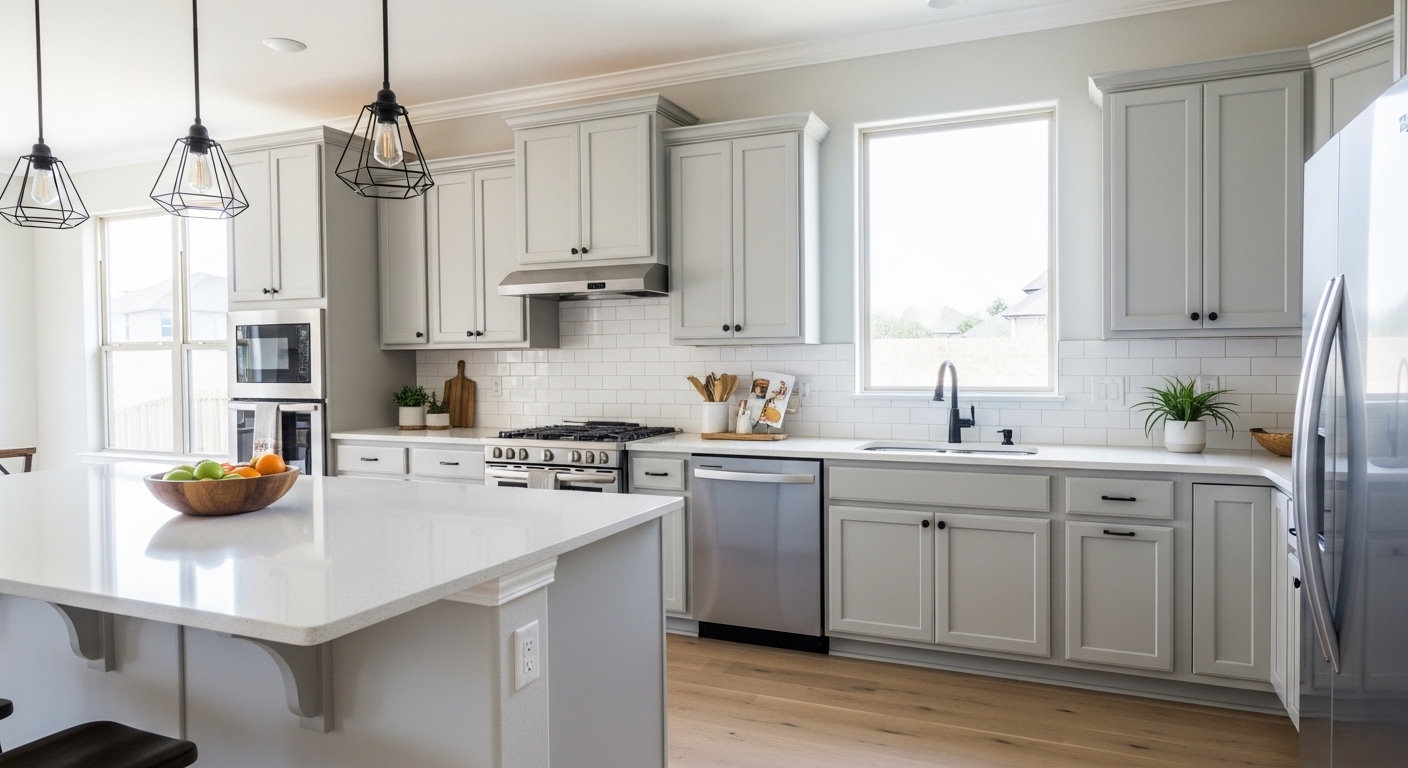
A friend of mine renovated her kitchen about four years ago. Beautiful cabinets — she went with a warm white painted finish, soft-close everything, the whole deal. She spent real money on it and was genuinely proud of how it turned out.
By year two, the finish near her sink was starting to yellow. By year three, one of the cabinet doors near the dishwasher had a soft spot at the bottom corner where the paint was lifting. She called the company she’d used. They told her it was “normal wear.”
It wasn’t normal. It was a finish that wasn’t built for Southeast Texas, applied without the right prep, on a door style that trapped moisture at its edges. Every single part of that equation was wrong for where she lives.
And here’s what gets me — nobody told her. Nobody said “hey, you’re in Pasadena, the humidity here is relentless, so here’s what that means for your finish choice.” She just picked what looked pretty in photos, and the environment did the rest.
That’s the gap this guide is meant to close. If you’re renovating a kitchen or bathroom in Pasadena or anywhere in Harris County, the finish you choose matters differently here than it would in Denver or Phoenix. Humidity isn’t just a weather inconvenience — it’s an active force working on your cabinets every single day. Let’s talk about how to choose a finish that works with that reality instead of against it.
And if you’re already at the point of looking for a local expert, the cabinet and trim team at Ace Kustoms in Harris County works specifically with homeowners in this climate — worth a call before you commit to anything.
Why Pasadena’s Climate Is Harder on Finishes Than Most Places
Let’s get specific about what you’re dealing with.
Pasadena sits in the greater Houston metro, which consistently ranks among the most humid cities in the country. Summer relative humidity regularly sits between 70–90%. The temperature swings — hot days, cooler nights, the dramatic drops when cold fronts push through — cause materials to expand and contract more than people realize. And if you’re near the Ship Channel or any of the industrial areas, you’ve also got airborne particulates that can affect surfaces over time.
What does that actually do to a cabinet finish?
Moisture works its way into any weakness in the finish — a tiny chip at a door edge, a gap where the paint didn’t fully seal the wood, a hairline crack near a hinge. Once it’s in, it gets under the finish and starts lifting it from below. That’s the peeling and bubbling you see near sinks and dishwashers. It’s not random — it’s physics.
Temperature cycling causes the wood underneath to move, and when the finish isn’t flexible enough to move with it, it cracks. This shows up most at corners and seams.
And constant humidity, even without any dramatic moisture event, slowly degrades finishes that weren’t formulated to handle it. They dull, they yellow, they lose their ability to repel water over time.
The good news: there are finishes that are specifically designed to handle this. The bad news: not every cabinet company defaults to using them.
The Main Finish Options — And How They Actually Hold Up
Catalyzed (Conversion Varnish) Finish
This is the gold standard for humid climates, and honestly, it’s what most homeowners have never heard of but should be asking about by name.
Catalyzed finishes — sometimes called conversion varnish or post-catalyzed lacquer — are two-component systems that chemically cure rather than just drying. The result is a finish that’s dramatically harder, more moisture-resistant, and more durable than standard paints or lacquers. Think of it like the difference between a regular epoxy and a two-part epoxy — the chemistry is actually different, not just stronger.
In Southeast Texas humidity, catalyzed finishes perform like nothing else. They’re resistant to yellowing, they don’t absorb moisture the way standard latex does, and they hold up around water sources without peeling. If you’re getting painted cabinets in Pasadena, this is the finish conversation you need to have with your cabinet maker.
The catch: it requires professional spray application in a controlled environment. You can’t brush this on. It also needs proper ventilation and curing time. But a cabinet maker who’s set up to do this right will have a spray booth and know the process cold.
Ask your cabinet maker: “What’s your finish system?” If the answer is “Benjamin Moore Advance” or “Sherwin-Williams Emerald” — those are good paints, but they’re consumer-grade water-based products, not a professional catalyzed finish. There’s a real difference in performance.
Water-Based Acrylic Finish
This is the most common finish you’ll encounter because it’s what most consumer-grade cabinet lines and smaller shops use. It’s not bad — it’s just not ideal for high-humidity environments without some important qualifications.
Modern water-based acrylics have gotten significantly better over the last decade. A high-quality water-based finish from a professional cabinet line, applied correctly with proper coats and edge sealing, can perform reasonably well in humid climates. The key words are “high-quality” and “applied correctly.”
Where water-based acrylics tend to fail in Pasadena’s climate:
- Single-coat or minimal-coat applications that don’t fully seal the substrate
- Unsealed edges on MDF doors (the exposed edge grain on MDF is like a straw for moisture)
- Application in conditions that are too humid for proper curing
- Lower-quality products that sacrifice durability for easier application
If your cabinet maker is using a water-based finish, ask specifically about the number of coats, whether edges are sealed separately, and what the cure time is before the cabinets ship. Those answers will tell you whether you’re getting a quality application or a quick one.
Oil-Based Alkyd Finish
Oil-based finishes were the standard before water-based products took over, and they genuinely are more durable in a lot of ways. They cure harder, they’re more moisture-resistant, and they have a natural leveling quality that water-based products have to work hard to match.
The downsides in a modern context: oil-based finishes yellow over time, which is a problem if you’re going with white or light-colored cabinets. They also have longer dry times, strong fumes that require serious ventilation, and increasingly strict VOC regulations in some areas make them harder to use.
For stained cabinets — where yellowing isn’t a concern and you’re actually okay with the finish deepening slightly over time — oil-based or oil-modified alkyd finishes are a legitimate option. For painted white or gray cabinets in Pasadena, the yellowing issue is a dealbreaker.
Stain Plus Topcoat (for Wood Cabinets)
If you’re going with stained wood rather than painted, the conversation shifts. You’re still thinking about topcoat durability, but the stain itself isn’t where the moisture protection comes from — that’s all in the clear topcoat applied over it.
For stained cabinets in a humid climate, the topcoat choices are essentially: catalyzed varnish (excellent), oil-based polyurethane (good, but yellows somewhat), or water-based polyurethane (decent if applied in enough coats, but the least durable of the three).
One thing that often gets overlooked with stained cabinets: the sheen level matters for durability. Higher gloss finishes are actually more moisture-resistant than matte or satin finishes because they have more resin in the formula. A lot of people choose matte or satin for aesthetics, which is completely valid — just know you’re accepting slightly less durability as a trade-off. A good catalyzed satin finish closes that gap considerably.
Thermofoil and Laminate Surfaces
These aren’t traditional “finishes” in the paint sense, but they’re worth including because they come up frequently.
Thermofoil is a vinyl film heat-pressed onto a substrate. The surface is moisture-resistant, which sounds great for humid climates. And on the surface, it is. The problem is what happens at seams, edges, and over time as the adhesive ages in heat. Galveston we talked about in another piece, but Pasadena summers are brutal too — sustained heat accelerates thermofoil delamination. Near dishwashers and ovens especially, this is a real issue.
Laminate (like a quality EGGER or Wilsonart product) is actually more durable than thermofoil and handles heat and humidity better. It’s worth considering, particularly for a modern aesthetic. But it’s also harder to repair if it does get damaged.
Expert Insights: What the Professionals Actually Specify
When a professional cabinet maker who knows Southeast Texas is specifying a painted kitchen in this climate, here’s what that spec typically looks like:
Plywood box construction (not MDF or particleboard — plywood moves less and doesn’t swell)
MR (moisture-resistant) MDF door fronts, or solid wood doors if going with stain
Catalyzed conversion varnish finish, sprayed in a controlled booth environment
Full edge sealing on all MDF components — the edges sealed separately before the face coats go on
Soft-close hardware in stainless or solid brass — hardware that can handle the humidity without corroding
4+ finish coats with sanding between coats
That’s not an over-engineered spec. That’s just what you need to build a painted cabinet that looks good in ten years in this climate. It’s also why the quote from the shop doing it right is higher than the quote from the shop cutting corners. You’re paying for the difference between a kitchen that holds up and one that’s going to start disappointing you in year two.
The Pasadena and Harris County team at Ace Kustoms builds to this kind of spec because they know what the climate demands. That’s the conversation worth having before you sign anything.
How to Apply This: Questions to Ask Before You Commit
Here’s the practical part. When you’re interviewing cabinet makers, these are the questions that separate the ones who know what they’re doing from the ones who will give you beautiful photos and disappointing results:
“What’s your finish system?” — You want to hear “catalyzed” or “conversion varnish.” Water-based is acceptable if they can describe a proper multi-coat application with edge sealing.
“How do you handle MDF door edges?” — If they look at you blankly, that’s telling. Proper shops seal edges separately before face coating. It’s a process step that takes time and care.
“What’s your humidity protocol for painting?” — Finishes applied on high-humidity days don’t cure properly. A professional shop either has climate-controlled spray conditions or schedules around the weather.
“Can I see examples of your work that are 3–5 years old?” — New work always looks good. Work that’s held up in Southeast Texas for a few years is what tells you what you actually need to know.
“What’s your warranty on the finish?” — A confident cabinet maker stands behind their work. If the answer is vague, take note.
FAQ
Why is my painted cabinet finish turning yellow near the stove?
Two likely culprits: either a water-based finish that’s aging (many water-based whites yellow over time, especially with heat exposure), or an oil-based finish that was always going to yellow. If it’s near the stove specifically, heat is accelerating the process. A catalyzed finish yellows significantly less than either alternative.
Can I repaint my existing cabinets to get a better finish?
Yes, but it requires proper prep — which is most of the work. The existing finish needs to be lightly sanded for adhesion, doors need to be removed for proper coverage, and edges need attention. A DIY paint job with a roller and a can of paint is going to disappoint you in a humid climate. Professional spray application makes a real difference.
Is a higher sheen always better for humidity resistance?
Higher gloss does offer slightly better moisture resistance because of the resin content, but the bigger factor is the finish type and number of coats. A well-applied catalyzed satin will outperform a single-coat gloss water-based in a humid environment. Sheen is a secondary factor.
How long should a quality cabinet finish last in Pasadena’s climate?
A properly applied catalyzed finish on good substrate, in a well-ventilated kitchen, should realistically last 10–15 years before you’d want to consider refinishing. Near water sources (sinks, dishwashers), expect more regular touch-ups regardless of finish quality — those areas just take more abuse.
What’s the most common finish mistake homeowners make?
Choosing a finish based on color samples alone without asking about the finish system. The color is the fun part — but the chemistry is what determines whether it lasts. A lot of beautiful cabinet projects start disappointing their owners because nobody asked the right questions upfront.
The Bottom Line
Pasadena’s humidity isn’t going anywhere. Summer after summer, the Gulf air is going to do its thing, and your cabinets are going to be right there absorbing it. The question isn’t whether the climate is going to affect them — it’s whether you chose a finish that was built to handle it.
The answer isn’t complicated. Get a catalyzed finish if you can. Ask the right questions before you sign. Make sure your edges are sealed and your substrate is quality. And work with someone who actually understands what Southeast Texas weather does to cabinetry over time.
My friend who ended up with peeling cabinets in year three? She’s redoing the kitchen now. Better spec this time. She knows exactly what questions to ask. It’s just frustrating that she had to learn it the hard way.
You don’t have to. You’re already asking the right questions — and that puts you ahead of where most people start.
If you’re ready to talk specifics for your home in Pasadena or anywhere in Harris County, the cabinet and trim specialists at Ace Kustoms know this climate and build for it. Reach out, ask them what finish system they use, and see how they answer. A good answer to that question tells you a lot about who you’re working with.


Comments are closed