
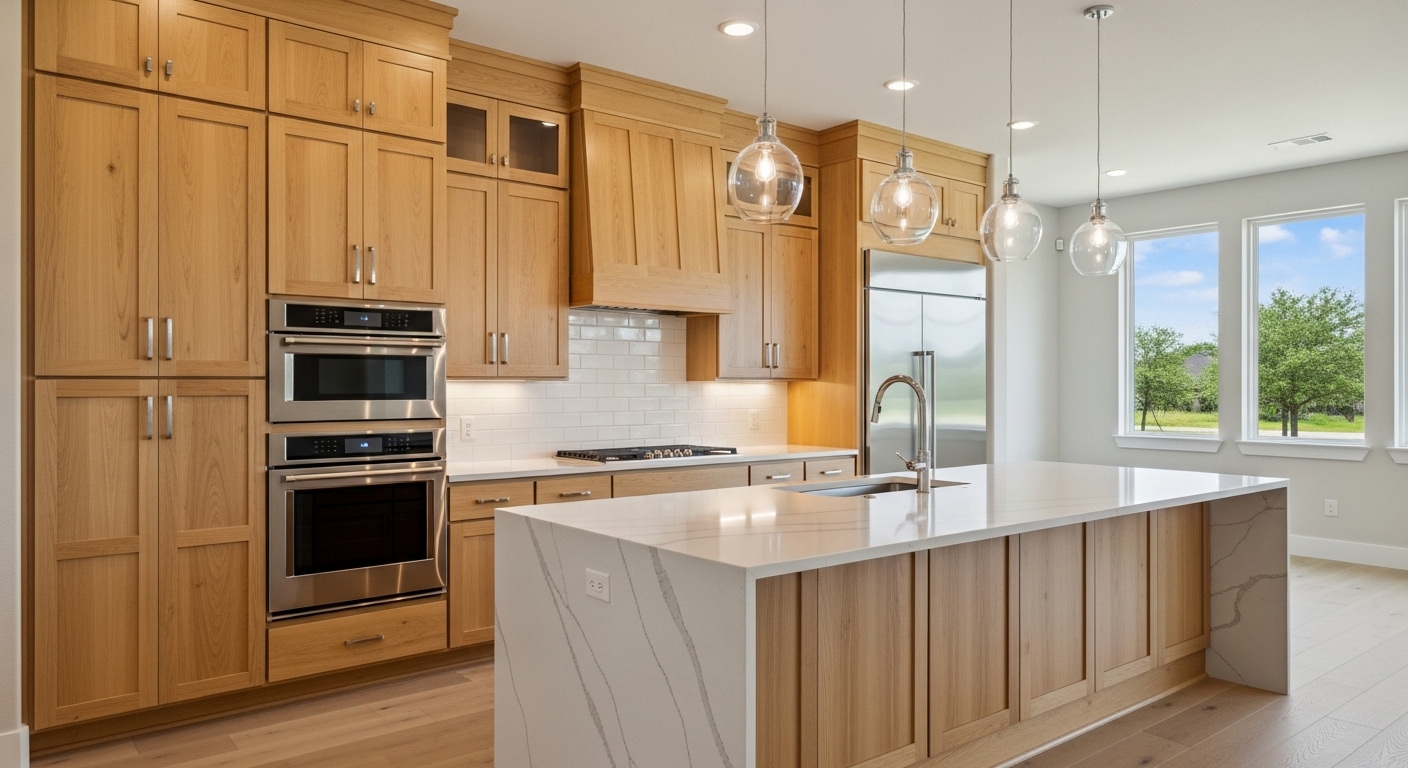
New Construction Cabinet Upgrades in Montgomery County, TX — Is It Worth It?
You’ve just signed on a new build. The floor plan is right, the neighborhood feels good, the location works for your commute. And then you walk through the model home and you see the kitchen — really see it — and something doesn’t quite match the excitement you had five minutes ago.
The cabinets are fine. Technically fine. But they’re also… flat. Stock. Identical to every other new construction home on the street. And you start wondering: is this really what we’re living with for the next decade?
That moment — that quiet little pang — is why we’re writing this.
If you’re building in Montgomery County, whether that’s Roman Forest, Conroe, The Woodlands area, or somewhere further out, you’re going to face this decision: stick with the builder-grade cabinets, or upgrade now while the walls are still open?
Honestly, it’s one of the smartest questions you can ask before closing. And we want to give you a real answer, not a sales pitch.
If you want to talk specifics before you finish reading — we do custom cabinet and trim work right here in Montgomery County and are happy to walk through what an upgrade would actually look like for your build.
First, Let’s Talk About What “Builder-Grade” Actually Means
Builder-grade cabinets aren’t bad. They’re… adequate. That’s the honest assessment.
They’re built to a price point — usually the lowest price that still looks acceptable in a model home. The boxes are typically particleboard or thin MDF. The doors are often thermofoil or basic paint-grade wood with simple flat profiles. The hardware is functional but forgettable. And the finish? It photographs fine, but up close it doesn’t have the depth or texture of quality painted or stained wood.
In Montgomery County’s new construction market — which has been booming — builders are squeezing margins and managing supply chains. That often means the cabinet line that looked decent in the design center showroom arrives at your home slightly… different. Finishes don’t always match exactly. Cabinet boxes vary. Quality control on the installation can be inconsistent.
None of this is catastrophic. But when you’re spending $350,000–$600,000 on a home, “adequate” starts to sting a little.
Before You Decide Anything: What You Actually Need to Know
Here’s what to figure out before you make any decision about upgrading:
What’s included in your builder’s cabinet package? Get specific. Ask about box material (solid wood vs. particleboard), door construction (solid vs. hollow), hinge quality, drawer slide type (undermount soft-close vs. side-mount), and finish process. Some builders in this market use surprisingly decent semi-custom lines. Others use the cheapest option they can source.
What’s the upgrade cost through your builder? Most production builders have upgrade tiers. The jump from standard to semi-custom through the builder might be $4,000–$12,000 depending on kitchen size. That sounds like a lot — but compare it to retrofitting after close, which is almost always more expensive because demolition and reinstallation get added to the bill.
What does your timeline look like? Upgrading during construction is dramatically easier than retrofitting. If you’re pre-drywall or even pre-cabinet installation, you have real options. If you’re three months post-close… it’s still doable, but plan for a full kitchen disruption.
Step-by-Step: How to Think Through (and Execute) a Cabinet Upgrade
Step 1: Audit What You’re Actually Getting
Before anything else, go back to your builder’s design center and ask to see the actual cabinet line they’re installing — not just the model home version.
Look at the insides of the cabinets, not just the fronts. Open every drawer and look at the glides. Pull on the door and see how the hinges feel. Ask specifically whether the boxes are plywood or particleboard. Plywood is meaningfully better — it holds screws, resists moisture, and lasts decades. Particleboard does… none of those things as well.
If your builder is using a solid plywood box with soft-close undermount drawer slides, their standard package might actually be worth keeping. If it’s particleboard boxes with side-mount drawer slides? That’s where an upgrade conversation starts to make real financial sense long-term.
What to look for: Soft-close hinges and drawer slides, plywood box construction, full-overlay doors (these look cleaner and higher-end), and dovetail drawer boxes. Those four things separate a decent cabinet from a frustrating one.
[IMAGE: Side-by-side comparison of particleboard vs. plywood cabinet box construction, with drawer slide types labeled]
Step 2: Decide Which Rooms to Prioritize
Not every cabinet in your home deserves the same upgrade budget. Here’s how we think about it:
Kitchen first, always. You’re in that room multiple times a day. You’re putting weight on those shelves, slamming those drawers when your hands are full, and that cabinetry is the backdrop for every dinner party, every morning coffee, every school lunch rush. The kitchen is where cabinet quality is most felt — and most visible to guests and future buyers.
Primary bathroom second. The primary bath is used daily by the people who care most about quality in your home. It’s also where moisture is a factor — and better cabinet construction handles humidity significantly better.
Secondary baths and laundry — keep it sensible. You can often keep builder-grade in these spaces, especially if they’re smaller, and invest the savings into the kitchen and primary bath.
Honest take: We’ve talked to a lot of homeowners in Montgomery County who wish they’d upgraded the kitchen and primary bath during construction and saved their money everywhere else. The people who tried to upgrade everything on a limited budget often ended up with quality that felt inconsistent throughout the house.
Step 3: Figure Out the “During Construction” vs. “Post-Close” Decision
This is the one most people don’t think about clearly enough.
If you’re still pre-close: The best window for a cabinet upgrade is before drywall is finished and before your builder’s cabinet crew is scheduled. At this point, you can often negotiate directly with your builder to skip their standard cabinet package (or a portion of it) and have a custom shop handle it instead. Some builders allow this. Some don’t. It’s worth asking — the worst they say is no.
If you’re post-close but within the first year: Retrofitting is totally doable. You’ll need to plan for 1–3 weeks without a functional kitchen (depending on scope), and you’ll want someone who knows what they’re doing on the installation side. The cost is higher because of demolition, disposal, and reinstallation — but the result is exactly what you want, built to your spec.
If you’re several years in: At this point, it’s a full kitchen remodel. Budget accordingly — but don’t let that stop you. A kitchen you love for the next 20 years is worth the disruption.
If you’re in the Montgomery County area and want to know what the timing and cost looks like specifically, reach out to our team in Roman Forest. We can give you an honest picture without running you through a sales process.
[IMAGE: Before/after photos of a builder-grade kitchen cabinet retrofit in a new construction Montgomery County home]
Step 4: Choose Your Cabinet Style With Longevity in Mind
Here’s where a lot of people get tripped up — they pick whatever’s trending right now without thinking about whether it’ll feel dated in eight years.
Right now in Montgomery County and the greater Houston area, the most popular cabinet looks are:
- White or off-white shaker cabinets — clean, versatile, ages well, works with almost any countertop
- Warm wood tones — stained oak and hickory have come back strong, and they’re genuinely timeless
- Two-tone kitchens — upper cabinets in a light color, lower cabinets in a navy or deep green. Looks great, but commit carefully — this takes a specific countertop and backsplash to land right
Whatever you choose, make sure it’s something you’d still be happy with in a decade. Trends move faster than cabinet replacement cycles.
Pro tip: If you’re unsure, go with a shaker door profile in a classic white or warm white. It’s not boring — it’s reliable. You can change your countertops, hardware, and backsplash for far less money than redoing cabinets.
Step 5: Get the Hardware Right
This one sounds small. It isn’t.
Hardware is the jewelry of your cabinetry. The right pulls and knobs can make a good cabinet look great and make a builder-grade cabinet look substantially more intentional.
In Montgomery County new builds right now, the most popular hardware choices are brushed gold/champagne bronze, matte black, and brushed nickel. Brushed nickel has gotten slightly more versatile since it pairs with both warm and cool finishes.
The size matters too — oversized bar pulls (6″–12″ long) have become the dominant kitchen look in this market, and for good reason. They’re easy to grab when your hands are full, they look modern without being trendy, and they make cabinets look more substantial.
Budget $3–$10 per pull/knob for decent hardware, $10–$25 for premium. On a full kitchen, that’s $200–$800 depending on door count — a real but manageable number that makes a big visible difference.
Troubleshooting: Common Questions We Hear
“My builder says I can’t swap out their cabinet package. Now what?” Ask if you can buy down to a lower tier and pocket the credit, then apply it toward a post-close upgrade. Some builders will work with you on this. If not, plan your retrofit for 6–12 months after close when you’re settled.
“I upgraded through the builder and the quality still isn’t what I expected. What happened?” Unfortunately this is common. Builder “upgrade” tiers still use production cabinet lines — they’re better than standard, but they’re not custom. If you wanted semi-custom or fully custom quality, the builder’s upgrade program wasn’t going to get you there.
“We’re already past close. Is it too late to make it feel like a high-end kitchen?” Definitely not. A full cabinet replacement, or even just a door and hardware upgrade (keeping the existing boxes if they’re in decent shape), can completely transform the space. We’ve done this in Montgomery County homes and the results are dramatic.
Expert Tips for New Construction Cabinet Upgrades
Don’t forget the interior. Pull-out shelves, drawer organizers, built-in spice racks, and waste basket drawers are all things that make a kitchen function better — and they’re hard to add retroactively without modification. If you’re doing a custom install, plan the interior from the start.
Match your trim throughout. If you’re upgrading cabinets, upgrade the surrounding trim at the same time. Crown molding above the upper cabinets, a matching furniture-style toe kick, and consistent door casing throughout the kitchen makes the whole thing feel intentional. Our team does cabinet and trim installation throughout Montgomery County and this is something we always plan together.
Think about the range hood. A custom range hood — wood, painted, or metal — is one of the most impactful visual elements in a kitchen and it’s almost never included in a builder’s standard package. If you’re upgrading cabinets, price a custom hood into the project. It’s the finishing touch that makes the kitchen feel designed rather than assembled.
Get real references. If you’re hiring a cabinet shop or installer, ask for photos of completed work in new construction homes, not just high-end custom builds. New construction installs have specific challenges — dealing with out-of-square walls, uneven floors, and working around other trades — that a custom shop experienced with Montgomery County builders will know how to handle.
[IMAGE: Example of custom cabinet install with matching trim and custom range hood in a Montgomery County new build]
So — Is a Cabinet Upgrade Worth It?
Honestly? Yes. With one condition: if it’s done well.
A poorly planned upgrade with a budget cabinet line and mediocre installation isn’t worth the money or the disruption. But a thoughtfully spec’d cabinet upgrade — good box construction, solid doors, quality hardware, and professional installation — is one of the highest-return investments you can make in a new construction home.
In the Montgomery County market, homes with quality kitchens sell faster and at higher prices. Buyers notice. And more importantly, you’ll notice every single day you live there.
The question isn’t really “is it worth it?” It’s “which upgrade, done the right way, makes the most sense for your home and your budget?” That’s a more specific question — and it’s one worth getting a real answer to.
Summary & Next Steps
Here’s the short version of everything above:
- Audit your builder’s actual cabinet package before accepting it — box material and drawer slides are the two biggest quality tells
- Prioritize kitchen and primary bath for any upgrade budget; hold the line on secondary spaces
- Upgrading during construction is easier and cheaper than retrofitting, but retrofitting is absolutely doable
- Choose a cabinet style built for longevity, not just what’s trending right now
- Hardware matters more than most people realize — it’s a high-impact, lower-cost upgrade
- If you’re post-close and unhappy with what you have, a cabinet replacement is still one of the best investments you can make in the home
If you’re anywhere in Montgomery County — Roman Forest, Conroe, Spring, Porter, New Caney — and you’re thinking through a cabinet upgrade on a new build or a retrofit, we’d genuinely love to help you figure it out.
No pressure, no rush. Just an honest conversation. You can find our work and reach us at our Montgomery County cabinet and trim page. We’re local, we know this market, and we’re here when you’re ready.

Comments are closed