
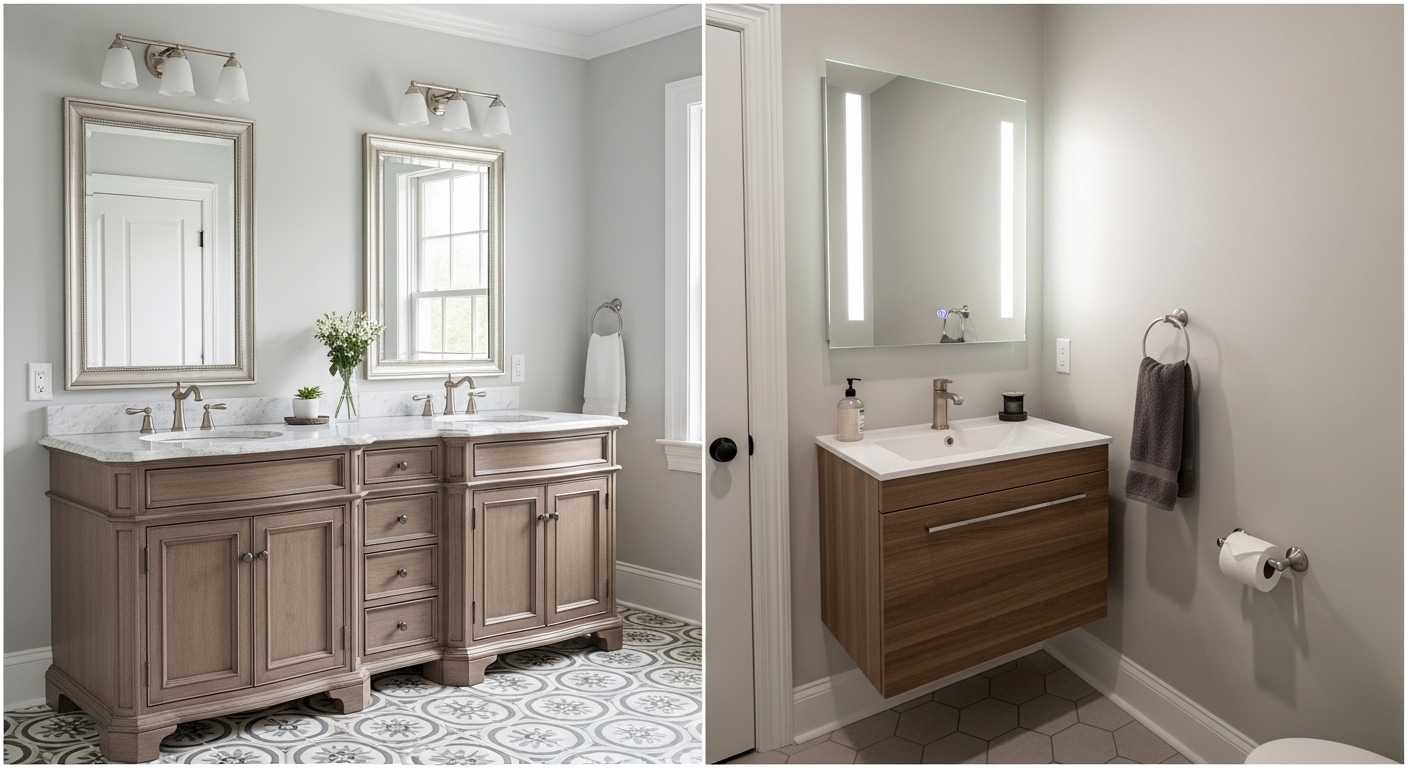
Few decisions shape the feel of a bathroom remodel quite like the vanity. It’s the first thing you see every morning and the last thing you see at night, and it sets the tone for everything else in the room — your mirror, your lighting, your storage, even how the space flows. Yet when homeowners start planning a remodel, one question comes up again and again: should you go with a single vanity or a double vanity?
It seems like a simple choice, but it touches almost everything else in your bathroom design. Square footage, daily routines, resale value, storage needs, and even plumbing all play a role. In this guide, we’ll break down the real differences between single and double vanities, who each option works best for, and how to think through the decision for your own space.
What Is a Single Vanity?
A single vanity is exactly what it sounds like — one sink, one faucet, and one continuous counter and cabinet base built around it. It’s the traditional setup found in most starter homes, guest bathrooms, and powder rooms, and it remains one of the most popular configurations in homes across the country.
Single vanities typically range from a compact 24-inch unit suited to a small powder room up to a generously sized 48- or 60-inch vanity that still centers around just one sink. That extra width on a larger single vanity can be used for additional counter space, a second set of drawers, or simply a more open, uncluttered look.
What Is a Double Vanity?
A double vanity features two separate sinks set into one continuous countertop, usually with a shared cabinet base beneath. Each sink gets its own faucet and, ideally, its own dedicated section of counter and storage. Double vanities are most common in primary (master) bathrooms, where two people are getting ready at the same time on a regular basis.
Because they need to comfortably fit two sinks with enough space between them, double vanities require significantly more width — most start around 60 inches and can extend well beyond that in larger primary suites.
Single Vanity: Pros and Cons
Advantages of a Single Vanity
Space efficiency. This is the single biggest advantage. A single vanity fits comfortably into small to mid-sized bathrooms without overwhelming the room or crowding the walkway. If your bathroom is on the smaller side, a single vanity often allows for a more open, breathable layout.
Simpler plumbing. One sink means one set of supply lines and one drain to route, which simplifies both the design and the eventual installation. This is particularly relevant in older homes where plumbing access can already be limited.
More design flexibility. With a single vanity, you have more freedom in how you use the surrounding wall and floor space. You might pair it with a tall linen cabinet, a bench, or open shelving instead of a second sink — giving you more storage variety rather than more sink capacity.
Lower visual clutter. A single, well-proportioned vanity often reads as cleaner and more cohesive, especially in bathrooms with a minimalist or spa-like design direction.
Drawbacks of a Single Vanity
Limited counter and storage space when shared. If two people use the same bathroom daily, a single vanity can quickly start to feel cramped — especially around busy morning routines.
One sink means waiting. Whether it’s a couple sharing a primary bath or a family sharing a hall bathroom, a single sink can create a bottleneck during peak hours.
Double Vanity: Pros and Cons
Advantages of a Double Vanity
Built for two people at once. This is the defining benefit. Two sinks mean two people can brush their teeth, wash their hands, or get ready simultaneously without stepping on each other’s routine.
More storage, divided cleanly. A double vanity typically offers two separate sets of drawers and cabinet space, which makes it much easier to keep personal items — skincare, toiletries, hair tools — separated and organized rather than sharing one crowded cabinet.
A strong selling point for resale. In many markets, a double vanity in the primary bathroom is viewed as a standard expectation rather than a luxury upgrade, particularly in family-oriented neighborhoods. It’s often associated with a smoother, more functional renovation that future buyers tend to appreciate.
Better for daily routines in shared households. Couples, roommates, and families with older children all benefit from not having to negotiate sink time before work or school.
Drawbacks of a Double Vanity
Requires more square footage. This is the biggest constraint. A double vanity needs enough width to comfortably fit two sinks with adequate spacing between them, plus walkway clearance in front. Forcing one into a space that’s too tight can make the entire bathroom feel crowded rather than upgraded.
More complex plumbing. Two sinks mean two sets of supply lines and drains, which adds complexity to the installation — something worth discussing early with whoever is handling your custom bathroom vanities so the layout is planned correctly from the start.
Can feel excessive in smaller households. If you live alone or rarely share the bathroom with another person at the same time, a double vanity may simply add bulk and storage you don’t need, when that same space could go toward a single vanity with a separate linen tower or seating area instead.
Single vs. Double Vanity: Side-by-Side Comparison
| Factor | Single Vanity | Double Vanity |
|---|---|---|
| Best for | Small to mid-sized bathrooms, guest baths, powder rooms | Primary/master bathrooms, shared households |
| Space needed | Works well from 24″ to 60″ wide | Generally needs 60″+ in width |
| Plumbing complexity | Simpler — one supply and drain line | More involved — two supply and drain lines |
| Storage | One shared cabinet and drawer set | Two separate, divided storage zones |
| Ideal household | Individuals, couples who don’t share peak routine times | Couples and families getting ready simultaneously |
| Design flexibility | More room for a linen tower, bench, or shelving | Layout centers around the two-sink footprint |
How to Decide: Key Questions to Ask Yourself
Choosing between a single and double vanity isn’t just about square footage — it’s about how your household actually uses the space. Here are the questions worth sitting with before you commit to a layout:
How many people will use this bathroom regularly? If it’s a primary bathroom shared by a couple, a double vanity often makes sense. If it’s a guest bath or powder room used occasionally, a single vanity is usually the better fit.
Do your morning routines overlap? Even in a two-person household, if you’re rarely getting ready at the exact same time, a single vanity with strong storage might serve you just as well as a double.
What’s the actual width of the room? Measure first. A double vanity crammed into a space that’s too narrow can make the whole bathroom feel tight and awkward, even if it technically “fits” on paper.
How important is storage organization to you? If you and your partner have very different routines, products, and clutter tolerance, having two distinct storage zones can meaningfully reduce daily friction.
Are you renovating with resale in mind? In primary bathrooms especially, a double vanity tends to be a feature buyers actively look for, which can make it a worthwhile addition even if it’s not strictly necessary for your own use.
Beyond the Sink Count: Other Design Factors to Consider
The single-versus-double decision often gets framed purely as a numbers game — one sink or two — but there are a handful of other design factors that should weigh into your final choice just as heavily.
Mirror and lighting layout. A single vanity typically pairs with one large mirror and a centered light fixture, which creates a clean, symmetrical focal point. A double vanity usually calls for either one extra-wide mirror or two separate mirrors with individual sconces or vertical lighting on either side. Getting this balance right matters more than people expect — uneven lighting across a double vanity can make one side feel like the “good” sink and the other an afterthought.
Counter depth and overhang. It’s not just about width. A vanity that’s too shallow can leave faucets crowding the edge of the counter or splashback hitting the wall. Whether you choose single or double, make sure the counter depth gives both the sink and the surrounding workspace enough breathing room.
Faucet and hardware spacing. On a double vanity, faucet placement needs to be planned with enough separation that two people can use both sinks comfortably without elbows colliding. This sounds minor on a floor plan, but it’s one of the most common complaints homeowners raise after living with a poorly spaced double vanity for a few months.
Knee space and accessibility. If accessibility is a consideration — for aging in place, a multigenerational household, or simply long-term comfort — a single vanity with open knee space underneath, or a slightly lower counter height, can be a more practical choice than a standard double vanity setup.
Material and finish consistency. Whether you go with one sink or two, keeping the cabinetry finish, hardware, and countertop material consistent across the full width of the vanity helps the piece read as one cohesive built-in rather than two mismatched halves bolted together. This is especially important on wider double vanities, where seams and grain patterns in solid surface materials need to be planned carefully so they don’t draw the eye.
Common Scenarios and Which Vanity Fits Best
To make this a little more concrete, here’s how the decision tends to play out in real homes:
A primary bathroom shared by a couple with overlapping schedules. This is the classic case for a double vanity. Two people getting ready at the same time, every day, benefits enormously from two sinks and two storage zones.
A guest bathroom used a few times a month. A single vanity almost always makes more sense here. The bathroom isn’t used frequently enough to justify the extra width and plumbing of a second sink, and that space is often better spent on a slightly larger single vanity with a linen cabinet beside it.
A hall bathroom shared by siblings. This one can go either way. If mornings are chaotic and both kids need the sink at once, a double vanity solves a real daily problem. If the bathroom is small or the kids’ routines don’t overlap much, a single vanity with strong storage organization can work just as well.
A primary bathroom in a smaller or older home. Sometimes the room simply isn’t wide enough for a true double vanity without compromising walkway clearance. In these cases, a well-designed single vanity — sized as large as the space comfortably allows — often delivers a better day-to-day experience than a cramped double.
Making the Most of Either Option
Whichever direction you choose, the layout around the vanity matters just as much as the vanity itself. Good lighting, smart storage planning, and a layout that doesn’t feel cramped will do more for your daily experience than the sink count alone.
If you’re working with a smaller footprint and leaning toward a single vanity, it’s worth exploring how thoughtful custom storage solutions can make up for the lack of a second sink — built-in organizers, vertical drawer dividers, and pull-out shelving can go a long way toward keeping a single-sink bathroom feeling functional for two people.
On the other hand, if you’re planning a full bathroom remodel around a double vanity, it’s worth thinking beyond just the sinks. Consider how the mirror, lighting, and outlets will be split evenly so both sides of the vanity feel equally functional, not like one side is the “main” sink and the other an afterthought.
And once your vanity is installed, keeping it looking its best comes down to a few simple habits — wiping down countertops regularly, avoiding standing water near seams, and using the right cleaning products for your surface material. We cover this in more detail in our guide on how to care for your custom bathroom vanities, which is worth a read regardless of which layout you choose.
Final Thoughts
There’s no universal right answer to the single vs. double vanity debate — only the right answer for your space, your household, and how you actually move through your morning. A single vanity offers simplicity, efficiency, and design flexibility, making it ideal for smaller bathrooms or bathrooms used by one person at a time. A double vanity offers convenience and dedicated storage for two, making it a strong fit for primary bathrooms in busy, shared households.
The best approach is to start with how the bathroom is actually used day to day, not just what looks impressive on a floor plan. From there, the right vanity configuration tends to become obvious.
If you’re still weighing your options, working with a team that designs and builds custom vanities to fit your exact space — rather than forcing a standard size into your bathroom — makes the whole decision a lot easier. A vanity built around your layout, your storage needs, and your routine will always outperform one that simply fits on paper.


Comments are closed