
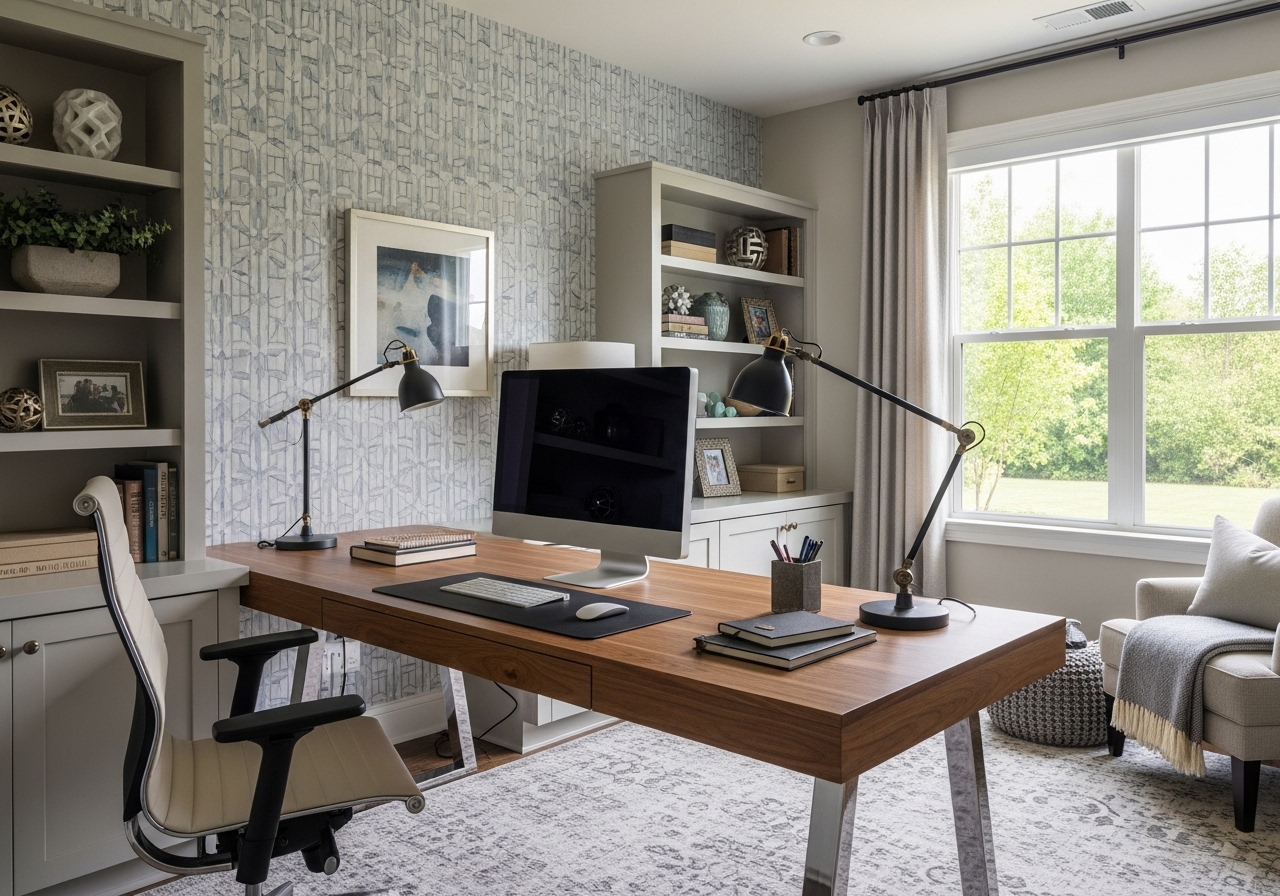
If you work from home — or just need a dedicated space to manage your household, run a side business, or stay organized — you already know that a true home office makes all the difference. And if you live in Montgomery County, TX, chances are your home came with a flex room: that bonus space marketed as a “flex room,” “study,” “game room,” or simply “optional room.” The good news? That room is a blank canvas, and with the right planning and custom craftsmanship, it can become the most productive and impressive space in your entire home.
This guide walks you through exactly how to do that — step by step — from planning your layout to choosing the right built-ins, storage, and finishing touches that make a home office feel truly custom.
What Is a Flex Room — and Why Is It Perfect for a Home Office?
A flex room is simply a spare room in a home that doesn’t have a fixed designated purpose. Builders in Montgomery County communities like The Woodlands, Conroe, Magnolia, Spring, and Willis regularly include flex rooms in floor plans because buyers love the flexibility.
These rooms typically range from 120 to 200 square feet, have at least one window, and sit adjacent to the main living areas or upstairs near bedrooms. That makes them ideal for a home office conversion. They’re close enough to be convenient but separated enough to give you quiet and focus during working hours.
The challenge is that a flex room in its raw form — builder-grade paint, basic flooring, no built-ins — doesn’t feel like a real office. It feels like a spare bedroom that someone forgot to furnish. The goal of a custom home office conversion is to change that entirely.
Step 1: Define How You’ll Actually Use the Space
Before you pick paint colors or furniture, get specific about how you’ll use your office. Ask yourself:
- Do you take video calls? (You’ll need a clean, professional backdrop.)
- Do you have a lot of physical files, binders, or reference materials?
- Do you work with multiple monitors or large-format screens?
- Will clients or colleagues ever visit in person?
- Do you need a separate zone for creative work or a printer station?
Your answers will shape every decision that follows — from desk placement to cabinet depth to lighting choices. Homeowners in Montgomery County increasingly need multi-purpose offices: spaces that function as a professional workspace by day and a reading room or hobby area by evening. A well-designed custom office can handle all of it.
Step 2: Assess the Room’s Structural Bones
Walk into your flex room and take an honest look at what you’re working with:
Natural light: Which direction does the window face? North-facing light is even and ideal for screens. South or west-facing windows mean afternoon glare — you may need window treatments or a different desk orientation.
Electrical outlets: Most flex rooms have the bare minimum. A proper home office requires outlets near your desk, along walls for charging stations, and possibly a dedicated circuit for high-draw equipment. Schedule an electrician early in the process.
Internet connectivity: Is there a hardwired ethernet port in the room? If not, you may want to run a cable before walls get finished — especially important in older homes where Wi-Fi signals drop through thick walls.
Door and traffic flow: A door that opens into the room can eat into usable wall space. Consider whether a barn door, pocket door, or even French doors would serve the space better and look more intentional.
Step 3: Plan Your Layout Around Workflow, Not Aesthetics
The most common mistake homeowners make when converting a flex room is choosing furniture and decor before they plan their workflow. Layout always comes first.
A standard home office layout has three zones:
- Primary work zone — your desk, monitors, keyboard, and task lighting. This is your highest-priority area.
- Reference zone — shelving, filing, books, and materials you access regularly but not constantly.
- Support zone — printer, scanner, supplies, extra seating for guests.
For a 12×12 flex room (common in Montgomery County builds), you can comfortably create all three zones with a U-shaped or L-shaped desk configuration along two walls, built-in upper cabinets for reference storage, and a freestanding or built-in filing section on the third wall.
If your flex room is narrower — say 10×12 — a single-wall built-in desk with floating shelves above and a small side cabinet can be equally effective.
Step 4: Invest in Custom Built-In Cabinetry
Here is where a flex room transformation goes from “nice” to “exceptional.” Off-the-shelf furniture can fill a room, but it will never make a room feel designed. Custom built-in cabinetry does exactly that.
Built-ins do four things that flat-pack furniture simply cannot:
They maximize every inch. Standard furniture is made in fixed sizes. Custom cabinetry is built to fit your exact wall dimensions — floor to ceiling, corner to corner, working around windows and outlets with precision.
They unify the space. When all your cabinetry shares the same finish, hardware, and style, the room feels cohesive and intentional — not like a collection of mismatched pieces you assembled over the years.
They add permanent value. Built-in cabinetry is a real estate asset. Homebuyers in Montgomery County actively look for homes with custom built-ins because they’re a sign of quality craftsmanship and thoughtful design.
They’re stronger. A properly built and installed cabinet will outlast flat-pack furniture by decades. For a workspace where you’re opening drawers and pulling shelves multiple times a day, durability genuinely matters.
When planning your built-ins, work with a team that offers true custom cabinets — not semi-custom or pre-assembled options. The difference is visible the moment you see the finished product.
Step 5: Design Your Desk Configuration
Your desk is the centerpiece of the office, and in a custom build, it doesn’t have to be a separate piece of furniture at all. A built-in desk surface — constructed from the same materials as your cabinetry — creates a seamless look and gives you options you’d never get from a store-bought desk:
- Custom depth (standard desks are 24–30 inches; you may want 32 or more for multiple monitors)
- Cable management cutouts built directly into the surface
- Integrated drawer units beneath the surface
- A matching return or peninsula for a secondary work zone
- Floating design with open space below for a cleaner aesthetic
Choose your work surface material based on how you use your desk. Laminate is durable and budget-friendly. Butcher block adds warmth and character. Quartz or solid surface is sleek and easy to clean. Each works beautifully in a home office context when professionally installed.
Step 6: Build Smart, Accessible Storage
A home office without intelligent storage is just a desk in a spare room. Storage is what makes the space function.
For a custom home office in Montgomery County, think in layers:
Upper cabinets (above desk height): ideal for binders, books, and items you reference occasionally. Glass-front doors let you see contents at a glance while keeping dust out.
Lower cabinets (below desk height): perfect for files, printer paper, office supplies, and items you need within reach but don’t want on display.
Open shelving: great for displaying books, awards, or decorative items that give the room personality. Custom shelving can be sized precisely for your tallest binders or most-used reference books, avoiding the awkward gaps you get with standard shelf heights.
Lateral file drawers: if you keep physical documents, custom lateral file drawers built into your cabinetry keep everything organized and within arm’s reach without the eyesore of a metal filing cabinet.
The goal is to have a designated home for every item in the room — so that clutter is never the default. Thoughtful custom storage solutions make that possible without sacrificing style.
Step 7: Don’t Forget Lighting
Lighting is chronically underestimated in home office design, and it directly affects your productivity, mood, and eye health.
A well-lit home office in Montgomery County should have at least three layers:
Ambient lighting: your room’s primary overhead light. Recessed can lights are cleaner and more modern than a single builder-grade fixture. A dimmer switch lets you adjust based on time of day and task.
Task lighting: a dedicated desk lamp or under-cabinet LED strip that illuminates your work surface without glare on your screen. This is non-negotiable for long working hours.
Accent lighting: inside glass-front cabinets, along shelves, or as a backlight behind your monitor. Accent lighting elevates the visual quality of the room and makes the space feel polished during video calls.
When planning your build-out, talk to your contractor about adding in-cabinet lighting at the same time as the cabinetry — it’s far easier and less expensive to wire lighting before the cabinets are installed.
Step 8: Choose Finishes That Match Your Home’s Style
Your home office should feel like a natural extension of your home’s overall aesthetic — not a jarring departure. In Montgomery County homes, you’ll find everything from transitional craftsman styles to modern farmhouse to clean contemporary, and each lends itself to different cabinet finishes and hardware.
- Transitional: painted white or soft gray cabinets, brushed nickel hardware, wood accents on the desk surface
- Modern: flat-front cabinetry, matte black hardware, integrated handle-free push-open drawers
- Craftsman/Traditional: stained wood in warm tones, shaker-style doors, antique brass or oil-rubbed bronze hardware
- Farmhouse: painted cabinets in a muted color palette, open shelving with metal brackets, warm Edison-style lighting
Whatever direction you choose, consistency is key. Your floor, ceiling, trim, doors, and cabinet finishes should all work together. If your home has existing millwork, match the profile. If your doors are shaker-style, carry that through into your cabinetry.
Step 9: Consider a Nearby Area for Additional Organization
Many Montgomery County homeowners find that once they convert their flex room into a home office, they want additional organizational features nearby — in an adjacent hallway, a closet wall, or even the garage. If your home office has a connected closet, don’t leave it as dead storage.
A custom closet conversion adjacent to your office can house a filing system, supply storage, a mini server rack, or even a dedicated media cabinet. Custom closet solutions integrated into your office design make the entire workspace more functional and keep the main room clean and distraction-free.
Step 10: Work With Local Professionals Who Know the Area
This is the step most people skip — and it’s the one that makes the biggest difference.
Online furniture retailers and big-box stores can sell you components, but they can’t design a space that fits your specific flex room, your specific workflow, and your specific home. Local professionals who work in Montgomery County understand the architectural styles common to this region, the humidity considerations for material selection, and the preferences of homeowners in communities from The Woodlands to Conroe to Splendora.
If you’re in or near the Splendora area, explore what’s possible with custom office solutions services in Splendora, TX — a team that brings local expertise and craftsmanship directly to your home office project.
Working with a local custom craftsman also means you get a real consultation, where someone measures your space in person and designs to the inch — not a generic template that sort of fits.
Final Thoughts: Your Flex Room Is an Opportunity
A flex room is one of the most valuable spaces in a Montgomery County home — precisely because it isn’t locked into one purpose. But “flexible” shouldn’t mean “unfinished.” With intentional planning, quality custom cabinetry, smart storage, and the right lighting, a flex room becomes your most productive and personally meaningful space in the house.
Whether you work remotely full time, run a business, manage your household, or just need a quiet place to think — a custom home office in Montgomery County, TX is an investment that pays back every single day. Stop tolerating a room that doesn’t quite work, and start designing one that truly does.


Comments are closed