
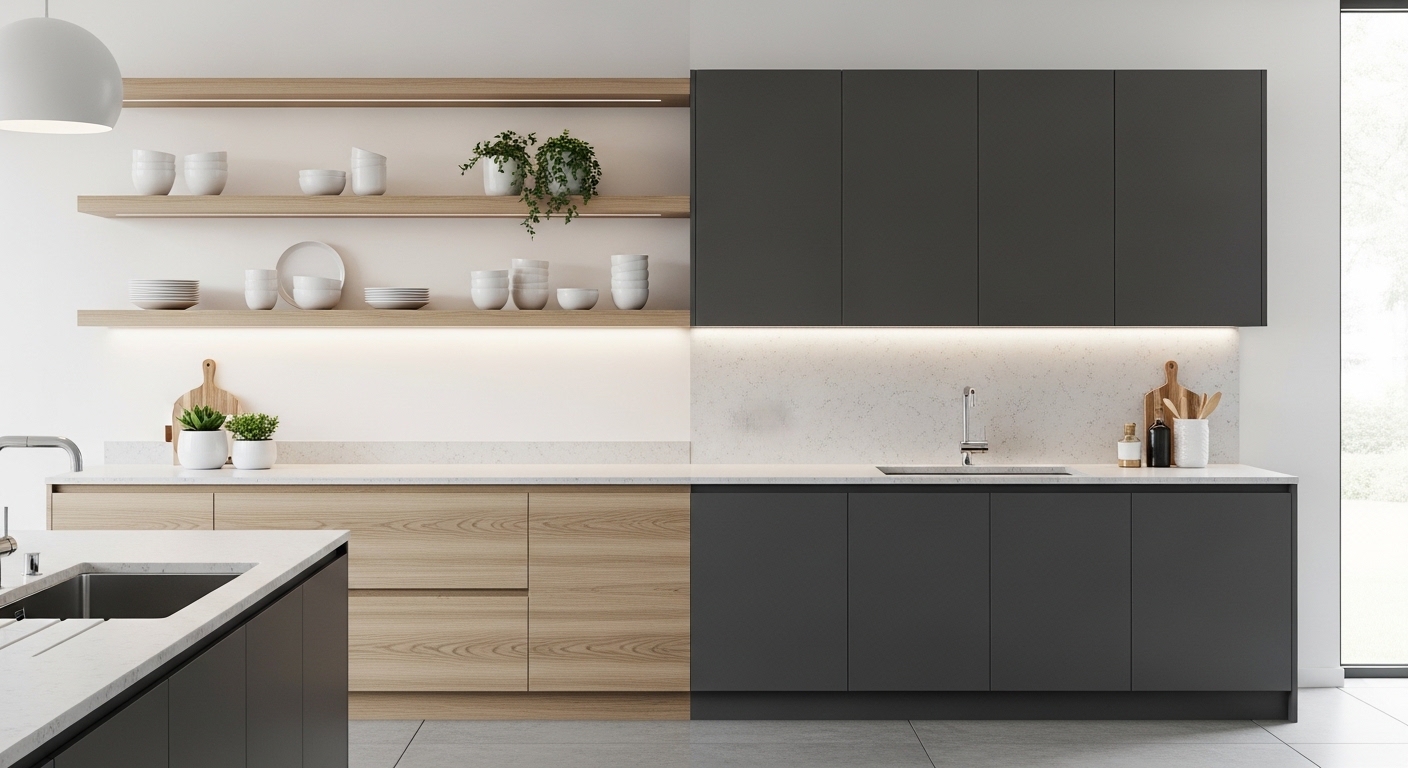
You’ve seen the Instagram kitchens — floating shelves lined with white dishes, glass jars, and trailing plants. They look effortlessly put-together. But then there’s the reality of a busy Houston household: grease mist from weekend fajitas, humidity from coastal air, and the fact that nobody in your family arranges spices in height order. So which storage option actually wins — open shelving or upper cabinets?
At Ace Kustoms Cabinets & Trim, we’ve completed over 600 custom projects across Harris County, Fort Bend County, Galveston County, and beyond. We see this question come up in nearly every kitchen consultation. The honest answer is: it depends on how you cook, how you live, and what your kitchen actually needs. Let’s break it down.
[Get a Free Kitchen Consultation →]
What Is Open Shelving — And Why Is Everyone Talking About It?
Open shelving means exactly what it sounds like: wall-mounted shelves with no doors, no frames, and no enclosures. Whatever you put on them is always visible. The appeal is real — open shelves make a kitchen feel larger, lighter, and more personalized. They work especially well in smaller kitchens where upper cabinets can feel like walls closing in.
In terms of design, open shelves pair beautifully with transitional, farmhouse, and modern kitchen styles. They give you the chance to display pieces you’re proud of — heirloom pottery, a curated set of cookbooks, handmade ceramics. For homeowners who love the idea of a “lived-in” kitchen with character, open shelving can deliver that atmosphere in a way enclosed custom kitchen cabinets simply can’t.
The flip side is maintenance. Open shelves collect dust, grease, and moisture — all of which are particularly aggressive in Houston’s coastal climate. Everything on display needs to be cleaned regularly, not just the shelves themselves. If you tend to have a rotating collection of mismatched containers and half-used bags, open shelving will show every bit of that clutter.
[See Our Open Shelving Work in the Gallery →]
The Case for Upper Cabinets: Function That Never Goes Out of Style
Upper cabinets have been the backbone of American kitchen design for decades — and for good reason. They’re practical, enclosed, and forgiving. You can stash everyday items without worrying about whether they look good. A cabinet door hides the mismatched Tupperware lids, the bulk-bought rice bags, and the coffee mugs you’ve collected from every road trip since 2009.
From a resale standpoint, upper cabinets consistently win. Buyers shopping homes in Pearland, Sugar Land, and The Woodlands still expect fully enclosed storage in their kitchen. Open shelving can feel polarizing to buyers who aren’t sure they can maintain the aesthetic — which can affect your home’s appeal when it comes time to sell.
Storage capacity is the other big factor. Upper cabinets offer significantly more closed storage per linear foot. If your household does serious cooking — bulk grocery runs, large pots, a full spice collection — the enclosed depth of a well-built cabinet simply holds more in a more organized way.
At Ace Kustoms, our custom cabinetry and built-ins are built to spec for your exact kitchen layout, so upper cabinets don’t have to feel heavy or outdated. The right door style, hardware, and finish can make enclosed cabinetry look just as modern as any open shelf trend.
[Explore Custom Cabinet Styles & Finishes →]
Side-by-Side: How They Actually Compare
Here’s how open shelving and upper cabinets stack up across the factors that matter most for Houston homeowners:
Maintenance: Open shelves require frequent dusting and wiping — especially near the stove. In humid coastal kitchens, grease settles on displayed items faster than you’d expect. Upper cabinets keep everything protected and only need occasional interior wipe-downs.
Visual Space: Open shelves win here. They make a kitchen feel taller and more open, particularly in homes with lower ceilings or tighter galley-style layouts. Upper cabinets, especially dark-finished ones, can make a kitchen feel more enclosed.
Storage Volume: Upper cabinets hold more usable items per square foot. Shelves require intentional, sparse styling — which means less functional storage in practice.
Resale Value: Upper cabinets remain the safer choice for resale. Open shelving is a design preference that not every buyer shares.
Cost: Open shelving is typically less expensive to install initially. However, high-quality custom shelving with proper anchoring, brackets, and finishing is not as inexpensive as many homeowners assume. If you’re comparing floating shelves to fully custom solid surface countertops and cabinetry as part of a full kitchen remodel, the price gap narrows significantly.
Humidity Tolerance: This matters specifically in Southeast Texas. The moisture and salt air in Galveston County and along the coast can warp improperly sealed shelving materials over time. Enclosed cabinets with solid construction protect contents and surfaces better in these conditions.
[Talk to a Local Cabinetry Expert About Your Kitchen →]
The Hybrid Approach: Best of Both Worlds
Most of the best kitchen designs we install at Ace Kustoms don’t pick one or the other — they combine both strategically. A common layout in homes across Montgomery County and Fort Bend County uses upper cabinets flanking the range and refrigerator for heavy storage, while open shelves fill in shorter wall runs on either side of a window or above a breakfast nook.
This hybrid approach gives you a display moment — a styled section of shelving that feels intentional and photogenic — without sacrificing the enclosed storage your household actually depends on. It also breaks up the visual heaviness of a full wall of upper cabinets, which can help a kitchen feel more balanced.
Another popular direction: skip upper cabinets on one wall entirely and use that wall space for a dramatic floor-to-ceiling pantry cabinet or a full-height custom storage solution that consolidates everything in one place. This leaves the main prep and cooking walls cleaner while dramatically increasing organized storage elsewhere in the kitchen.
[Request a Design Consultation for Your Kitchen →]
What Should You Choose? Honest Advice from Ace Kustoms
If you cook heavily and value low-maintenance living, lean toward upper cabinets with thoughtful door styles and hardware that match your aesthetic. If your kitchen is small and needs to feel larger, or if you genuinely enjoy curating and maintaining a styled shelf display, open shelving can elevate the space.
If you’re planning a full kitchen remodel — not just a cabinet swap — this decision becomes part of a bigger picture that includes countertop selection, lighting, and layout. That’s where working with a local team who knows the Houston market makes a real difference.
At Ace Kustoms Cabinets & Trim, we’ve served homeowners throughout Harris County, Brazoria County, Galveston County, Fort Bend County, Montgomery County, and the surrounding areas. We don’t push trends — we build kitchens that work for the way your family actually lives. Whether you’re ready to commit to open shelving, custom upper cabinets, or a combination of both, we’ll help you make the right call for your home.
Call us at (281) 660-3903 or reach out at randy@acekustoms.net to schedule your free consultation.


Comments are closed