
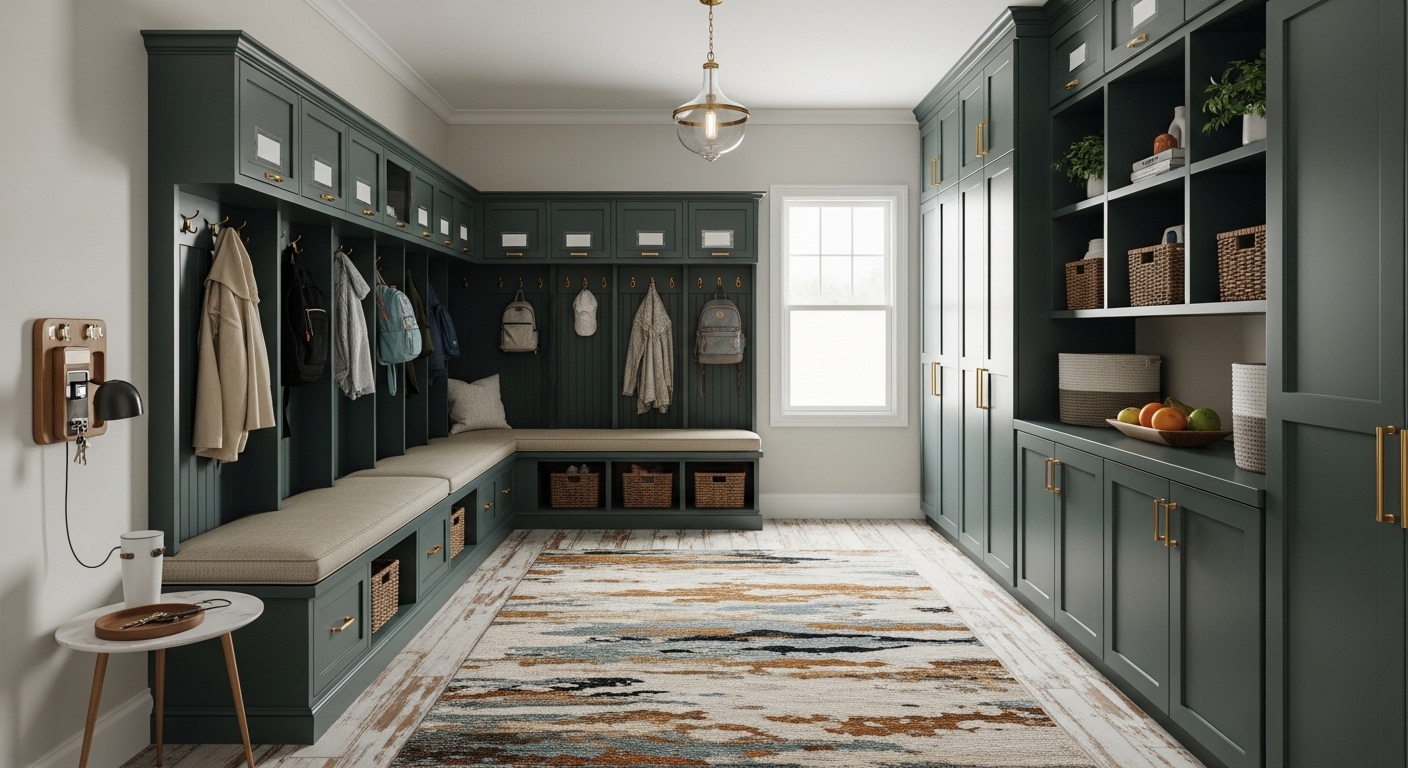
Walk into most Houston homes and you’ll find the same scene by the back door: a pile of shoes, a backpack slumped against the wall, mail stacked on a counter that was never meant to hold it, and a dog leash hanging off a doorknob because there’s nowhere else to put it. This is what happens when a home has an entryway but no real plan for it. A well-designed mudroom or drop zone fixes that problem entirely, turning the busiest doorway in your house into the most organized one.
Whether you’re working with a dedicated mudroom off the garage or just a narrow strip of wall by the back door, the right combination of cabinetry, storage, and layout can completely change how your family moves through your home every day. Here’s what actually goes into a drop zone that works, and how to design one that fits your space, your family, and the way you actually live.
What’s the Difference Between a Mudroom and a Drop Zone?
The terms get used interchangeably, but there’s a useful distinction. A mudroom is typically a separate room — often between the garage and the kitchen — built specifically to catch dirt, shoes, coats, and gear before they reach the rest of the house. A drop zone, on the other hand, doesn’t require a dedicated room at all. It’s a designated area, sometimes just a few feet of wall, equipped with the right storage to serve the same function: hooks, a bench, cubbies, and a landing spot for keys and mail.
Houston homes vary widely in layout, so not everyone has the square footage for a full mudroom. The good news is that a drop zone built with thoughtful, custom cabinetry can deliver almost all the same organizational benefits in a fraction of the space.
Why Custom Built-Ins Outperform Stock Furniture
It’s tempting to solve entryway clutter with a big-box bench-and-hooks combo from a furniture store. The problem is that off-the-shelf pieces are built for an average space, not your space. They rarely fit flush against a wall, they don’t account for ceiling height, door swing, or window placement, and they almost never offer storage proportional to family size.
Custom cabinetry and built-ins solve this by being designed around the actual dimensions of your entryway. Every inch of wall space gets used intentionally — corners that would otherwise be dead space become shoe cubbies, awkward nooks become charging stations, and the finished look matches the rest of your home’s trim and cabinetry instead of looking like a piece that was dropped in from a catalog.
There’s also a durability difference. Drop zones take more daily abuse than almost any other part of a house — wet shoes, dropped backpacks, dog paws, kids leaning on benches. Built-in cabinetry constructed from solid materials and finished properly holds up to that wear far better than particleboard furniture.
The Core Elements of a High-Functioning Drop Zone
A mudroom or drop zone that actually gets used (instead of becoming another dumping ground) tends to include the same handful of features, scaled to fit the household.
Bench seating with storage underneath. A bench gives people somewhere to sit while putting on or taking off shoes, and built-in storage underneath — whether open cubbies, drawers, or lift-top compartments — keeps footwear contained instead of scattered across the floor.
Individual cubbies or lockers. For families with kids, assigning each person their own cubby (sized appropriately by age, with lower hooks for younger children) cuts down on the “whose backpack is this” chaos almost overnight. Locker-style compartments with a door work well if you want a cleaner look when guests come over.
Hooks at multiple heights. A single hook line at adult height doesn’t work for a five-year-old. Staggering hook placement, or adding a lower row specifically for kids, makes the system usable for the whole family rather than just the tallest member of it.
Dedicated shoe storage. Open shoe shelving keeps things accessible for quick changes, while closed cabinetry hides shoes from view — many Houston families opt for a mix of both, with everyday shoes on open shelves and seasonal or special-occasion pairs tucked away.
A landing zone for small items. Keys, mail, sunglasses, wallets, and phone chargers all need a home. A shallow drawer or a small open tray built into the cabinetry keeps these items from migrating to the kitchen counter.
Storage That Scales With Your Family
One of the biggest mistakes in drop zone design is building for the family you have today without leaving room for the family you’ll have in five years. A toddler’s gear takes up very different space than a teenager’s sports equipment, and storage that can’t adapt becomes obsolete quickly.
This is where custom storage solutions earn their value. Adjustable shelving, modular cubbies, and configurable hanging rods let a drop zone evolve as kids grow, hobbies change, and seasonal gear shifts from soccer cleats to ski jackets and back again. Rather than ripping out furniture every few years, a well-built system simply gets reconfigured.
For larger families or households with significant outdoor gear — think golf bags, fishing equipment, or game-day tailgating supplies, all common in the Houston area — built-in vertical storage and taller cabinet sections can handle bulky items that a basic bench-and-hooks setup never could.
Open Shelving vs. Closed Cabinets: Finding the Right Mix
Every drop zone design eventually comes down to a question of visibility: what do you want to see, and what do you want hidden? Open shelving is fast and convenient — grab your shoes or bag without opening a single door — but it shows everything, including the mess on a busy week. Closed cabinetry keeps things tidy-looking at all times but adds a small extra step to retrieve items.
Most well-designed mudrooms split the difference: open cubbies or hooks for daily-use items that need to be grabbed quickly, and closed cabinets or drawers for things used less often or items you’d rather not have on display, like cleaning supplies or pet food. Custom shelving built specifically for this purpose lets you dial in exactly how much of each you need, rather than being locked into whatever ratio a pre-made unit happens to offer.
Materials That Hold Up in Houston’s Climate
Entryways take in more moisture, humidity, and temperature swings than almost any other room, and that’s especially true in Southeast Texas. Wet umbrellas, sweaty gym bags, and the general humidity that comes with a Gulf Coast climate can warp or swell low-quality materials over time.
For drop zone cabinetry, look for finishes and core materials built to resist moisture — sealed solid wood, moisture-resistant engineered panels, and durable hardware that won’t corrode. Flooring underneath should be similarly tough: tile, sealed concrete, or water-resistant LVP all outperform carpet in a space that regularly sees wet shoes and muddy paws. Getting these material choices right at the design stage saves homeowners from replacing warped cabinetry or stained flooring a few years down the line.
Small-Space Solutions When You Don’t Have a Dedicated Mudroom
Not every home has room for a full mudroom, and that’s perfectly fine. A narrow hallway, the wall beside a back door, or even a portion of a laundry room can function as an effective drop zone with the right build-out.
In tight spaces, depth matters more than width. A shallow bench (12–16 inches deep) with hooks mounted above it can fit in surprisingly narrow areas without blocking foot traffic. Vertical storage — tall, narrow cabinets rather than wide ones — makes use of height instead of competing for floor space. Sliding doors or no doors at all (just open cubbies) also help in cramped footprints where a swinging cabinet door would be a constant annoyance.
Many homeowners are also combining drop zone functionality with the laundry room, since the two spaces share similar demands: durable surfaces, storage for outerwear, and proximity to an exterior door. If you’re exploring this combined approach, a previous look at built-ins designed specifically for mudrooms breaks down how to layer laundry function and entryway storage into one cohesive space without it feeling cramped or cluttered.
Lighting and Finishing Touches
Good lighting is easy to overlook in mudroom design, but it makes a real functional difference. A bright, well-lit drop zone makes it easier to spot dropped items, read labels on storage bins, and actually see what you’re grabbing on a dark morning before work or school. Overhead fixtures combined with under-cabinet or under-bench lighting tend to work best, especially in mudrooms that don’t get much natural light.
Beyond lighting, small details — a mirror near the door for a last-second check before heading out, a chalkboard or whiteboard panel for family notes, or coordinating the cabinetry finish with the rest of your home’s trim — turn a purely functional space into one that feels intentional rather than utilitarian.
Building a Drop Zone That Actually Works for Your Household
The mudrooms and drop zones that stay organized long-term aren’t the ones with the most storage — they’re the ones designed around how a specific family actually moves through their day. That means thinking through morning routines, after-school chaos, weekend gear, and everything in between before a single cabinet gets built.
A custom approach makes that level of fit possible in a way that pre-made furniture simply can’t match. Every cubby, hook, and drawer can be sized, placed, and finished to match both the physical space and the real habits of the people using it daily.
If you’re ready to turn a cluttered entryway into a space that actually keeps your family organized, the Ace Kustoms team can walk through your space and design a mudroom or drop zone built specifically for it. Reach out today to start planning a layout that fits your home, your storage needs, and your budget.


Comments are closed