
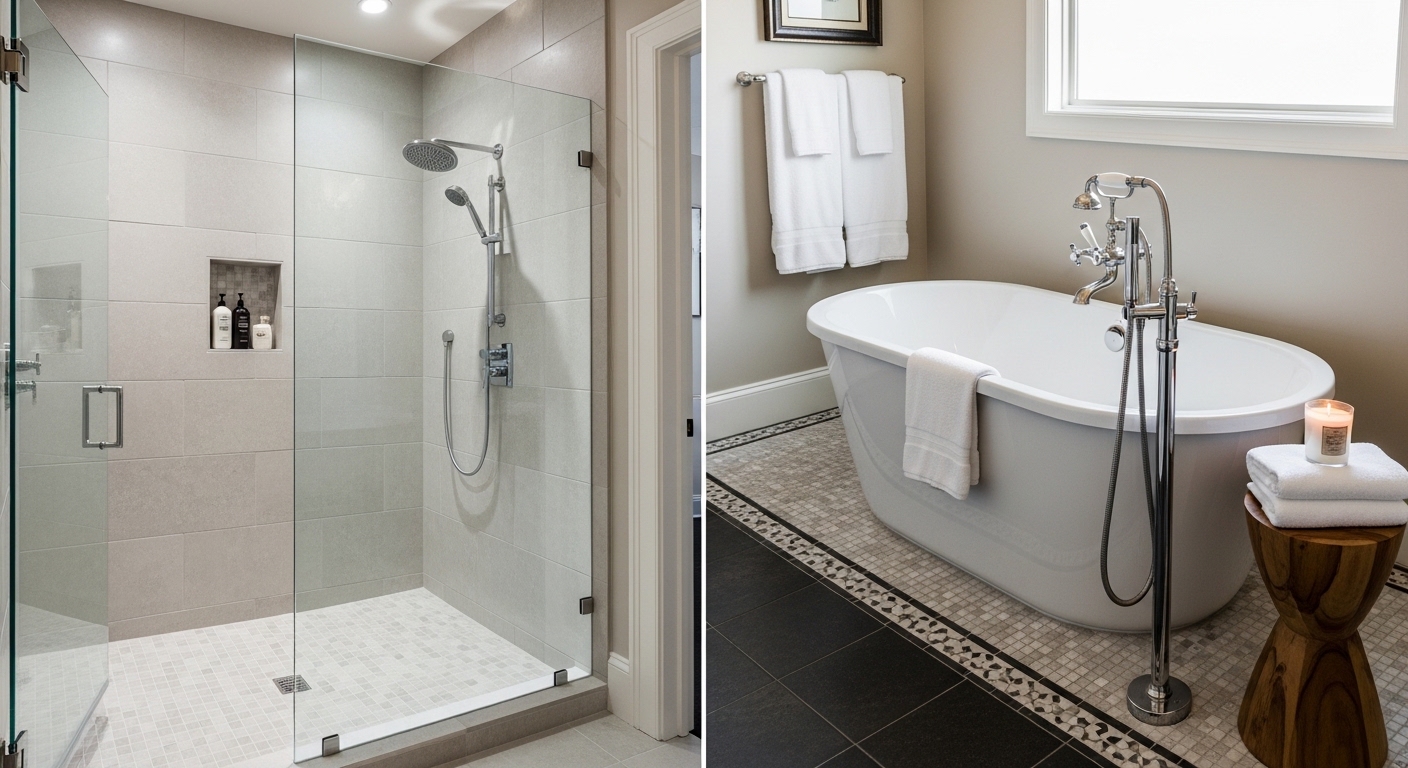
If you’re planning a bathroom remodel in Houston, you’ve probably landed on the same fork in the road every homeowner eventually hits: do you rip out the bathtub for a sleek walk-in shower, or do you keep the tub because “buyers expect one”? It sounds like a simple either/or decision, but the real answer depends on your neighborhood, your home’s price point, and who’s likely to buy it next.
In the Houston market, where new-construction subdivisions sit next to 1980s ranch homes and luxury primary suites compete with starter-home layouts, the walk-in shower vs. bathtub debate isn’t one-size-fits-all. Let’s break down what actually moves the needle on resale value, when each option makes sense, and how to make the choice that pays off for your specific home.
Why This Decision Matters More in Houston Than You Might Think
Houston’s housing market is unusually diverse. You’ve got young professionals buying starter homes in Pearland and Katy, growing families upgrading in Sugar Land and The Woodlands, and retirees downsizing or aging in place in Friendswood and League City. Each of these buyer groups has different bathroom expectations, and that’s exactly why a blanket “always do this” answer doesn’t hold up.
Add to that Houston’s humid, subtropical climate, and the materials and layout choices you make in a bathroom carry extra weight. Poor ventilation, moisture-trapping tile, and outdated fixtures don’t just look dated — they can become real maintenance headaches and inspection red flags when it’s time to sell.
So before you commit to a demo day, it helps to understand exactly what appraisers, agents, and buyers are actually responding to.
The Case for Walk-In Showers
Walk-in showers have been the dominant bathroom trend for the better part of a decade, and for good reason. Here’s what’s driving their popularity — and their value — in Houston homes specifically.
1. They match how buyers actually live. Surveys from the National Association of Home Builders and major real estate platforms consistently show that most households use showers far more often than tubs. A primary suite with a spacious, well-designed walk-in shower signals a modern, low-maintenance lifestyle that resonates with today’s buyers.
2. They’re a strong fit for Houston’s luxury and move-up market. In higher-priced neighborhoods — think Fulshear, Cross Creek Ranch, or the Memorial-area suburbs — a curbless walk-in shower with a frameless glass enclosure, a built-in bench, and a rain shower head reads as a luxury upgrade. Pair it with thoughtful interior tile & stone work, and you’ve created a spa-like focal point that photographs beautifully for listings and tends to draw strong buyer interest.
3. They support aging in place. Curbless, zero-threshold showers are safer for buyers planning to stay in their home long-term, including older adults or anyone with mobility concerns. In a market with a growing number of 55+ buyers, this isn’t a niche feature anymore — it’s a genuine selling point.
4. They free up space and simplify design. Removing a bulky tub often opens up the floor plan, which is especially valuable in smaller secondary bathrooms or primary suites with awkward layouts. If your bathroom is on the tighter side, a well-planned shower conversion can make the whole room feel larger without adding a single square foot. For more layout-specific strategies, our guide to small bathroom remodel ideas covers exactly this kind of space-maximizing approach.
5. Lower long-term maintenance. Showers, especially those with quality glass and properly sealed tile, tend to require less upkeep than tubs with caulking, grout lines around tub surrounds, and aging tub finishes.
The Case for Keeping a Bathtub
Despite the shower trend, removing every tub in the house is one of the most common renovation regrets — and one real estate agents warn against constantly. Here’s why bathtubs still matter for resale value in many Houston homes.
1. Family buyers expect at least one tub in the house. This is the big one. Real estate professionals widely agree: if your home has only one full bathroom, or if it’s the kind of property likely to attract families with young children, removing the only tub in the house can actively hurt resale value and narrow your buyer pool. Families bathing toddlers, and buyers who simply enjoy soaking, will often pass on a home with zero tubs.
2. Appraisers and lenders can flag it. In some cases, a home with no bathtub at all may be viewed less favorably in appraisals compared to similar homes in the neighborhood that have at least one. This is especially relevant in family-oriented Houston suburbs like Pearland, Missouri City, and parts of Katy, where comparable homes typically include a tub.
3. Tubs in secondary bathrooms protect flexibility. A common and smart middle-ground strategy: convert the primary suite to a luxury walk-in shower, but keep (or even upgrade) the tub in the secondary or hall bathroom. This gives you the best of both worlds — a spa-style primary retreat plus the practical tub that broadens your home’s appeal to families.
4. Resale data tends to favor “at least one tub” homes. Multiple housing market studies have found that homes with zero bathtubs can take longer to sell or sell for less than comparable homes with at least one tub, particularly in family-heavy markets. Houston’s suburban sprawl, with its concentration of young families, makes this a real consideration rather than just folklore.
So Which One Actually Adds More Value in Houston?
Here’s the honest, nuanced answer: it depends on which bathroom you’re renovating and who’s likely to buy your home.
- Primary suite, higher-end home, smaller household or empty-nester market: A walk-in shower upgrade — especially paired with quality finishes — tends to add more perceived value and broader buyer appeal in this scenario.
- Only bathroom in the house, or a family-oriented starter/move-up home: Keep at least one tub. Removing your only tub is one of the highest-risk renovation moves you can make for resale.
- Home with multiple full bathrooms: This is where you get to have it both ways. Convert the primary to a walk-in shower, keep a tub in the secondary bathroom, and you’ve satisfied both the luxury-shower trend and the family-buyer expectation.
This “convert one, keep one” strategy is consistently what we recommend to Ace Kustoms clients across Houston-area neighborhoods, from Sugar Land to Conroe. It captures the modern appeal of a walk-in shower without gambling on resale flexibility.
Cost Considerations
Budget plays into this decision too. A bathtub-to-shower conversion in an existing footprint is often more cost-effective than building a brand-new walk-in shower from scratch, since you’re working within existing plumbing lines. Costs climb when you add curbless entry (which typically requires floor reframing for proper drainage), frameless glass, premium tile, or a built-in bench.
Keeping your existing tub and refreshing it — new surround, updated fixtures, a fresh vanity — is almost always the lower-cost path if your goal is value preservation rather than a full luxury upgrade.
Either direction, cabinetry and storage matter more than people expect. A bathroom remodel that swaps a tub for a shower but leaves behind a dated, undersized vanity won’t deliver the value lift you’re hoping for. Upgrading to custom bathroom vanities alongside your shower or tub work ties the whole room together and reads as a complete renovation rather than a partial fix — which is exactly what appraisers and buyers respond to.
2026 Design Trends Worth Knowing
If you’re leaning toward a walk-in shower for 2026, current Houston-area trends include:
- Curbless, zero-threshold entries for a seamless, accessible look
- Large-format tile with minimal grout lines for an easier-to-clean, more modern surface
- Built-in niches and benches instead of bulky shower caddies
- Matte black or brushed brass fixtures as a warm alternative to chrome
- Frameless glass over framed enclosures, for a cleaner sightline
If you’re keeping or upgrading a bathtub, freestanding soaking tubs continue to outperform built-in tub/shower combos in terms of perceived luxury, particularly in primary suites where there’s already a separate shower elsewhere in the home.
Don’t Overlook the Resale Math Beyond the Tub
It’s worth zooming out here: a bathtub-or-shower decision is just one piece of the larger renovation ROI picture. Cabinetry, materials, and finish quality consistently play an outsized role in what buyers and appraisers actually notice. If you want the fuller picture on how renovation choices translate into appraised and resale value across a home — not just the bathroom — our breakdown on custom cabinets and home resale value is a useful companion read before you finalize your bathroom plans.
Questions to Ask Before You Decide
Before you book a contractor or pick out tile, walk through these questions with your household — and with a local agent if you’re renovating specifically for resale:
- How many full bathrooms does the house have? If it’s just one, think twice before removing the only tub.
- What’s the typical buyer profile in your neighborhood? Pull recent comparable sales. Are buyers mostly young families, move-up households, or retirees? This tells you a lot about whether a tub or a shower-only suite will resonate more.
- Is this renovation for your own enjoyment, or purely for resale? If you’re staying in the home for years, prioritize what you’ll actually use daily. If you’re renovating right before listing, weigh buyer expectations more heavily than personal preference.
- Does your primary suite already have a tub elsewhere in the home? If a hall bathroom has a tub, converting the primary to a walk-in shower is a much lower-risk move.
- What’s your realistic budget? A full curbless shower conversion with reframing, glass, and premium tile costs meaningfully more than a tub refresh. Make sure the investment matches the value lift you expect for your specific home and price point.
Answering these honestly will usually point you toward the right decision faster than chasing whatever’s trending on social media.
Quick FAQ
Does removing a bathtub always hurt home value? Not always — but removing the only bathtub in a home, especially in a family-oriented neighborhood, carries more risk than converting a tub in a home that has multiple bathrooms.
Is a walk-in shower a good investment in Houston? Yes, particularly in primary suites and higher-end homes where buyers expect a spa-like retreat. It’s less of a sure bet in single-bathroom homes likely to attract families.
What adds more value: a new tub or a new shower? Neither wins universally. A new shower tends to add more perceived luxury and visual impact in a primary suite; a well-kept tub protects your buyer pool in homes with limited bathrooms. The bigger value driver is usually the overall quality of materials, cabinetry, and finishes used in the remodel.
Can I do both — keep a tub and add a walk-in shower? Yes, and it’s often the smartest move if your home has more than one full bathroom. Convert the primary suite to a shower-only layout and keep a tub in the secondary bathroom.
Making the Right Call for Your Home
There’s no universal winner in the walk-in shower vs. bathtub debate — only the right choice for your specific bathroom, your home’s overall layout, and the buyer pool you’re most likely to attract down the road. A good rule of thumb for most Houston homeowners: protect at least one tub somewhere in the house if family buyers are a realistic part of your resale audience, and feel free to go all-in on a luxury walk-in shower in the primary suite where it adds the most visual and lifestyle impact.
What matters just as much as the tub-or-shower decision is execution. A beautifully tiled walk-in shower next to a cheap, builder-grade vanity undercuts the whole room. A refreshed tub paired with custom cabinetry, smart storage, and quality finishes can outperform a half-finished “trendy” remodel any day.
If you’re weighing this decision for your own Houston home, Ace Kustoms Cabinets & Trim can walk you through what makes sense for your layout, your budget, and your neighborhood’s resale expectations — from the cabinetry and vanities to the tile and trim that pull the whole space together. Reach out to start planning a bathroom remodel that adds real, lasting value.


Comments are closed