
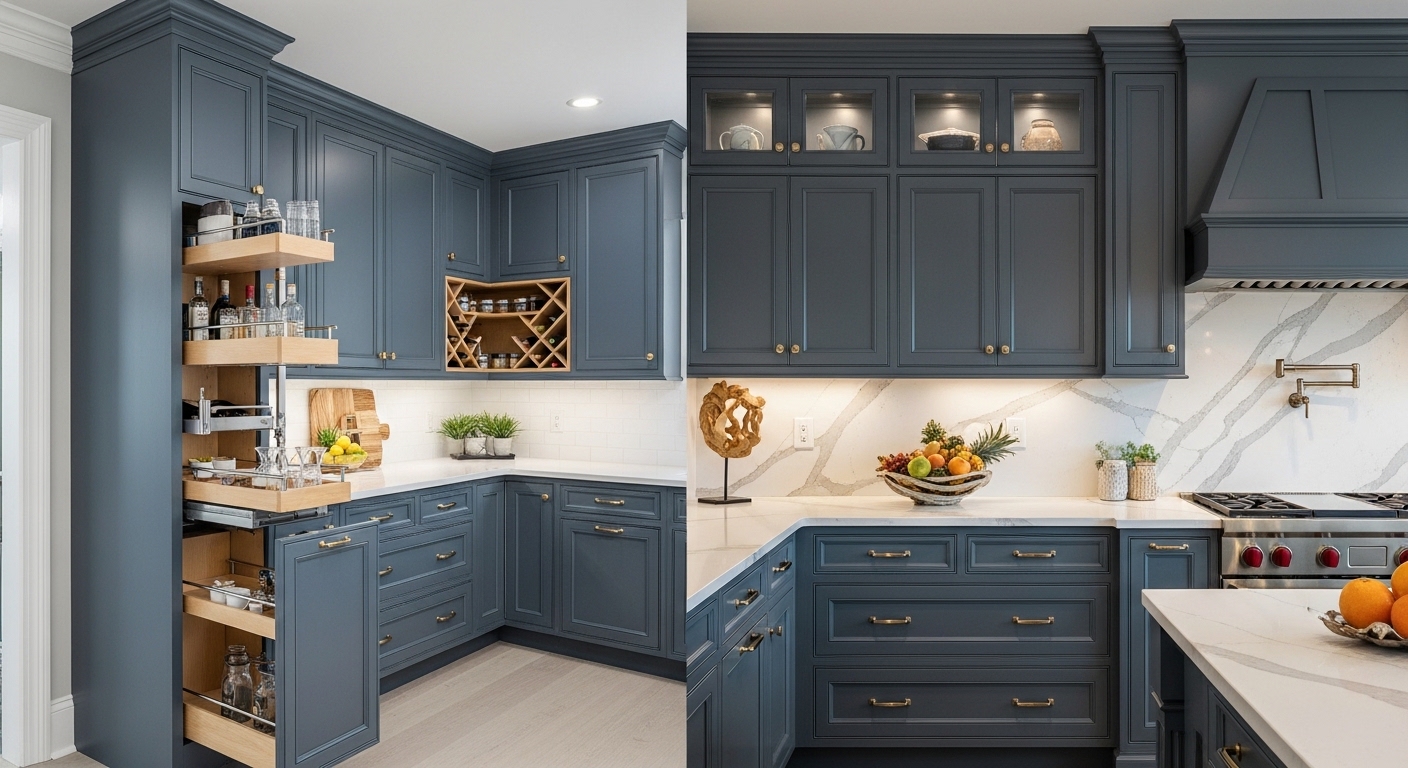
Semi-Custom vs. Custom Cabinets in Houston: Which Is Actually Worth It?
Here’s a scenario I hear all the time from Houston homeowners: you walk into a showroom, fall a little in love with the idea of beautiful, built-just-for-you cabinets, and then the quote lands in your inbox. And suddenly you’re wondering if you maybe… don’t need custom after all?
Or maybe it’s the opposite. You went the semi-custom route to save money, and now you’re living with a kitchen that doesn’t quite fit — literally — and it’s been bothering you for two years.
Both situations are real. And both are avoidable if you go in with a clear picture of what you’re actually choosing between.
So let’s talk through it — no fluff, just what you need to know to make the right call for your home and your budget.
1. What “Semi-Custom” Actually Means (It’s More Than You Think)
A lot of people assume semi-custom is basically just a step above stock cabinets from a big-box store. That’s… not really accurate anymore.
Semi-custom cabinets are built to order within a set range of sizes, finishes, and features. You’re not picking off a shelf — you’re choosing from a defined menu. The manufacturer builds your cabinets when you order them, usually within 4–8 weeks.
The catch? You work within their system. You can choose from maybe 20 wood species, 50+ finishes, a handful of door styles, and a range of standard dimensions. That sounds limiting, but honestly? For most kitchens, it’s plenty.
Real-world example: A Houston homeowner in the Heights with a fairly standard galley kitchen layout? Semi-custom almost certainly gets them exactly what they want — quality materials, great finish options, and a look that feels intentional and tailored. No compromises necessary.
Quick tip: Don’t confuse “semi-custom” with “cheap.” Brands like Kraftmaid, Medallion, and Decora operate in this space with genuinely high-quality construction. The “semi” just means the design parameters are pre-set, not that the quality is.
2. What Custom Cabinets Actually Get You
Custom cabinets are built from scratch — literally from raw lumber or panels — to your exact specifications by a local craftsman or custom shop. No standard sizes, no preset menus. You want a cabinet that’s 17.5 inches wide with a specific pull-out shelf and a hand-applied glaze? Done.
This is where custom really shines: unusual spaces, high ceilings, non-standard wall angles, or a design vision that’s genuinely specific. Custom cabinet makers in Houston can accommodate things that would be flat-out impossible with semi-custom — like a curved island, floor-to-ceiling built-ins in an awkward alcove, or a very specific wood grain match.
And the craftsmanship is often — not always, but often — a step up. You’re usually working with a local shop where someone is physically making your cabinets. There’s accountability baked in.
Real-world example: An older Bellaire home with a kitchen that’s, say, 9 feet tall with a soffit that doesn’t hit at a standard height? Custom is probably the move. Semi-custom manufacturers build in fixed height increments. Custom builders don’t care — they’ll make it fit.
Quick tip: Ask to visit the shop. Seriously. Any legitimate custom cabinet maker in Houston should be happy to show you their workspace. If they’re hesitant, keep looking.
3. The Cost Gap (And When It Actually Matters)
Let’s be honest about numbers because this is usually the deciding factor.
Semi-custom cabinets in Houston typically run $150–$650 per linear foot installed, depending on the line and finish choices. A mid-range kitchen might land between $8,000 and $20,000 all-in.
Custom cabinets? You’re usually looking at $500–$1,200+ per linear foot installed. That same kitchen might run $20,000 to $50,000 or more, depending on complexity and the shop.
That gap is real. But here’s the thing — it’s not always meaningful.
If your kitchen is a standard layout, semi-custom gets you 90–95% of the way to the same result at maybe 50–60% of the cost. You’re not “settling.” You’re being smart.
But if you have a truly unique space — or if this is your forever home and the kitchen is the room you use most — the custom investment starts making more sense. You’re paying for fit, precision, and the fact that nobody else will have exactly what you have.
For a deeper look at how custom and pre-made options compare across different kitchen types, this comparison of custom cabinets vs. pre-made options breaks it down really well.
Quick tip: Get quotes for both before deciding. The price difference might surprise you in either direction — some semi-custom lines are more expensive than local custom shops, and vice versa.
4. Timelines: The Hidden Factor Nobody Talks About
This one sneaks up on people.
Semi-custom cabinets typically have lead times of 4–10 weeks from order to delivery. You’re working with a factory schedule, and that’s that.
Custom cabinets? Could be 6 weeks from a smaller shop, or 16+ weeks if you’re working with someone who’s booked out. Good custom shops in Houston often have waitlists. That’s actually a good sign — it means they’re in demand — but it can absolutely derail your renovation timeline if you’re not planning ahead.
If you’re trying to time a kitchen remodel around a life event — selling your house, moving in, a family gathering — this really matters.
Real-world example: A Katy homeowner planning a renovation before listing their home in spring? Semi-custom is almost certainly the smarter call for timeline reasons alone, not just cost.
Quick tip: Always ask for current lead time estimates before you fall in love with a particular shop or product. Get it in writing.
5. Design Flexibility: Where the Real Trade-offs Live
Here’s where I think most people get tripped up. They think “semi-custom = limited” and “custom = unlimited.” But it’s more nuanced than that.
Semi-custom has gotten genuinely impressive in the last decade. Most quality lines now offer:
- Hundreds of finish combinations
- Multiple door styles and profiles
- Varied box constructions (frameless vs. face-frame)
- Specialty features like soft-close hardware, pull-out trays, and custom organizational inserts
Where it does get limited: odd dimensions, highly specific aesthetic requests, and truly unusual wood species or grain matches. If your design vision lives outside the standard menu, semi-custom will frustrate you.
Custom is also your only real option if you want built-ins that look like they were always part of the house — bookshelves, window seats, mudroom lockers, entertainment centers that match your kitchen cabinetry exactly. A custom shop can build all of it as one cohesive project.
Quick tip: Before assuming you need custom, spend an afternoon going through the catalog of a quality semi-custom line. You might find everything you wanted was already there.
6. Quality: Separating Reality from Marketing
Not all semi-custom is equal. Not all custom is better.
Let that sink in for a second.
There are semi-custom lines with genuine dovetail drawer boxes, solid wood face frames, and 10-year warranties that outperform some locally-made custom cabinets built by a less experienced shop. And there are small Houston cabinet makers doing extraordinary work that blows factory cabinets out of the water.
The key questions to ask for either type:
- Box construction: Plywood sides vs. particleboard? (Plywood is significantly better.)
- Drawer box material and joinery: Dovetail solid wood vs. stapled MDF?
- Hinge and slide quality: European soft-close hinges and undermount slides are what you want.
- Finish durability: Catalyzed finishes hold up; UV-cured finishes are even tougher.
These specs matter more than the “semi-custom vs. custom” label. A well-spec’d semi-custom cabinet beats a poorly-built custom one every time.
7. Resale Value: Does It Actually Pay Off?
Honest answer? Sort of.
Kitchens generally return somewhere between 60–80% of renovation cost at resale, depending on the market. Houston’s market tends to reward updated kitchens, especially in neighborhoods where homes are transacting at higher price points.
The thing is, buyers don’t usually know if your cabinets are semi-custom or custom. What they see is: do the cabinets look beautiful, are they in good condition, and do they feel quality? If you’ve installed beautiful semi-custom cabinets with quality hardware, you’ll likely get the same buyer response as custom.
Where custom can differentiate: luxury market homes in River Oaks, Memorial, or Tanglewood, where buyers are discerning and may actually notice — and care about — the difference.
Quick tip: Talk to a local Houston realtor before spending extra on custom if resale is part of the equation. They’ll tell you whether your neighborhood rewards that investment.
Comparison Summary
| Factor | Semi-Custom | Custom |
|---|---|---|
| Cost (installed) | $150–$650/linear ft | $500–$1,200+/linear ft |
| Lead Time | 4–10 weeks | 6–16+ weeks |
| Size Flexibility | Standard increments | Fully flexible |
| Design Options | Wide but defined | Truly unlimited |
| Quality Ceiling | Very high (depends on line) | Very high (depends on shop) |
| Best For | Standard layouts, budget-conscious remodels | Unique spaces, high-end builds |
| Resale Impact | Strong in most markets | Strong in luxury markets |
Key Takeaways
- Semi-custom is not “settling” — for most Houston kitchens, it delivers excellent results at a meaningful cost savings.
- Custom is worth it when you have a non-standard space, a very specific design vision, or you’re building for the long term in a home you love.
- Quality varies wildly within both categories — focus on construction specs, not just the label.
- Timeline is a bigger factor than most people plan for. Build in buffer.
- Get quotes for both before committing. The numbers might surprise you.
So Which One Is Right for You?
Here’s my honest take: if you have a standard kitchen layout and a realistic budget, semi-custom probably gets you 95% of what you want at a fraction of the cost. Go tour a showroom, ask hard questions about construction quality, and don’t let anyone pressure you into spending more than you need to.
But if your kitchen has unusual dimensions, high ceilings, architectural quirks, or you’re looking to create something truly specific to your home — or if this is your forever house and the kitchen is your joy — then custom is worth the conversation. Find a local Houston shop with a strong portfolio, visit them in person, and get a detailed quote.
Either way, the best cabinet is the one that fits your space, your life, and your budget. Not the most expensive one. Not the one that sounds most impressive to describe.
Curious which direction makes more sense for your specific kitchen? We’d love to walk you through it — no pressure, just a real conversation about what works for your home.
Want to dig deeper into how different cabinet types compare across quality levels, materials, and price points? Check out this detailed comparison of custom vs. pre-made cabinet options to help frame your decision.


Comments are closed