
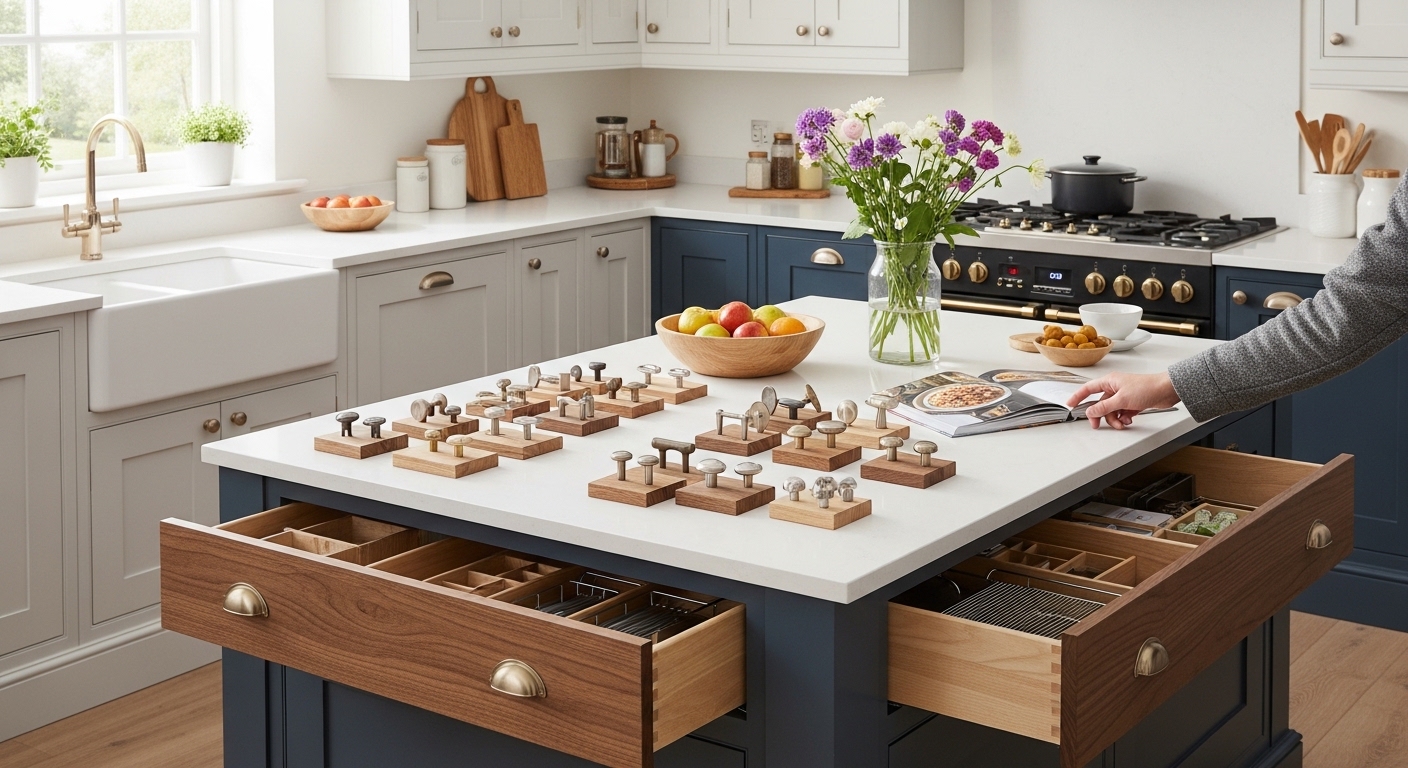
You’ve finally done it. You’ve picked out the custom kitchen cabinets, agonized over the perfect shade of “not-too-yellow” white paint, and even settled on a backsplash. But now you’re standing in a hardware aisle or staring at an endless online grid of metal bits, and your brain is officially fried.
Knobs? Pulls? Matte black or champagne bronze? It feels like picking out earrings for an outfit. It’s a small detail, but man, does it change the whole vibe. Hardware really is the jewel of the kitchen. It’s the finishing touch that can make a standard cabinet look high-end or a modern kitchen feel warm and lived-in.
Honestly, I’ve seen people breeze through a whole kitchen remodel only to get completely paralyzed by a two-inch piece of brass. If that’s you, don’t worry. We’re going to break this down together. Think of this as a casual chat over coffee about how to dress up your cabinets without making it weird.
The Lineup: Knobs vs. Pulls vs. Finger Latches
Before we get into the “shiny” stuff, we have to talk about the shapes. Usually, you’re looking at three main contenders for your cabinet faces.
1. Knobs: The Classic Choice
Knobs are the old reliable. They’re small, usually circular (though they can be square or even T-shaped), and require only one hole in your cabinet door.
- The Vibe: Traditional, understated, and timeless.
- Pros: They’re generally cheaper and easier to install. Plus, they don’t distract from the beauty of the wood or paint.
- Cons: They don’t provide as much “grip” for heavy drawers. If you have a massive drawer full of cast-iron pans, a tiny knob might feel a bit flimsy.
2. Pulls (Handles): The Modern Standard
Pulls are long handles that require two screws. They’ve become the go-to for most modern kitchen designs.
- The Vibe: Modern, functional, and sleek.
- Pros: Incredibly easy to use. You can hook a finger through them even when your hands are covered in flour. They also protect the cabinet finish because your oily fingers aren’t constantly touching the wood.
- Cons: They’re more expensive. Also, if you ever want to change them later, you’re committed to that specific “center-to-center” distance between the two holes.
3. Finger Pulls & Edge Latches: The Minimalist Dream
These sit on the top edge of the drawer or the side of the door. They’re almost invisible from a distance.
- The Vibe: Ultra-modern, industrial, and “clean.”
- Pros: No visual clutter. Perfect if you spent a lot of money on beautiful custom bathroom vanities and want the wood grain to be the star.
- Cons: They can be a bit tricky for people with limited grip or long fingernails.
Side-by-Side: Which Hardware Suits You?
| Feature | Knobs | Pulls (Handles) | Edge/Finger Pulls |
| Install Difficulty | Easy (1 hole) | Moderate (2 holes) | Easy to Moderate |
| Grip Strength | Low | High | Low to Moderate |
| Price Point | $ | $$ | $$$ |
| Style Feel | Traditional/Transition | Modern/Universal | Ultra-Modern |
| Cleaning | Easy | Easy | Can trap crumbs |
Let’s Talk Finishes (The Fun Part)
This is where the “jewel” part really comes in. The finish you choose should talk to your faucet and your lighting accent features, but they don’t have to match perfectly. Mixing metals is actually very “in” right now.
- Matte Black: Honestly? It’s the “little black dress” of hardware. It looks good on everything—white, wood, navy. It’s modern but doesn’t feel cold.
- Champagne Bronze/Brushed Brass: This is the warm gold look. It’s great for adding a bit of luxury. It makes a kitchen feel “expensive” without being gaudy.
- Polished Chrome/Nickel: The classic “silver” look. Chrome is great for a clinical, clean feel. Nickel is a bit warmer and hides fingerprints a lot better.
- Oil-Rubbed Bronze: This is for the farmhouse lovers. It has a dark, rich, almost chocolatey tone that develops a “patina” over time.
Pro Tip: If you have small kids, stay away from polished chrome. You will spend your entire life wiping off tiny fingerprints. Go for a “brushed” or “satin” finish instead.
Expert Recommendations: How to Choose Like a Pro
Here’s the thing… there aren’t many hard rules, but there are some “unspoken” guidelines I always share with my clients.
- The Mix-and-Match Strategy: I usually recommend pulls for drawers (since you’re pulling a heavier weight) and knobs for doors. It breaks up the visual monotony and makes the kitchen feel more designed.
- Scale Matters: If you have a huge 36-inch drawer, don’t put a tiny 3-inch pull on it. It’ll look like a giant wearing a baby’s hat. Aim for a pull that is roughly 1/3 the width of the drawer.
- Think About Your Hands: Honestly, go to a store and grab the hardware. Some pulls have sharp edges that feel “stabby” when you grab them. Some knobs are too close to the door, so your knuckles hit the cabinet every time. If it doesn’t feel good, don’t buy it.
The Decision Framework: 3 Steps to Success
Still stuck? Use this checklist to narrow it down:
- Step 1: Check your lighting. If your kitchen has a lot of under-cabinet lighting, polished finishes will reflect that light and “sparkle.” If your kitchen is darker, matte finishes will blend in better.
- Step 2: Look at your faucet. You don’t have to match it, but you should stay in the same “temperature.” If your faucet is cool (Chrome), maybe do cool hardware (Nickel). If it’s warm (Brass), stay warm.
- Step 3: Buy samples. Seriously. Spend $30 and buy one of each of your top three choices. Tape them to your cabinets. Look at them in the morning light and the evening light. You’ll know which one is “the one” within 24 hours.
FAQ: Quick Answers for Homeowners
Q: Can I mix knobs and pulls in the same kitchen?
A: Absolutely! In fact, most high-end designs do this. Knobs on doors, pulls on drawers is the gold standard.
Q: Should hardware match the appliances?
A: Not necessarily. Your dishwasher and fridge are usually stainless steel. If you match everything to that, the kitchen can feel a bit “gray.” Don’t be afraid to use brass or black to add some personality.
Q: Where exactly do I place the knobs?
A: For doors, the standard is about 2 to 3 inches from the corner opposite the hinges. For drawers, dead center is classic, but for very tall drawers, some people like them placed on the top third.
Wrapping It Up
At the end of the day, hardware is one of the easiest things to change in a home. If you pick something today and hate it in five years, it only takes a screwdriver and an afternoon to swap them out (provided you kept the hole spacing the same!).
Don’t let the pressure of finding the “perfect” jewel keep you from enjoying your kitchen. Pick what makes you smile when you walk in the room.
If you’re feeling overwhelmed by the choices or you want to see how different hardware looks on our custom cabinetry work, feel free to reach out. We serve everyone from Harris County to Montgomery County, and we’d love to help you add that final bit of sparkle to your home.

Comments are closed