
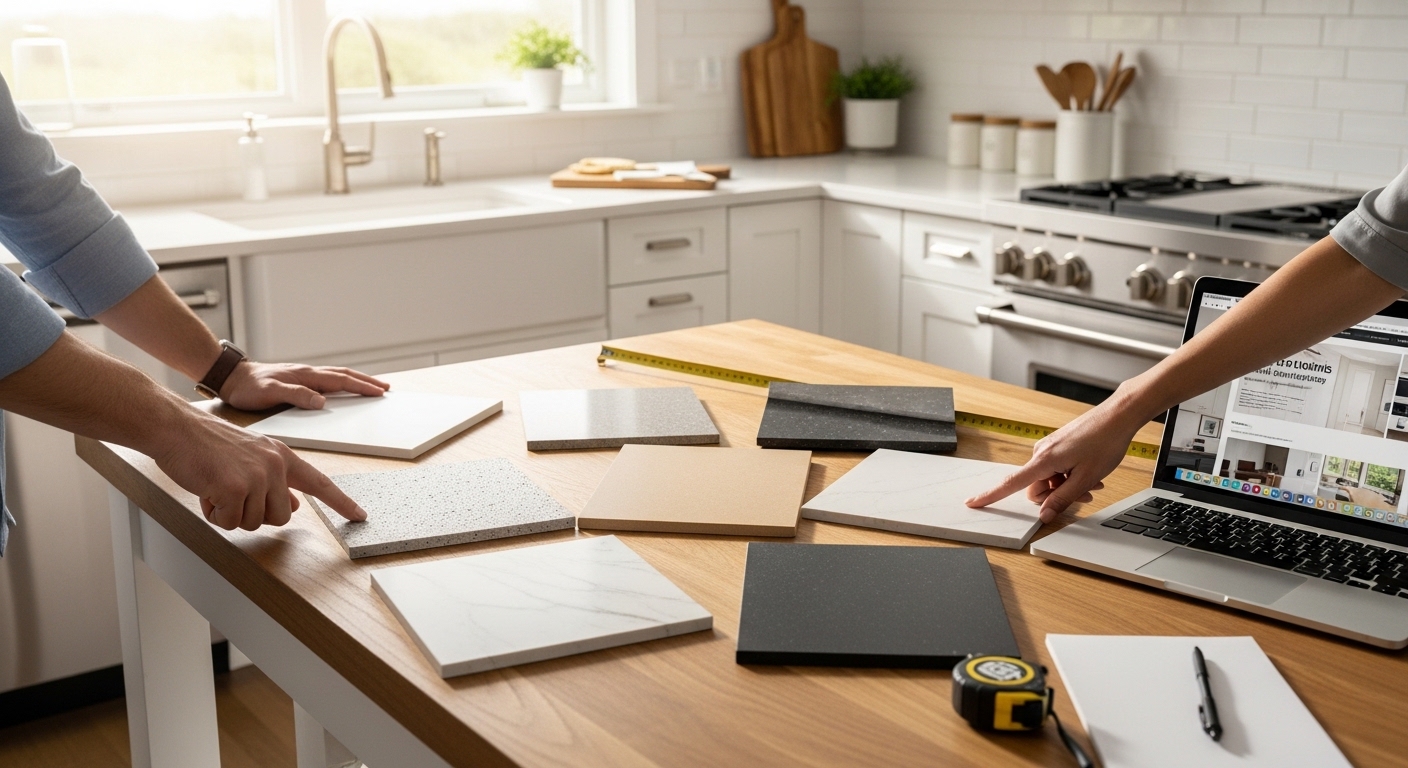
You’re standing in a showroom, looking at what feels like 500 different countertop samples, and honestly? They’re all starting to blur together. The sales guy keeps throwing around terms like “non-porous” and “heat resistance,” but all you really want to know is: which one won’t make you regret this decision in five years?
I get it. Choosing the right solid surface countertop for your home shouldn’t feel like you need a degree in materials science. And if you’re like most homeowners I talk with here in Houston, you’ve got enough on your plate without adding countertop anxiety to the mix.
Here’s the thing, though. The countertop you choose isn’t just about looks. It’s about how you actually live in your kitchen. Do you bake every Sunday? Got kids who treat the counter like a science lab? Or maybe you’re the type who just wants something that looks great and doesn’t require a maintenance manual?
Let’s figure this out together. No jargon, no sales pitch. Just real talk about what actually matters when you’re picking a solid surface countertop.
Why This Decision Keeps You Up at Night
Look, I’ve watched people agonize over countertop choices for weeks. And it’s not because they’re indecisive. It’s because this is one of those purchases that sits right at the intersection of expensive and permanent. You can’t exactly swap out countertops like you’re changing throw pillows.
The problem goes deeper than just picking a color. You’re trying to predict the future. Will this material hold up when your teenage daughter decides to make pancakes at midnight? What about when you accidentally set a hot pan down because your hands are full and the smoke alarm is going off?
And then there’s the Houston factor. Our humidity is no joke. Some materials just don’t play nice with our climate, and nobody tells you that until you’re dealing with warping or discoloration a year down the road.
But here’s what really gets people stuck: the options all sound amazing on paper. Every manufacturer claims their product is the most durable, the most beautiful, the easiest to maintain. So how do you actually know what’s real and what’s marketing?
What’s Really Going On Here
The countertop industry has gotten really good at making everything sound perfect. But the truth? Every material has trade-offs. Every single one. And the “right” choice completely depends on your specific situation.
Most people start their search thinking about color and pattern. That’s totally natural. But you know what actually determines whether you’ll love your countertops five years from now? How well they fit your daily routine.
Think about it this way. If you cook a lot, you need different things than someone who mostly reheats takeout. If you’ve got a house full of kids, durability trumps pretty much everything else. And if you’re planning to sell in a few years, you’re thinking about resale value more than personal preference.
The other thing nobody really explains is that solid surface countertops are actually a specific type of material. Not granite, not quartz, but a manufactured blend of acrylic polymers and natural minerals. Brands like Corian made them famous. They’re different from stone options, with their own set of pros and cons.
This distinction matters because when you’re choosing the right solid surface countertop for your home, you need to understand what you’re actually getting. These aren’t natural stone that’s been quarried and cut. They’re engineered products, which means consistency, repairability, and some limitations on heat resistance.
Solutions That Actually Work
Alright, let’s get practical. Here’s how to think through this decision without losing your mind.
Start with your lifestyle, not your Pinterest board. I know that sounds backward, but hear me out. That gorgeous white countertop you saved? It might be a nightmare if you cook with turmeric or drink red wine. Be honest about how you actually use your kitchen. Not how you wish you used it.
Consider the Houston climate seriously. Our humidity can affect certain materials over time. Solid surface countertops generally handle it well because they’re non-porous, which means moisture can’t seep in and cause problems. That’s a real advantage over some other options that might develop issues in our climate.
Think about maintenance reality. Some countertops need to be sealed regularly. Others require special cleaners. Solid surface options are pretty forgiving – soap and water usually does the trick. But if a material needs monthly maintenance and you know you’ll forget, that’s important information.
Test your tolerance for imperfection. Solid surface countertops can scratch more easily than quartz or granite. But here’s the flip side: they can be sanded and repaired. A scratch isn’t permanent. For some people, that’s a huge relief. For others, the idea of any scratch is unacceptable. Know which camp you’re in.
If you’re doing a full kitchen remodel, your countertop choice affects everything from your backsplash to your cabinet hardware. It’s worth getting this decision right.
Look at real installations, not just samples. Those little squares in the showroom don’t tell you what 30 square feet of countertop actually looks like in a room. Visit actual homes or check out completed projects. The whole vibe changes when you see it at scale.
Your Practical Action Plan
Here’s what I’d do if I were in your shoes:
Map out your hot zones. Where do you actually work in your kitchen? If you’re always at the stove, that area needs serious heat consideration. If you prep salads at the island, you’re thinking about staining and knife marks. Different areas might even benefit from different materials, honestly.
Set a realistic budget with wiggle room. Solid surface countertops typically fall in the middle price range. Not as pricey as high-end granite or quartz, but not bottom-of-the-barrel either. Figure out your number, then add 15% for the inevitable extras nobody mentions upfront.
Get samples and live with them. Bring home actual samples and put them in your kitchen. Look at them in morning light, evening light, with your cabinet colors. Spill coffee on them. See what happens. This isn’t being paranoid; it’s being smart.
Ask about repair and warranty details. This is huge. What’s covered? For how long? Can scratches or burns be fixed, and how much does that cost? A great warranty can make a riskier material choice feel safer.
Talk to your installer early. Before you fall in love with something, make sure your installer has experience with it. Some custom cabinetry and built-in projects require specific countertop considerations. An experienced installer knows the tricks that make installations smooth.
Consider your edge profile now, not later. The edge detail affects the whole look and can add cost. Some edges work better with certain materials. Plus, rounded edges are more forgiving in homes with kids – no sharp corners to worry about.
Think about seams strategically. Unless you’ve got a tiny kitchen, you’ll have seams. With solid surface materials, seams can be nearly invisible when done right. Ask to see examples of seam work from your fabricator.
Plan for the total project, not just materials. Installation costs, edge profiles, backsplash integration, sink cutouts – it all adds up. When you’re pricing countertops and surface work, make sure you’re comparing apples to apples.
Test the oops factor. What happens when something goes wrong? Red wine spill, hot pan, dropped knife. Ask specifically about each scenario. Some materials laugh off these moments. Others… not so much.
Don’t forget the sink situation. Solid surface countertops can have integrated sinks – where the sink and counter are one seamless piece. It looks incredible and eliminates that gross seam where stuff gets trapped. But it also means if one fails, you’re replacing both. Just something to think about.
Making Your Final Call
Look, at the end of the day, the right countertop is the one that makes sense for how you live. Not the one that looks best on Instagram or the one your neighbor swears by.
If you’re still feeling stuck, that’s normal. This is a big decision. Maybe start by eliminating what definitely won’t work for you, then compare what’s left. Sometimes it’s easier to know what you don’t want than what you do.
And here’s something I’ve noticed: the people who love their countertops years later are usually the ones who were honest about their priorities from the start. They didn’t pretend they were going to baby their counters when they knew they wouldn’t. They didn’t choose high-maintenance materials when they wanted low-maintenance lives.
Ready to see what solid-surface countertops could look like in your kitchen? We work with homeowners all over Houston to find materials that fit their real lives, not just their design dreams. Whether you’re doing a full kitchen overhaul or just updating your solid surface countertops, we can help you figure out what makes sense.
Give us a call at Ace Kustoms Cabinets and Trim, or shoot us an email at randy@acekustoms.net. Let’s talk about what you actually need, not just what looks pretty in a showroom.
Questions Everyone Asks
How do solid surface countertops compare to quartz or granite?
They’re generally less expensive than both and easier to repair. Quartz and granite are harder and more heat-resistant, but if they chip or crack, you’re dealing with a permanent problem. Solid surface materials can be sanded and buffed out. It’s really about which trade-offs matter more to you.
Can I put hot pots directly on solid surface countertops?
Short answer: don’t. While they have some heat resistance, they’re not designed for direct heat from pots and pans. Always use trivets. This is one area where natural stone has a real advantage. But honestly, using trivets is a good habit regardless of your countertop material.
Are solid surface countertops good for bathrooms too?
Absolutely. They’re actually great for custom bathroom vanities because they’re non-porous and resist moisture damage. Plus, you can get integrated sinks that make cleaning so much easier. In Houston’s humidity, that non-porous quality is clutch.
How long do solid surface countertops last?
With proper care, 20-25 years easily. I’ve seen them last longer. The ability to repair and refinish them significantly extends their life. A deep scratch that would ruin granite can be buffed out of solid surface material.
What colors and patterns are available?
Pretty much anything you can imagine. Solid colors, patterns that mimic stone, modern looks, and traditional styles. The range has gotten so much better over the years. But here’s a pro tip: stick with patterns that have some variation. Solid colors show every little thing.


Comments are closed