
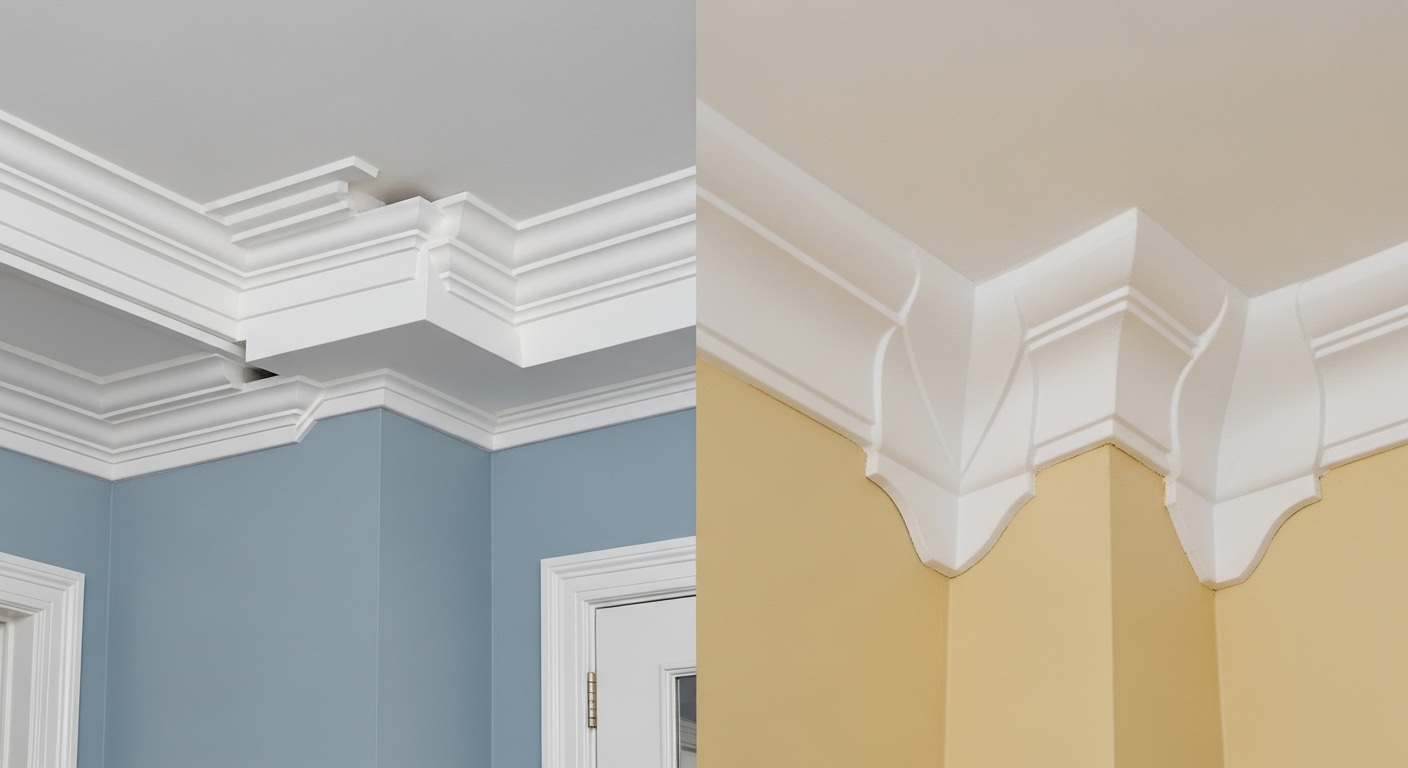
That “Unfinished” Feeling: Why Trim is the Hero of the Room
You know that feeling when you walk into a beautifully staged home and everything just looks… expensive? You might think it’s the furniture or the rug, but if you look up at the corner where the wall meets the ceiling, you’ll usually find the real secret.
It’s the molding.
Without it, even the best paint job can feel a bit like an unfinished thought. Trim work is the architectural eyeliner of your home; it defines the edges and smooths out the transitions. But when you start looking at options, you’re immediately hit with the big debate: Crown Molding vs. Cove Molding.
Honestly, to the untrained eye, they both just look like “fancy wood strips.” But choosing the wrong one can make a modern room feel dated or a traditional room feel a bit hollow. It’s about more than just a piece of wood; it’s about the “vibe” of your sanctuary.
I’ve spent a lot of time perched on ladders doing trim and finishing work, and I’ve seen how the right profile can completely change the way light hits a room. Let’s break down the differences so you can stop guessing and start finishing your space with confidence.
1. Crown Molding: The Ornate Classic
If molding were a royal family, this would be the King. Crown molding is the most popular choice for high-end custom cabinetry and built-ins. It’s characterized by its complex, multi-tiered profile that “springs” out from the wall toward the ceiling.
It usually features a mix of convex (curves that bulge out) and concave (curves that dip in) shapes. This creates a lot of little ridges and valleys that catch the light and create shadows, giving the room a massive sense of depth and history.
A Quick Scenario: I once worked on a library project in The Woodlands. The homeowner wanted the room to feel like an old-world estate. We used a massive, 5-piece built-up crown. The shadows those layers created made the 10-foot ceilings look like a work of art.
Pro Tip: Because crown molding projects out at an angle, the “miter cuts” at the corners are notoriously difficult. This isn’t a project for a dull saw or a faint heart!
2. Cove Molding: The Graceful Minimalist
Cove molding is the quieter, more sophisticated cousin. Unlike the “steps” of crown molding, cove has one primary feature: a smooth, concave (c-shaped) curve. It essentially “scoops” the transition between the wall and the ceiling.
It’s significantly less “busy” than crown. If you love the clean lines of mid-century modern design or a transitional aesthetic, cove is your best friend. It provides a finished look without demanding everyone’s attention the second they walk in.
Think about it this way: Cove molding is like a well-tailored t-shirt. It’s simple, it fits perfectly, and it never goes out of style. It’s also a fantastic choice for custom bathroom vanities where you want a clean, sanitary look that doesn’t trap a lot of dust in tiny crevices.
3. The Material Factor: Wood vs. MDF
This is where the Crown Molding vs. Cove Molding decision meets your budget.
- Solid Wood: Perfect if you want to see the grain (like Oak or Walnut). It’s tough and adds a lot of “heirloom” value to custom kitchen cabinets.
- MDF (Medium Density Fiberboard): The go-to for painted trim. It’s perfectly smooth, doesn’t have knots, and is much more stable (less shrinking) in the Houston humidity.
I’ve seen this happen: A homeowner insisted on solid pine crown molding for a large living room. Over the first year, the Houston heat made the wood expand and contract so much that the corners opened up like a hungry mouth. For painted applications, honestly, save yourself the headache and go with high-quality MDF or primed poplar.
4. Scale and Ceiling Height
You wouldn’t wear a giant top hat if you were four feet tall, right? The same logic applies to your trim.
- Standard 8-foot ceilings: Stick to a 3-inch to 4-inch profile. Anything larger will make the ceiling feel like it’s crashing down on you.
- 10-foot or 12-foot ceilings: You need scale. This is where crown molding shines. You can even “build up” the look by adding a flat baseboard piece under the crown to make it look like one massive, custom piece.
Comparison at a Glance: Crown vs. Cove
| Feature | Crown Molding | Cove Molding |
| Profile Shape | Complex (Ogee, tiers, steps) | Simple (Concave curve) |
| Style Vibe | Traditional, Formal, Luxury | Modern, Minimalist, Transitional |
| Dust Factor | Higher (More ledges) | Lower (Smooth surface) |
| Best For… | Formal Dining, Master Suites | Kitchens, Bathrooms, Modern Living |
| Installation | Difficult (Complex miters) | Moderate (Easier to fit) |
Key Takeaways for Homeowners
- Look at your furniture: If you have a lot of antiques or traditional pieces, go with Crown Molding. If your home is full of clean lines and simple shapes, Cove Molding is the winner.
- Don’t forget the cabinets: Transitioning the molding from your walls to your custom storage solutions creates a “built-in” look that significantly boosts home value.
- Lighting is the secret sauce: Use custom under-cabinet lighting or uplighting to highlight the curves of your molding. It makes the trim pop at night.
- Houston Humidity: Always use high-quality caulk and wood filler. In our climate, things move. A good “flexible” finish is the difference between a job that looks good for a month and one that looks good for a decade.
Which Profile Tells Your Story?
At the end of the day, there is no “right” answer in the Crown Molding vs. Cove Molding debate—there is only the answer that makes you smile when you walk into the room.
Trim work is the final layer of your home’s personality. It’s the difference between a house that feels like a collection of boxes and a home that feels like a designed space. Whether you’re looking to add that “wow” factor to a new kitchen remodel or you just want to finish out a hallway, the profile you choose sets the tone for everything else.
If you’re feeling a bit stuck looking at small samples, or you’re worried about making those tricky corner cuts yourself, give us a shout. We’ve spent years perfecting the art of trim installations and we’d love to help you figure out which “royal” profile fits your palace.
What’s the vibe you’re going for? The ornate elegance of the Crown, or the smooth, modern grace of the Cove? Either way, it’s going to look incredible.
Would you like me to help you calculate exactly how many linear feet of molding you’ll need if you provide your room dimensions?


Comments are closed