
The Moment You Stop Settling for “Good Enough”
Here’s how it usually goes. You’re standing in your bathroom, coffee in hand, staring at that builder-grade vanity. The laminate is peeling at the corners. The drawer slides feel like they’re filled with wet sand. And there’s just… not enough storage. Again.
You’ve told yourself it’s fine. You’ll deal with it later. But lately, “later” keeps creeping closer.
A friend of mine in Houston went through this exact thing last year. She’d been eyeing custom vanities online for months — gorgeous walnut-fronted cabinets with soft-close drawers and a vessel sink that actually made the room feel like somewhere she wanted to be. But every time she started researching costs, she’d hit a wall of vague estimates and contractor run-arounds.
Sound familiar? That’s what this article is about. Not the dream — you already have that. But the real numbers, the honest trade-offs, and what you can actually expect when you pursue a custom bathroom vanity in Houston in 2026.
If you want to jump straight to getting a feel for your options, this comparison of custom vs. pre-made cabinetry is a great place to start before we dig into cost.
First, What Are We Actually Talking About?
“Custom vanity” gets used loosely in the industry — and honestly, it causes a lot of confusion. So let’s break it down quickly.
There are basically three tiers:
- Stock vanities — what you find at Home Depot or IKEA. Standard sizes, limited finishes, usually particleboard construction. Cheap upfront, but they show their age fast.
- Semi-custom — pre-built boxes with some flexibility in size, finish, or hardware. A middle ground that works for some budgets.
- Fully custom — built to your exact dimensions, your exact specs, your exact vision. This is what we’re talking about today.
A fully custom bathroom vanity means no compromises on size (perfect for those awkward bathroom layouts Houston older homes are famous for), no compromises on materials, and a finished look that’s genuinely yours.
And yes, it costs more. But the gap between stock and custom has narrowed more than people think — especially when you factor in longevity.
The Real Cost Breakdown: What Houston Homeowners Are Paying in 2026
Okay, the part you actually came here for. Here’s what I’ve seen in the market:
Entry-Level Custom: $1,500 – $3,500
This range typically covers simpler designs — painted or stained finishes, standard hardware, solid wood construction but without a lot of decorative complexity. You’re getting quality over cookie-cutter, but keeping things clean and functional.
Mid-Range Custom: $3,500 – $7,000
This is where most Houston homeowners land for a single bathroom vanity. You’re looking at more refined joinery, better drawer systems (Blum soft-close is basically standard at this level), and more material options — think oak, maple, or even painted MDF for a cleaner look. This range also usually includes the installation.
High-End Custom: $7,000 – $15,000+
We’re talking specialty woods, furniture-grade finishes, integrated lighting, custom stone tops, and a vanity that genuinely looks like it belongs in a magazine. If you’re renovating a primary bath in a higher-end Houston home, this range isn’t unusual at all.
These ranges don’t include plumbing work, mirrors, or lighting fixtures — that’s separate. And if you’re replacing tile or making structural changes, that’s its own budget conversation.
What Drives the Price Up (And What You Can Control)
Here’s something most contractors won’t spell out clearly: the cost isn’t random. Every decision you make shifts the number. Knowing which levers matter helps you spend where it counts.
Wood Species
Painted MDF is surprisingly durable and keeps costs down. Solid oak is mid-range. Walnut, white oak, or specialty hardwoods push costs up significantly — sometimes $800–$1,500 more just in material.
Size and Configuration
A 48″ single-sink vanity is very different from an 84″ double vanity with a center tower. Every linear foot adds to the build time and material cost. More drawers, more doors, more money — but also more storage, which is often worth it.
Hardware
This one surprises people. The difference between builder-grade pulls and quality European hardware (Blum, Hettich) can be $300–$800 on a full vanity. It’s also one of the most tactile parts of your daily experience, so it matters more than the price suggests.
Finish Quality
A spray-applied factory finish holds up better than brushed paint. If you’re investing in a custom piece, don’t cut corners on the finish — it’s what protects everything underneath.
Speaking of smart decisions — if you’re weighing whether custom is really worth it for your situation, read through this custom vs. pre-made comparison. It might clarify the decision faster than anything else.
Expert Insight: What the Contractors Don’t Tell You
I want to share a few things that took me a while to piece together from conversations with craftspeople and homeowners who’ve been through this process.
First — lead times are real. Custom cabinetry in Houston right now is running 6 to 12 weeks for most shops. If you’re planning a bathroom renovation and expecting your vanity to arrive in two weeks, that’s going to create a problem. Plan your timeline before you finalize anything else.
Second — the cheapest quote usually isn’t. I’ve seen people go with a lower bid and end up with veneered particleboard when they expected solid wood, or drawer boxes that don’t fit squarely. Ask what materials are being used. Get it in writing. A $500 difference in quotes can mean very different things.
Third — installation matters more than people think. A custom vanity built to tight tolerances needs to be set level and plumb, with clean cuts around plumbing. This isn’t a “hire whoever’s cheapest” situation. Make sure your installer has experience with cabinet work specifically.
And honestly? Most homeowners don’t regret spending a little more. The regrets I hear about are almost always from people who cut costs on the wrong things.
How to Plan Your Custom Vanity Budget (Practically)
Alright, let’s make this actionable. Here’s how to approach the budgeting process without going in blind:
- Start with your non-negotiables. Is size the issue? Storage? Aesthetics? Knowing your actual priorities helps you have a useful conversation with any shop.
- Get at least 3 quotes — and ask each shop to spec out the same design. Comparing apples to apples is the only way to evaluate pricing fairly.
- Ask about the build timeline upfront. If you have a hard deadline (guests coming, a renovation schedule), make sure the shop can hit it before you fall in love with their portfolio.
- Budget a 10–15% contingency. Plumbing surprises, tile that needs replacing once the old vanity is out — it happens. Build wiggle room in from the start.
- Ask to see finished work in person, not just photos. Photos are great; touching the actual drawers and seeing how the finish looks under bathroom lighting is better.
Frequently Asked Questions
Is a custom vanity actually worth the investment for resale value?
Generally, yes — especially in Houston’s mid-to-upper price bracket homes. A well-built custom vanity signals quality to buyers in a way that stock cabinets don’t. It won’t add dollar-for-dollar to your home value, but it absolutely helps a bathroom show better and sell faster.
Can I get a custom vanity if my bathroom is oddly shaped or has unusual plumbing placement?
That’s actually one of the best arguments for going custom. Stock vanities assume standard layouts. If your bathroom doesn’t cooperate, custom is often your best option — not just your luxury option.
How long does a quality custom vanity last?
A well-built solid wood vanity with quality hardware and a proper finish should last 20–30 years with normal care. Compare that to a stock vanity that might look tired in 5–7 years, and the math starts to make sense.
What’s the difference between a custom vanity shop and a big-box store’s “custom” offering?
Big-box “custom” is usually semi-custom at best — limited size increments, a handful of finish options, and construction that uses more engineered materials. A true custom shop builds to your specs from scratch. Very different products, even if the word “custom” appears in both.
How do I know if a Houston cabinet shop is reputable?
Ask for references from completed bathroom projects specifically. Look for shops that will show you the wood and hardware they use, not just photos of finished rooms. And trust your gut — a shop that’s evasive about materials or timelines is telling you something.
Back to That Friend in Houston…
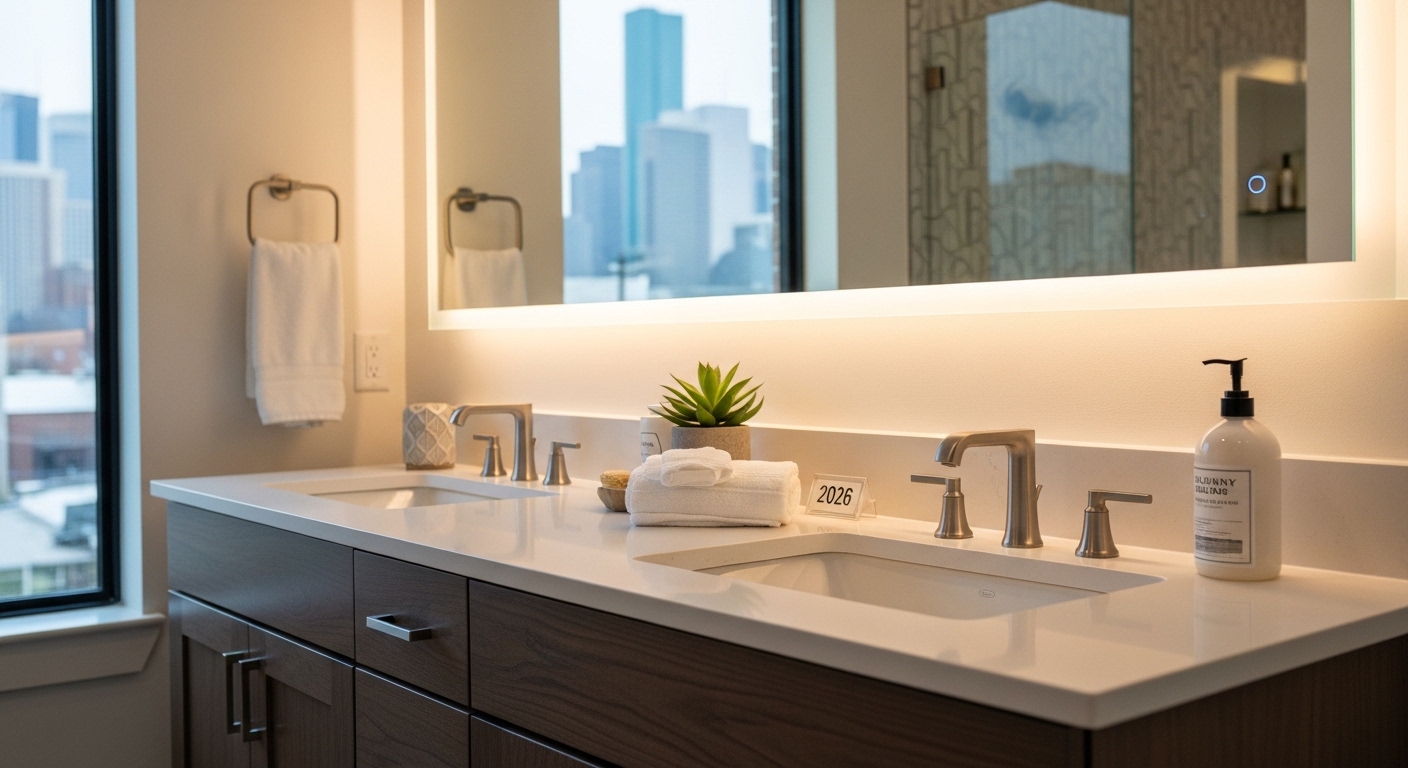
She ended up going with a mid-range custom shop, spending just under $5,200 for a 60″ double vanity in a warm white painted finish with quartz top. It took about 8 weeks from deposit to install.
She told me afterward: “I kept thinking I was overspending. Now every single morning I walk in there and feel like it was the best money I’ve spent on the house.”
That’s the thing about a space you use every day. The quality shows up every morning. It compounds.
If you’re in Houston and thinking seriously about a custom bathroom vanity — whether you’re in the early dreaming phase or ready to get quotes — the best next step is just having a real conversation with a shop that builds these things.
And if you’re still weighing custom against semi-custom or pre-made options, this side-by-side comparison breaks it down honestly. No fluff, just the real trade-offs.
You’ve been standing in front of that old vanity long enough. Let’s fix that.


Comments are closed