
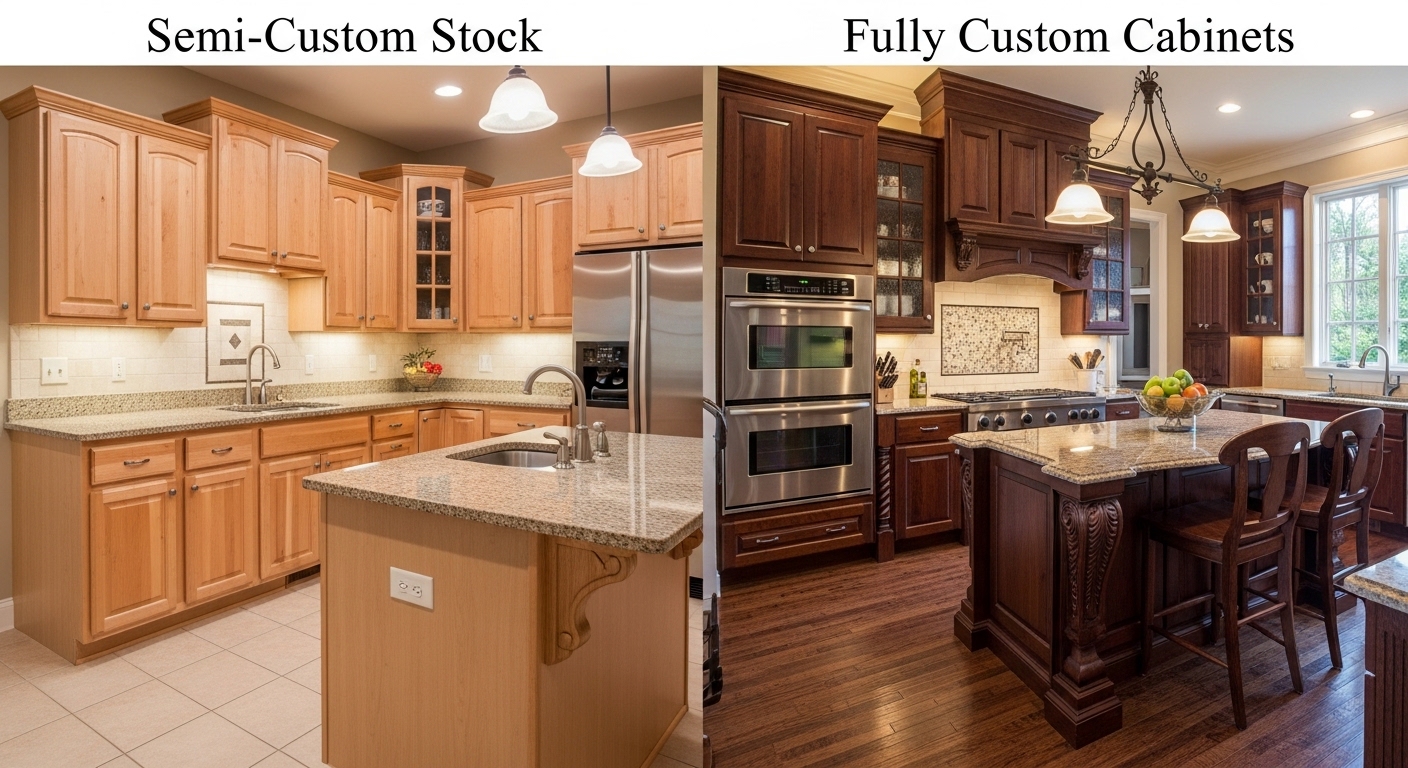
The “Filler Piece” Fiasco: A Cautionary Tale
I remember sitting on a subfloor in a kitchen three years ago, watching a homeowner named Sarah stare at a three-inch gap between her new cabinets and the wall. She’d bought “stock” cabinets from a big-box store because the price was unbeatable.
But here’s the thing: her kitchen walls, like almost every wall in every house ever built, weren’t perfectly square. To make those rigid, pre-made boxes fit, her installer had to use what we call “filler strips.” By the time they were done, her expensive new kitchen had these awkward, blank wooden spacers everywhere. It looked… well, it looked like it didn’t fit.
Sarah looked at me and said, “I saved four thousand dollars, but every time I walk in here, I’m just going to see those gaps.”
That’s the emotional heartbeat of the semi-custom vs stock vs fully custom cabinets debate. It’s not just about a line item in your budget; it’s about how you feel when you run your hand over the countertop or try to put away a oversized Thanksgiving platter that won’t fit in a standard-depth drawer.
If you’re weighing these options right now, I want to help you avoid Sarah’s “filler piece” heartache. Let’s pull back the curtain on what these terms actually mean when you’re standing in the middle of a demo zone.
Breaking Down the Big Three: What are you actually buying?
When you start shopping for kitchen remodels, the terminology gets thrown around like confetti. “Custom-grade,” “Modular custom,” “Boutique stock.” Honestly, it’s enough to make your head spin. To keep it simple, think of it like buying a suit.
1. Stock Cabinets (The “Off-the-Rack” Option)
Stock cabinets are pre-manufactured in specific sizes—usually in 3-inch increments. You want it, you buy it, you take it home (or wait a week for delivery).
- The Pros: They’re cheap. Like, significantly cheaper. If you’re flipping a rental or on a razor-thin budget, these are your best friend.
- The Cons: You’re stuck with what they have. If your wall is 100 inches long, and they only sell 30-inch and 36-inch cabinets… you’re going to have gaps. Plus, the materials are often particle board or thin plywood.
2. Semi-Custom Cabinets (The “Tailored” Option)
This is the middle ground where most homeowners land. The cabinet box is still a standard size, but you can change certain “dimensions.” Maybe you want the cabinet to be 2 inches deeper, or you want a specific door style in a custom paint color.
- The Pros: Much better flexibility than stock without the “total custom” price tag. You get better hardware (soft-close hinges are usually standard here).
- The Cons: You’re still working within a manufacturer’s “menu.” If you want a truly unique storage solution, like a hidden spice rack that slides out of a 4-inch pillar, they probably can’t do it.
3. Fully Custom Cabinets (The “Bespoke” Option)
This is what we do at Ace Kustoms. There is no warehouse. There are no pre-made boxes. We take measurements of your actual walls—every weird bump and out-of-plumb corner—and build the cabinets to fit that specific space to the millimeter.
- The Pros: Absolute freedom. You want 10-foot tall cabinets that touch the ceiling? Done. You want a custom entertainment center that matches your kitchen island exactly? Easy. The quality is usually night-and-day better because they’re built by hand.
- The Cons: It takes longer. You can’t rush craft. And yes, the upfront cost is higher.
Expert Insights: The “Hidden” Costs of Going Cheap
Look, I’m going to be honest with you. I’ve seen people save $5,000 on stock cabinets only to spend $3,000 extra on labor because the installer spent three days trying to “hack” them into place.
Here’s a professional secret: Custom cabinets often save you money on the back end. When a cabinet is built for the space, it slides in like a glove. There’s no “fudging” it.
Also, think about the hardware. Have you ever had a drawer “catch” or a door start to sag after two years? That’s usually the hallmark of stock cabinetry hardware. When you opt for custom cabinetry and built-ins, you’re usually getting heavy-duty, undermount slides that can hold 100 lbs of cast-iron pans without flinching.
Why Material Choice Changes Everything
In the world of semi-custom vs stock vs fully custom cabinets, the “guts” of the cabinet matter more than the face.
- Stock often uses staples and glue.
- Semi-custom moves into pocket screws.
- Fully custom often uses dado joints or dovetail drawers.
If you’re planning on living in your home for more than five years, those joints matter. They’re the difference between a kitchen that “looks good in photos” and a kitchen that survives a decade of slamming doors and heavy use.
Practical Application: How to Decide for Your Home
I get asked all the time: “Is it worth the extra money for custom?” My answer is always a question: What is the “pain point” of your current kitchen?
- If your kitchen is a weird shape: Go custom. Don’t fight your architecture. You’ll regret the filler strips every single day.
- If you have a standard “L-shaped” kitchen and a tight budget: Semi-custom is a great win. You can get a high-end look with a few custom “touches” like lighting accent features to make it feel more personal.
- If you’re just freshening up a laundry room or a garage: Stock is perfectly fine. You don’t need heirloom-quality boxes for your detergent.
Frequently Asked Questions
Q: How much longer do custom cabinets take? Honestly, it varies. While stock cabinets are “now,” custom can take anywhere from 6 to 12 weeks depending on the shop’s schedule. But remember, that time is spent ensuring every cut is perfect for your house.
Q: Can I mix and match? Actually, yes! I’ve seen homeowners use semi-custom for the perimeter of the kitchen and then do a custom kitchen cabinet island to serve as the “showstopper.” It’s a smart way to balance the budget.
Q: Does custom cabinetry add more home value? In my experience? Absolutely. When a buyer walks in and sees cabinets that perfectly fit the ceiling and have high-end finishes, it signals that the rest of the house was well-maintained too. It’s a “quality” cue that stock cabinets just don’t give off.
The Verdict: Don’t Settle for “Close Enough”
Remember Sarah from the beginning of the story? We eventually went back in, pulled those stock cabinets out, and built her a set of custom kitchen cabinets in Pearland. We eliminated the gaps, took the cabinets all the way to the ceiling to give her 30% more storage, and added a custom pull-out for her standing mixer.
She told me later, “I thought I couldn’t afford custom. Turns out, I couldn’t afford the mistake of not going custom.”
Look, your home is likely your biggest investment. Whether you go semi-custom or fully custom, make sure you’re choosing the path that makes you love coming home. If you want to talk through your specific layout—maybe you’ve got a weird corner or a dream for a custom walk-in closet—we’re here.
We’d love to help you figure out which option is actually “worth it” for your specific space. Reach out to us and let’s look at your floor plan together. No pressure, just real talk about what’s going to work.
Would you like me to create a custom budget breakdown for your specific kitchen dimensions to see how the numbers actually stack up between these three options?

Comments are closed