
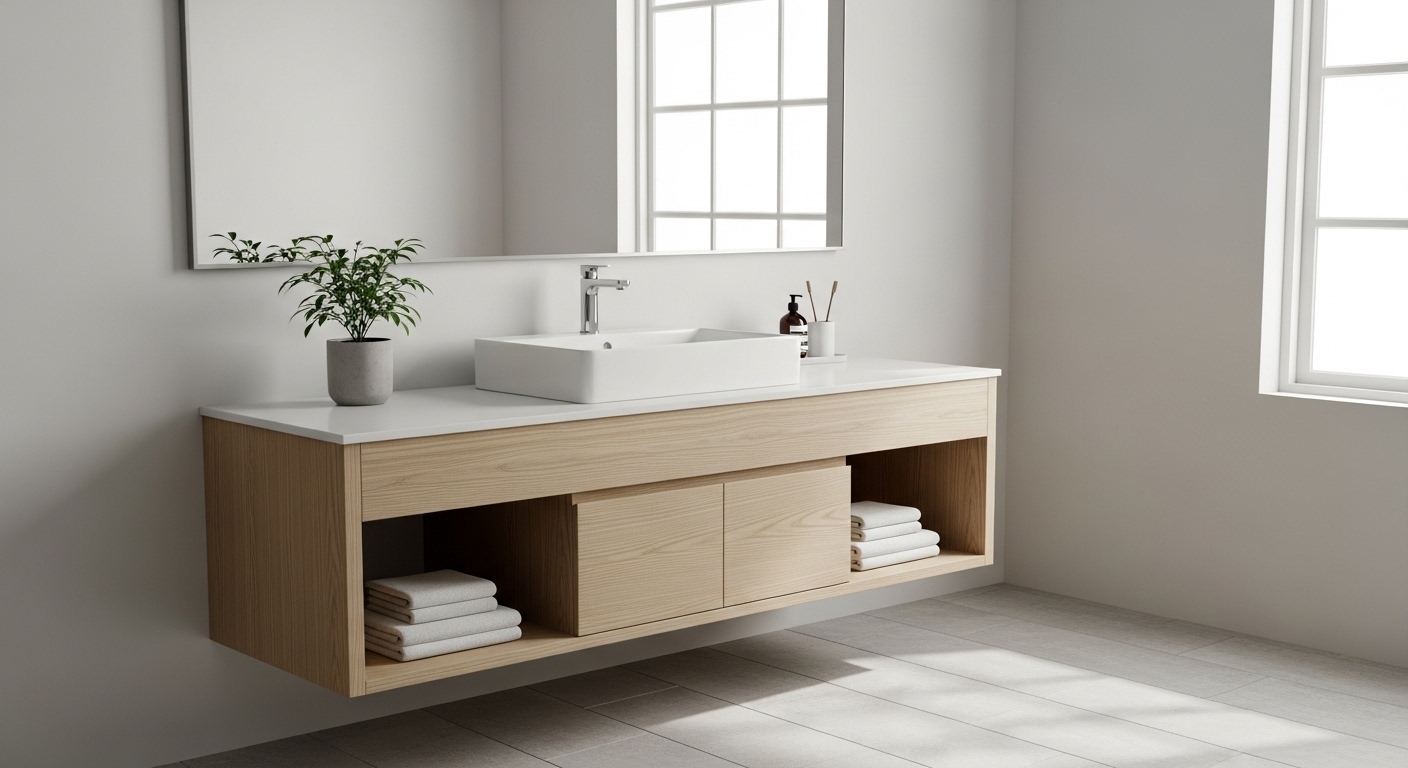
Bathroom Vanity Sizing Guide for Houston, TX Homes | Ace Kustoms Cabinets and Trim
Not sure what size bathroom vanity fits your Houston home? Ace Kustoms Cabinets and Trim (Houston, TX 77009) breaks down everything you need to know — plus custom solutions built for your exact space. Call (281) 660-3903.
Honestly, I’ve seen it happen more than I’d like to admit.
Choosing the Wrong Vanity Size Is a Costly Mistake. Here’s How Houston Homeowners Get It Right.
You found a vanity you love. The finish is perfect. The hardware is exactly what you pictured.
Then it arrives — and it’s three inches too wide for the doorway. Or it blocks the toilet. Or it leaves a gap on one side that looks like an afterthought.
This happens constantly to Houston homeowners who size vanities using generic online guides that don’t account for real bathroom layouts, older home construction quirks, or the specific proportions common in Houston-area builds from the ’70s, ’80s, and ’90s.
Getting vanity sizing right requires more than measuring wall width. It requires understanding clearance rules, plumbing rough-in locations, door swings, and how a new vanity will interact with everything else in the room.
At Ace Kustoms Cabinets and Trim — Houston, TX 77009 — we’ve helped hundreds of homeowners across Harris County and the surrounding area get this exactly right. This guide gives you the framework to do the same.
📞 Skip the guesswork. Call (281) 660-3903 for a free in-home consultation.
The Solution Cluster: How to Size Your Houston Bathroom Vanity Correctly
Each of the problems above has a clear solution. Here’s how to work through them systematically.
Solution 1: Measure Your Actual Available Space — Not Just Wall Width
Before you look at a single vanity option, take these four measurements:
- Usable wall width — measure from wall to wall, then subtract for any obstructions (door trim, light switch plates, baseboard transitions)
- Clearance in front — measure from the vanity wall to the nearest opposing fixture or wall
- Toilet centerline distance — measure from where the vanity edge will land to the center of the toilet
- Door swing radius — tape the door open and mark the arc; your vanity cannot enter that arc
Write these down before you shop. They are your hard constraints. Any vanity that violates them is the wrong vanity, regardless of how good it looks.
Use our bathroom vanity sizing guide for a printable measurement checklist you can take into the bathroom.
Solution 2: Account for Clearances Before You Fall in Love With a Size
Once you have your measurements, apply the clearance rules:
- Subtract 21 inches (minimum) from your front clearance measurement. What’s left is your maximum vanity depth.
- Confirm 15 inches from each side of the toilet centerline is clear. This determines how close the vanity edge can get to the toilet.
- Walk through your door swing arc and confirm your chosen vanity width and depth don’t intersect it.
If standard sizes don’t fit cleanly within these numbers, a custom-built vanity is the right answer — not a workaround.
Solution 3: Locate Your Plumbing Before You Choose a Vanity
Have a plumber or an experienced contractor identify your exact rough-in locations before you finalize a vanity choice. You need:
- The drain centerline position (left/right and distance from the wall)
- The supply line positions (hot and cold)
- Whether the supply lines exit the wall or the floor
Once you have those positions mapped, you can select a vanity (or commission a custom one) designed around your actual plumbing — not the other way around.
For homes in older Houston neighborhoods where plumbing is decades old, this step can also surface supply line issues worth addressing while the vanity is out anyway.
Solution 4: Choose Vanity Depth Based on Your Layout, Not Personal Preference Alone
Use this simple framework:
- Tight bathroom (less than 5 ft. wide): Consider a wall-mount or 18″ depth vanity to preserve clearance
- Standard bathroom (5–8 ft. wide): 21″ depth works well for most layouts
- Spacious master bath: 22–24″ depth gives you meaningful counter space if clearance allows
If your bathroom is an odd shape — common in converted spaces or older Houston homes with additions — a custom vanity built to a specific depth is often more cost-effective than trying to adapt a standard piece.
Our team at Ace Kustoms has built vanities at non-standard depths for clients throughout Harris County. The bathroom vanity sizing guide on our site walks through depth selection in more detail.
Solution 5: Choose Height Based on Who Uses the Bathroom Daily
Here’s the general guidance:
| Primary User(s) | Recommended Vanity Height |
|---|---|
| Children under 12 | 30–32 inches |
| Average adults | 34–36 inches |
| Taller adults (6 ft.+) | 36 inches |
| Mixed household | 34 inches (best compromise) or dual-height custom build |
| ADA / accessibility needs | 34 inches max with knee clearance underneath |
When a household has genuinely mixed needs, a custom vanity with a tiered countertop or a split double vanity at two different heights is a real option — one our team has executed for clients in The Heights, Midtown, and Cypress.
📞 Not sure what height works best for your household? Call (281) 660-3903 and we’ll work through it with you.
Side-by-Side Comparison
| Feature | Small (24″-30″) | Standard (36″-48″) | Double (60″-72″) |
| Counter Space | Minimal | Moderate | Massive |
| Storage Capacity | 1-2 small cabinets | Multiple drawers/cabinet | 4+ drawers/2 cabinets |
| Resale Value | Low | Moderate | High |
| Typical Depth | 18″ – 21″ | 21″ – 22″ | 21″ – 24″ |
| Plumbing Needs | 1 Sink line | 1 Sink line | 2 Sink lines |
Why Custom Beats Off-the-Shelf for Most Houston Bathrooms
Standard vanities are built around average bathrooms. Houston’s housing stock — ranging from 1940s bungalows in Montrose to new construction in Fulshear — is anything but average.
When you go custom with Ace Kustoms Cabinets and Trim Houston, TX 77009, you get:
- A vanity built to your exact wall width, no filler strips needed
- Depth calibrated to your specific clearance constraints
- Height set for your household’s daily users
- Plumbing cutouts positioned for your actual rough-in locations
- Materials selected to handle Houston’s humidity without warping or delaminating
- A finish, hardware, and style chosen to complement the rest of your bathroom
That last point matters more than people realize. Houston’s Gulf Coast humidity is hard on lower-quality cabinet materials. We select and build with that environment in mind — so your vanity looks and functions as well in year 10 as it does on install day.
What to Expect When You Work With Ace Kustoms
Our process is straightforward:
- Call us at (281) 660-3903 — we’ll discuss your bathroom, your goals, and your timeline
- In-home consultation — we come to your home, take every measurement that matters, photograph the space, and identify any constraints
- Design & quote — we present a custom design with a clear, itemized price. No surprises.
- Build & install — fabrication and installation handled by our team, on schedule
- Final walkthrough — we don’t leave until everything is right
We’re HomeAdvisor Screened & Approved, HomeAdvisor Elite Service rated, and BBB Accredited. With 600+ custom projects completed and a 60-person team, we bring real scale and real accountability to every bathroom project.
Frequently Asked Questions
What is the most common vanity size for a Houston master bathroom?
Double vanities in the 60–72 inch range are most common in master baths in Houston-area homes. Single vanities at 36–48 inches are typical for secondary bathrooms. The right size depends on your specific layout and clearance, not just what’s most popular.
Can I install a larger vanity by removing a wall or moving plumbing?
Sometimes, yes. Moving plumbing is possible but adds cost and complexity. Our team can assess whether the investment makes sense given your goals. In many cases, a custom vanity built to your existing rough-in location is a smarter path.
How do I know if my bathroom can fit a double vanity?
A double vanity needs at minimum 60 inches of wall space, plus appropriate clearance in front and on either side of the toilet. Use the clearance framework above, or call us for a free in-home assessment.
What materials hold up best in Houston’s humidity?
For Houston bathrooms, we recommend solid wood or plywood box construction with a moisture-resistant finish, rather than MDF or particleboard. Hardware should be solid brass or stainless to resist corrosion. We factor all of this into every custom build.
How long does a custom vanity take from consultation to installation?
Most projects run 2–4 weeks from approved design to completed installation. We’ll give you a firm timeline during your consultation.
Does Ace Kustoms handle the full bathroom remodel, or just the vanity?
Both. We can build and install just the vanity, or handle a full bathroom remodel including countertops, tile, lighting, and trim work. We work around your scope and your budget.
What if I already bought a vanity and it doesn’t fit right?
Call us. We’ve helped clients work through exactly this situation — whether that means building a filler piece, adjusting the install approach, or replacing the vanity with a custom-built solution. Don’t try to force a wrong-size vanity into place.
Conclusion: Get the Fit Right
At the end of the day, a vanity is a tool. It needs to hold your stuff, provide a surface for your routine, and let you move freely through your space. Don’t let a “great deal” on a pre-made cabinet dictate a layout that doesn’t work for you.
If you’re struggling with a weird layout or you want to maximize every square inch with custom storage solutions, we’d love to help. We’ve spent years crafting vanities that fit perfectly into Houston area homes, from Montgomery County to Galveston.
Give us a shout and let’s look at your floor plan. We can help you decide if that double sink is a dream or a logistical headache before you spend a dime.
Would you like me to help you sketch out a rough layout based on your bathroom’s specific wall-to-wall measurements?
Why Custom Vanities Are Better for Non-Standard Houston TX Bathrooms
Many homes across Houston TX, including older properties in Pasadena, Humble, and Galveston, were built with unique bathroom layouts that do not work well with standard store-bought vanity sizes. Pre-made bathroom vanities often leave wasted space, awkward gaps, or poor storage functionality. A custom bathroom vanity is designed specifically for your exact bathroom dimensions, helping maximize storage, improve traffic flow, and create a cleaner luxury appearance.
At Ace Kustoms, we build fully customized bathroom vanities tailored to your space, style, and countertop preferences. Whether you need floating vanities, double sink vanities, compact vanity solutions, or luxury built-in storage, our team creates solutions that fit perfectly in both modern and older Houston TX homes.
If you are planning a complete renovation, explore our bathroom remodeling services for custom layouts, cabinetry, and space-saving upgrades designed for Houston homeowners.
To protect your investment and keep your vanity looking new for years, read our guide on how to care for custom bathroom vanities.
Choosing the right countertop also matters for durability and moisture resistance. Learn more about our solid surface countertop options for Houston bathrooms.
Considering a full bathroom upgrade? Compare resale value and functionality in our guide: Walk-In Shower vs Bathtub for Home Value .
Bathroom Vanity FAQ – Houston TX
What is the standard bathroom vanity depth in TX?
The standard bathroom vanity depth is typically between 20 and 22 inches. However, many Houston TX homes require custom sizing for better space efficiency and storage.
What vanity size is best for a small Houston TX bathroom?
For smaller bathrooms, vanities between 24 and 36 inches wide are often ideal. Custom-built vanities help maximize storage while maintaining comfortable movement space.
Can I get a custom vanity in a non-standard size in Houston?
Yes. Ace Kustoms designs and builds custom bathroom vanities in any size to fit unusual layouts, older homes, and luxury bathroom renovations across Houston TX.
What countertop material is best for bathroom vanities in Houston TX?
Solid surface countertops, quartz, and moisture-resistant materials are popular choices for Houston bathrooms because they handle humidity well and are easy to maintain.


Comments are closed