
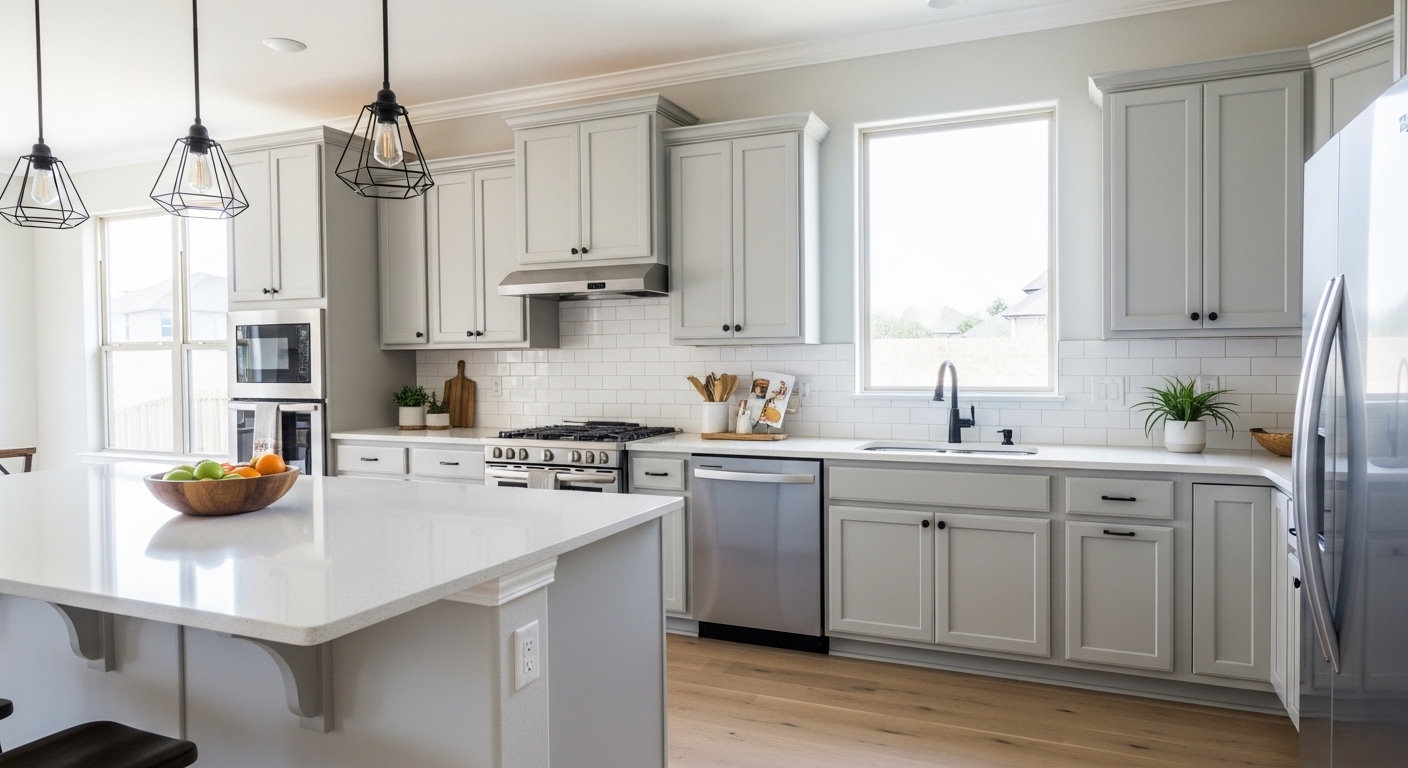
You just closed on a brand-new home in Magnolia. Months of waiting, decisions, paperwork, and now — you’re finally in.
And the kitchen looks… fine. Totally fine. It’s clean, it’s new, everything works. But somewhere around week three of living there, you start noticing it. The cabinet doors don’t have quite the same weight as you saw in your friend’s kitchen. The finish has a kind of plasticky quality in the afternoon light. The drawer front comes a little loose when you open it. And the more you look, the more you see: these are the cabinets the builder put in because they had to put something in.
That’s builder-grade. And if you’ve moved into a new construction home in Magnolia, there’s a decent chance you’re already living in it.
Here’s the thing — you’re not imagining it, and you’re definitely not being snobby. Builder-grade cabinets are a deliberate product category designed to look acceptable from a distance, meet code, and photograph reasonably well for the listing. They’re not designed for the way you actually live.
But there’s also real hope here. Upgrading builder-grade cabinets in a new build is one of the most impactful things you can do for a home — and because new builds are so consistent in their layout and construction, the process is often more straightforward than a full gut renovation of an older home.
Let’s talk through what you’re actually dealing with, what your options are, and how to think about this without getting overwhelmed.
What “Builder-Grade” Actually Means (and Why It Matters)
Builder-grade is an industry term, but what it really means in practice is: the minimum acceptable quality at the highest possible margin for the developer.
It’s not necessarily cheap — you probably paid for those cabinets as part of your home’s purchase price. It’s just that the value equation for the builder is completely different from yours. They need cabinets that install fast, look fine in photos, and don’t generate warranty calls in the first year. That’s it. Your preference for how the kitchen feels to cook in every morning? Not really their problem.
Here’s what builder-grade cabinetry typically involves:
Particleboard or MDF box construction. The cabinet boxes themselves are usually made of particleboard — pressed wood chips and glue — rather than plywood. It’s cheaper, heavier, and doesn’t hold up as well in humid environments. In Montgomery County’s climate, where summers are punishing, this matters.
Thermofoil or thin laminate doors. A lot of builder-grade cabinet doors are made with a thin vinyl film heat-pressed over an MDF substrate. They look like painted wood until they don’t — usually starting at the edges and corners, where the film peels away from humidity and heat. Once that starts, there’s no fixing it.
Overlay hinges and basic hardware. The hinges and drawer slides are functional but rarely smooth. Soft-close is sometimes included as an upgrade, but the standard option is the kind that slams if you let it go.
Limited depth and storage design. Standard builder cabinets are designed around what’s cheap to produce at scale, not around actual kitchen workflow. You get 12-inch upper cabinets that can barely fit a dinner plate standing upright. Lower cabinets with one fixed shelf and no pull-outs. Dead corner space that accumulates forgotten appliances.
None of this is a catastrophe. But it does mean you’re working with a kitchen that’s designed to look good on closing day, not to work well for the next 20 years.
The Magnolia New Build Situation Specifically
Magnolia has seen a lot of growth, and a lot of new construction — which means a lot of homeowners in similar situations. If you’re in a development built in the last five or six years out here in Montgomery County, there’s a good chance you’re working with one of a handful of builder cabinet lines that get used repeatedly across developments.
That consistency is actually useful. It means cabinet shops and installers in this area have seen your kitchen before. They know the standard ceiling heights, the typical island configurations, the way the pantry cabinets are usually situated. There’s less guesswork involved than you’d have in a 1970s ranch renovation.
It also means the upgrade path is well-worn. Ace Kustoms has worked with Magnolia homeowners on exactly this kind of project — coming into a new build, assessing what’s there, and figuring out the smartest way to get to the kitchen you actually want.
Your Options: What Does “Upgrading” Actually Look Like?
This is where homeowners sometimes feel stuck, because “upgrading cabinets” can mean a lot of different things. Let me break down the actual paths available to you.
Option 1: Replace Everything
Full cabinet replacement means pulling out the existing builder-grade boxes and doors and installing new custom or semi-custom cabinetry. This is the most comprehensive option — and honestly, if your builder-grade is particularly low quality or your kitchen layout doesn’t work for how you cook, it’s often the right one.
The benefit is that you get to start completely fresh. New box construction in plywood. New door styles, finishes, and hardware. A layout that actually makes sense for your family. Pull-out shelves, soft-close everything, proper corner solutions.
The cost is real — expect to budget $12,000–$30,000+ for a full Magnolia kitchen depending on size and materials — but so is the result. This is a kitchen that adds genuine value to your home and, more importantly, makes daily life better.
Option 2: Reface the Existing Cabinets
Cabinet refacing keeps the existing box structure in place and replaces only the doors, drawer fronts, and visible face frames. New veneer is applied to the boxes to match.
This is a legitimate option if — and this is key — your existing cabinet boxes are structurally sound and the layout works for you. If the particleboard is in good shape and you mainly want a different look, refacing can save you meaningful money.
The catch: if your boxes are already showing stress from humidity, or if your kitchen layout just doesn’t function well, refacing won’t fix any of that. You’ll have better-looking cabinets with the same daily frustrations.
Option 3: Selective Replacement
Sometimes the smartest move is in between. Maybe your upper cabinets are fine but the lower cabinets are too shallow and have no pull-out storage. Maybe the kitchen is good but the pantry cabinet is unusable. Replacing only the problem areas while leaving functional sections intact can dramatically improve your kitchen at a fraction of full replacement cost.
This approach requires a little more planning — you need to match finishes and door styles — but it’s often the most practical path for homeowners who like most of what they have but can’t stand specific pain points.
What to Prioritize When You’re Upgrading
Here’s where I’d push back on how most people approach this. The instinct is usually to focus on what looks different — the door style, the color, the hardware. And those things matter! But the upgrades that change how you feel in your kitchen every day are usually the functional ones.
Drawer slides first. I’m serious. Full-extension, soft-close drawer slides are the single upgrade that gets commented on most by people who’ve made the switch. You open a drawer and it glides out completely, silently, and closes without a sound. After years of yanking at a stuck drawer or wincing at the slam, it’s genuinely surprising. Budget for quality slides everywhere.
Lower cabinet pull-outs. The standard builder-grade lower cabinet has one fixed shelf and a door. Every pot, pan, and appliance lives in a dark cavern where the thing you need is always at the back. Pull-out shelves fix this. They’re not glamorous, but they change how the kitchen functions completely.
Corner solutions. Builder cabinets almost always default to blind corners — dead space where you lose square footage to a cabinet you can barely reach into. A proper lazy Susan or pull-out corner solution turns that dead zone into usable storage.
Hardware that has some weight to it. The pulls and knobs on builder-grade cabinets are often stamped metal that feels thin and cheap in your hand. Swapping to pulls with actual heft — something that feels substantial when you grab it — changes the perceived quality of the whole kitchen more than almost any other single change.
The Things Nobody Tells You About Upgrading New Build Cabinets
A few real insights worth having before you start this process:
New builds aren’t always level. You’d think they would be — they’re brand new! But new construction settles, and the framing isn’t always as precise as you’d expect. A good cabinet installer accounts for this. A less experienced one installs cabinets that look slightly off in a way you can’t quite name but always notice.
The countertop question comes first. If you’re replacing cabinets, you’re likely replacing countertops too. The sequence matters: cabinets go in before countertops, so you need to have your countertop decision made — and ideally your countertop templated — shortly after cabinet installation. Plan this in advance, not as an afterthought.
Matching existing cabinets is hard. If you’re doing selective replacement, finding an exact match for existing builder-grade doors and finishes is often impossible. The builder used a proprietary product line. This is actually a reason why many homeowners end up doing full replacements — because partial replacement means the new section looks different enough to bother you.
Permits may or may not be required. In Montgomery County, cosmetic cabinet replacement typically doesn’t require a permit. But if you’re moving cabinet locations, adding an island, or changing anything structural, check with your local building department. Ace Kustoms can help you navigate what applies to your specific project.
FAQ: Questions Magnolia Homeowners Actually Ask
How soon after moving in should I upgrade? Do I need to wait?
There’s no required waiting period, but practically speaking, most homeowners wait 6–12 months. You’ll have a much clearer picture of what actually bothers you after you’ve lived in the space through different seasons and routines. The things that seem annoying in month one sometimes turn out to be minor. Other things — like that one corner cabinet you can never reach into — get more infuriating every week.
Can I keep my existing countertops if I replace the cabinets?
Sometimes, but it’s tricky. Existing countertops are templated and installed specifically to the cabinet configuration underneath them. If you change the cabinets, you’ll almost certainly need new countertops too. It’s rare that the old countertop sits correctly on new cabinet boxes, especially if you’re changing anything about the layout.
What’s the most cost-effective upgrade that makes the biggest visual difference?
New doors and hardware, with the boxes staying in place, is typically the best return on investment for pure aesthetics. If the box construction is solid and the layout works, door replacement gives you a dramatically different look for meaningfully less than full replacement.
How long does a cabinet replacement take in a typical Magnolia kitchen?
For a full kitchen replacement, expect the project to take 3–6 weeks from final measurements to completion — including lead time for the cabinets to be built, delivery, and installation. The actual installation itself is usually 2–4 days for a standard kitchen. Plan for your kitchen to be out of commission during that window.
Will upgrading my cabinets add value to my home?
Yes, though the math is nuanced. Kitchen renovations have strong return on investment, but you rarely recoup 100% of the cost in resale value. The real value is in how you experience your home every day for the years you’re living there. If you’re planning to sell in two years, the calculus is different than if this is a 10-year home.
Putting It All Together
Here’s the honest version of where to start: live in your kitchen for a bit if you haven’t already. Make a list — not of what looks bad, but of what frustrates you. The drawer that jams. The corner cabinet you avoid. The pantry that doesn’t hold what it should. The surface that always seems cluttered because there’s nowhere logical to put things.
That list is your upgrade plan. Not a mood board from Instagram. The real friction points of your actual life in this kitchen.
Once you have that, you can have a real conversation about whether refacing makes sense, or selective replacement, or starting fresh. The answer is different for every kitchen and every family.
If you’re in Magnolia and starting to figure this out, reach out to Ace Kustoms for a conversation about what upgrading your builder-grade cabinets actually looks like for your home. No pressure, no pitch — just a realistic look at what’s possible and what it costs.
You moved into a new home. It should feel like yours. The kitchen is usually the best place to start.


Comments are closed