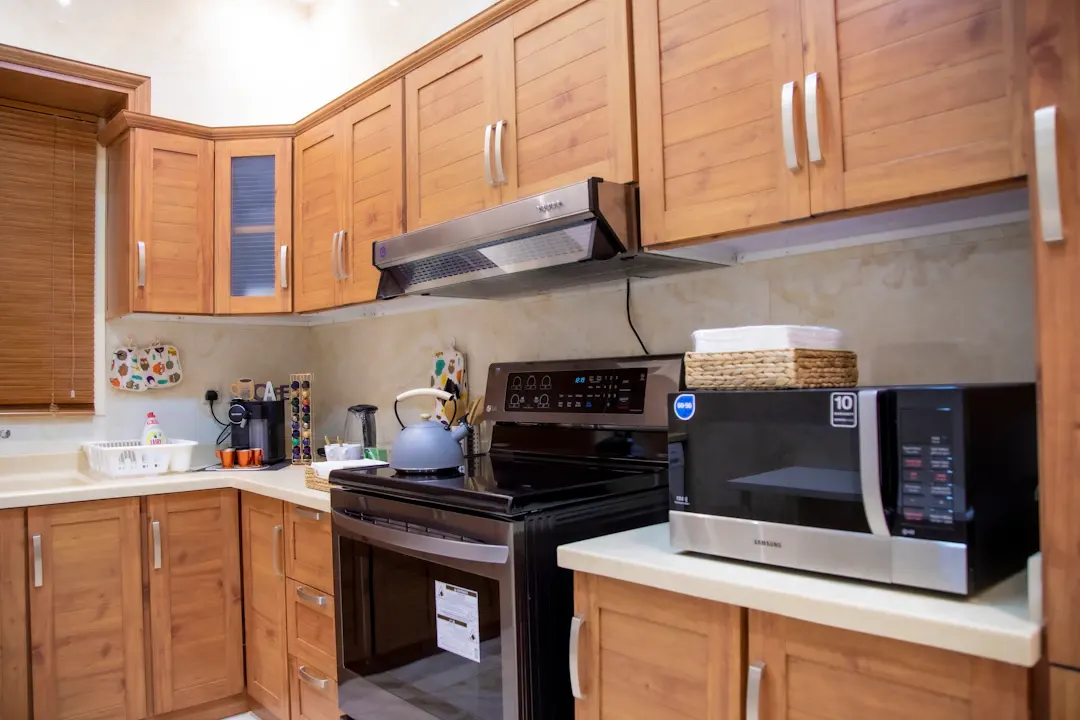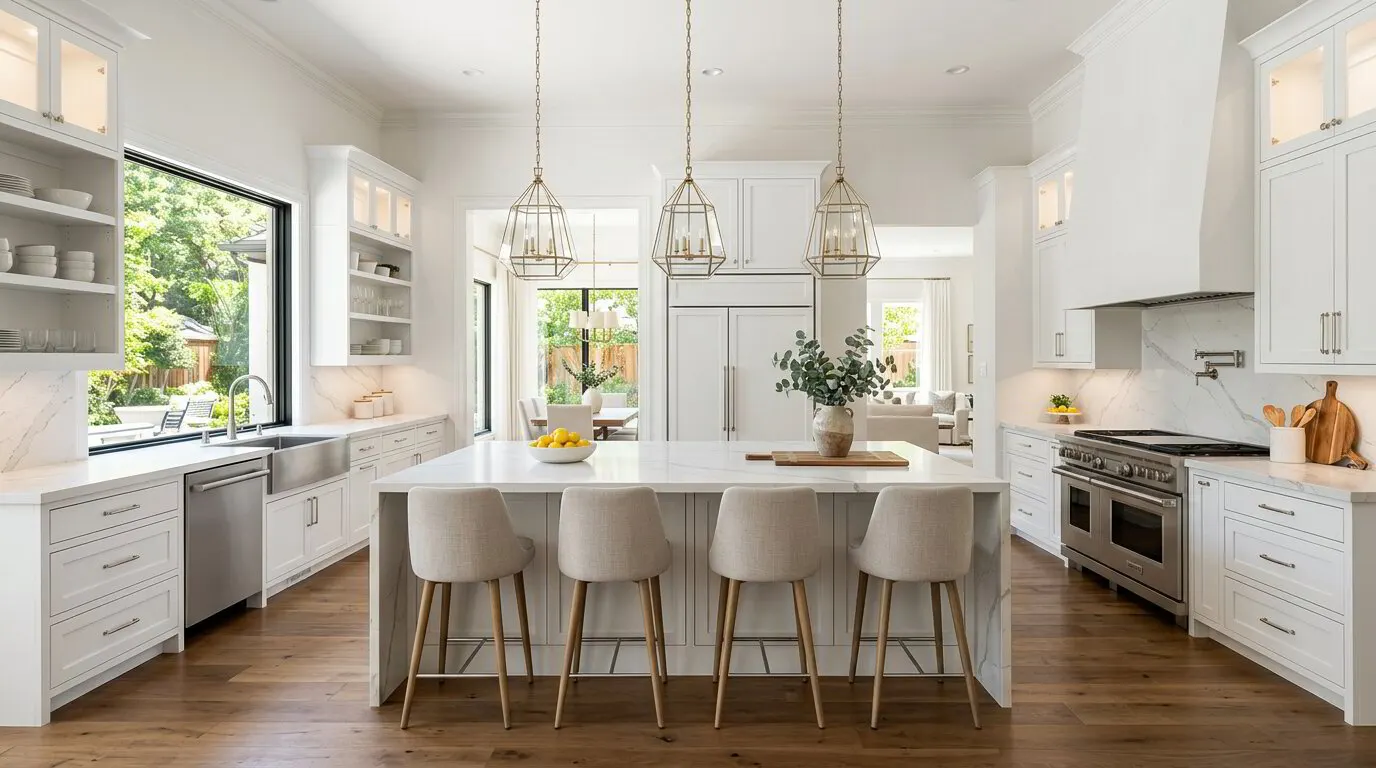
Custom Cabinets vs. Pre-Made Cabinets: Fit Test
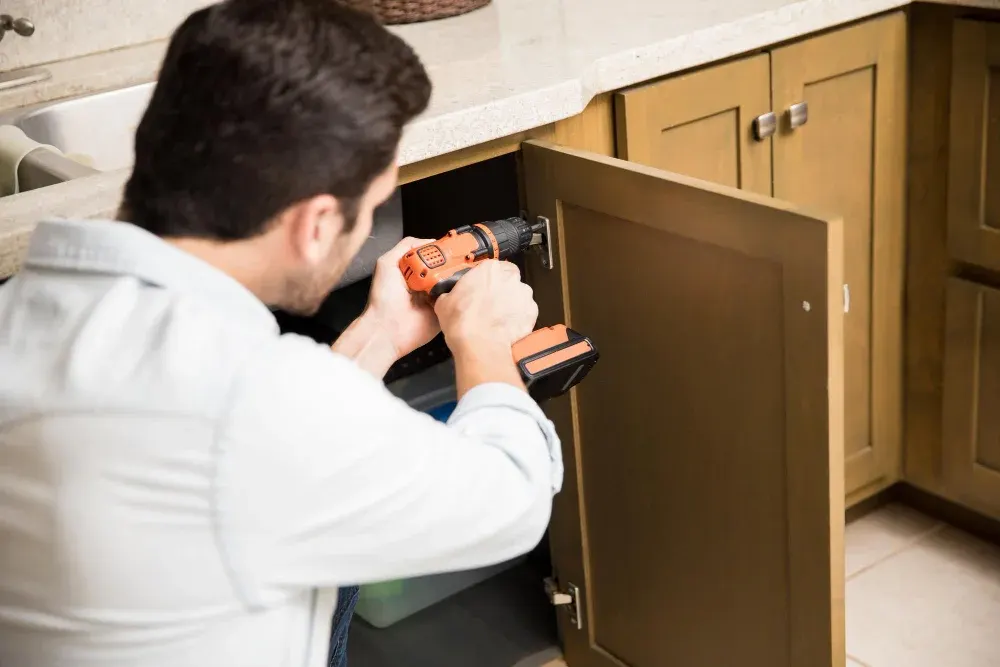
Every cabinet decision eventually comes down to fit. Does the cabinet fit the wall? Does it fit what you need to store? Does it fit the way you cook, the budget you have and how long you plan to stay in the house? When people compare custom cabinets vs. pre-made cabinets, they usually focus on price first. A better approach is to run your room through a fit test and see which option actually works.
This post is for Houston homeowners deciding between ready-made cabinet lines, whether stock from a home center or semi-custom from a catalog, and fully custom cabinets built for the room. It covers how each type is made, where pre-made cabinets fit well, where they fall short and how to evaluate your own kitchen, bathroom or built-in space.
We build custom cabinets in our Houston shop, but we will be straightforward: pre-made cabinets are the right answer for some rooms. The fit test below helps you tell which kind of room you have.
How Pre-Made and Custom Cabinets Are Built
Understanding how each product is made explains most of the differences in fit and longevity.
Pre-made cabinets
Pre-made, or stock, cabinets are manufactured in large runs in fixed sizes. Base cabinets commonly come in widths that step up by 3 inches, from about 9 to 36 inches or more, with standard depths of 24 inches for bases and 12 inches for uppers. Heights are also standardized. Semi-custom lines add more width options, modified depths and more finish choices, but still work from a fixed catalog.
Many stock lines use particleboard or MDF for boxes, thinner backs and stapled drawer boxes, though better lines offer plywood upgrades. Finishes are applied in a factory and are often durable, but options are limited.
Custom cabinets
Custom cabinets are designed for a specific room and built to its measurements. Width, height, depth, door style, wood species, finish and interior layout are all open. We build with furniture-grade plywood boxes and solid hardwoods, with no particleboard, and finish in our shop before installing with the same crew that built them.
For a fuller comparison that includes semi-custom options, see our guide to stock vs. semi-custom vs. fully custom cabinets.
The Fit Test: Six Questions About Your Room
Run your space through these questions. Each "yes" points toward custom.
- Do your wall lengths land between standard sizes? If a wall is 127 inches long, standard cabinets cannot fill it exactly. The leftover space becomes filler strips, which is lost storage.
- Are your walls out of square or out of plumb? Older Houston homes, especially 1950s to 1970s ranch houses, rarely have perfectly square corners. Pre-made boxes leave visible gaps or need heavy scribing.
- Do you have soffits, beams, sloped ceilings or tall ceilings? Standard upper heights often leave awkward gaps above or get blocked by soffits.
- Is there a window, door or vent close to a corner? Standard sizes often cannot work around these without big fillers.
- Do you need nonstandard depth? Shallow pantries, deep pot drawers, extra-deep islands and narrow hallway built-ins all fall outside catalog sizes.
- Do you have specific storage needs? Large appliance garages, tray dividers, spice pull-outs sized to your jars, mixer lifts or charging drawers are easier to build in than to retrofit.
If you answered "no" to most of these, a pre-made line may fit your room well. If you answered "yes" to three or more, custom cabinets will likely give you noticeably better fit and storage.
Where Filler Strips Cost You
Filler strips are the hidden cost of pre-made cabinets. They are flat panels used to close the gap between standard-width boxes and the actual wall length. A few inches here and there seem harmless, but they add up.
Consider a kitchen with four wall runs. If each run ends up with 2 to 4 inches of filler on each end, you can lose a foot or more of usable cabinet width across the kitchen. That is the equivalent of an entire drawer bank. Corner fillers also reduce the usable space in blind corners.
Custom cabinets can be built to fill each run, with only small scribe strips where needed to meet uneven walls. That space goes to storage instead of decoration.
Custom Cabinets vs. Pre-Made Cabinets Side by Side
| Factor | Pre-made (stock/semi-custom) | Custom |
|---|---|---|
| Sizing | Fixed widths, standard depths | Built to exact room measurements |
| Fit in older homes | Gaps, heavy fillers, visible scribing | Scribed to walls, leveled to floors |
| Box material | Often particleboard or MDF; plywood upgrade sometimes | Furniture-grade plywood |
| Door and frame | Factory hardwood, MDF or thermofoil | Solid hardwoods, any species |
| Finish options | Limited catalog | Any stain or paint color |
| Storage layout | Standard inserts | Designed around your items |
| Lead time | Often faster for in-stock lines | Several weeks for build and finish |
| Up-front cost | Lower | Higher |
| Lifespan | Varies; lower-end lines wear faster | Built for decades with maintenance |
Where Pre-Made Cabinets Make Sense
Pre-made cabinets are a reasonable choice in some situations:
- Square, simple rooms in newer homes where walls land close to standard widths.
- Rental properties or homes you plan to sell soon, where budget matters more than long-term fit.
- Garages and utility areas where finish and fit are less important, though even there durability matters.
- Short timelines where in-stock cabinets are available quickly.
If you go pre-made, look for plywood box upgrades, solid wood doors, full-extension drawer slides and soft-close hinges. Those choices make a big difference in how long the cabinets last in Houston humidity.
A hybrid approach
Some homeowners split the difference. They use pre-made cabinets in a laundry room or garage and put custom work where fit and appearance matter most, such as the kitchen, primary bath vanity or a living room media wall. Others keep a newer set of stock base cabinets in good condition and add a custom island or pantry wall that the catalog could not supply. A hybrid plan can make sense, as long as finishes and door styles are coordinated so the rooms that sit next to each other do not clash.
Watch the particleboard question
The biggest durability gap between pre-made and custom cabinets is usually the box, not the door. Particleboard swells permanently when it gets wet, and sink bases, dishwasher sides and laundry cabinets get wet sooner or later in a Gulf Coast house. If a pre-made line offers a plywood box upgrade, it is often the single most worthwhile option to pay for.
Where Custom Cabinets Earn Their Cost
Custom cabinets earn their higher cost in rooms where the fit test reveals problems pre-made cabinets cannot solve cleanly.
Older homes
Ranch homes from the 1950s through the 1970s around Houston often have settled slabs, uneven walls and soffits. Custom cabinets can be scribed and leveled to those conditions, so the finished kitchen looks intentional rather than patched together.
New-construction upgrades
Builder-grade cabinets in new homes across Katy, Cypress and Fulshear are often particleboard boxes in a limited range of finishes. Homeowners frequently replace them within a few years. Planning custom kitchen cabinets early can avoid paying for the kitchen twice.
Bathrooms and specialty rooms
Bathrooms are often tight, with plumbing in fixed locations. A custom bathroom vanity can be sized to the inch, with drawers arranged around the trap rather than a single cabinet with wasted space. Built-ins for offices, mudrooms and media walls almost always benefit from custom sizing.
Long-term owners
If you plan to stay for a decade or more, plywood boxes and solid wood doors will outlast most stock lines, which reduces the long-run cost of ownership.
Comparing Cost Realistically
Pre-made cabinets cost less up front. For a mid-size Houston kitchen, stock cabinets may run from a few thousand dollars for basic lines to well over $15,000 for upgraded semi-custom, before installation. Custom cabinetry for the same kitchen often falls in a general planning range of roughly $18,000 to $45,000 or more, including installation, depending on size, wood and finish.
Those are general planning ranges, not quotes. When comparing, include:
- Installation labor and any extra time for fillers and scribing.
- Upgrades like plywood boxes, soft-close hardware and pull-outs.
- Finished panels for exposed ends and islands.
- The likely replacement timeline.
Our post on when custom cabinets are a worthwhile investment explores the long-term value question in more detail.
Measure before you decide
The most useful thing you can do before choosing is measure your walls and sketch the room. Note window and door locations, ceiling height, soffits, outlet and plumbing locations, and any spots where walls look out of line. Even a rough sketch shows quickly whether standard sizes will fit or leave gaps.
If you would rather have a professional measure and walk you through both options, that is what our in-home consultation is for. We will tell you honestly if a room is a good candidate for pre-made cabinets.
Find the Right Fit for Your Home
Custom and pre-made cabinets both have a place. Pre-made lines fit square, simple rooms on a tight budget or schedule. Custom cabinets fit the rooms that are not standard, which in Greater Houston includes plenty of older ranch homes, new-construction kitchens with builder-grade limits and bathrooms with tight plumbing.
If you want help running your room through the fit test, schedule a free in-home estimate or call (281) 660-3903. We serve Houston and the surrounding counties, including Fort Bend County, and we will measure, discuss options and give you a written estimate.
Frequently asked questions
What is the main difference between custom and pre-made cabinets?
Are pre-made cabinets always cheaper?
How do I know if my kitchen needs custom cabinets?
Can custom cabinets be installed in a new-construction home?
Planning a project like this?
Get a free in-home estimate from the team that builds and installs the work.