How to Vet a Custom Cabinet Maker in Houston
Hiring a cabinetmaker is not like buying an appliance. You are choosing a person and a team who will design something for your home, build it by hand and install it in the most-used rooms you have. The finished product does not exist yet when you sign, so the only thing you can evaluate is the company. Knowing how to vet a custom cabinet maker in Houston protects your budget, your schedule and your home.
This guide is for homeowners across Greater Houston who are collecting estimates for kitchen cabinets, vanities or built-ins and want a practical way to compare companies. We will cover what to ask, what to look at, what belongs in a written estimate and the warning signs that should make you pause.
We are a cabinetmaker ourselves, so we have an obvious interest here. The checks below are the same ones we would want any homeowner to run on us, and they apply no matter who you hire.
Understand What "Custom" Means to Each Company
The word custom is used loosely. Some companies build every box to your measurements in their own shop. Others order semi-custom cabinets from a factory with size modifications and install them. Some subcontract both the building and the installing.
None of those models is automatically wrong, but you should know which one you are buying. Ask directly:
- Are the cabinets built in your own shop, or ordered from a manufacturer?
- If ordered, which manufacturer and which product line?
- Can sizes be built to the fraction of an inch, or only in standard increments?
- Who designs the layout, and who produces the drawings?
If you are unclear on the differences, our breakdown of stock vs semi-custom vs fully custom cabinets explains what each tier typically includes.
Check Materials and Construction Details
Two estimates for "custom maple cabinets" can describe very different products. The details that matter most are usually not visible once cabinets are installed, which is why you need them in writing.
Questions about materials
- What are the cabinet boxes made from: furniture-grade plywood, MDF or particleboard?
- What are the face frames and doors made from, and what species?
- How are drawer boxes built? Dovetailed hardwood, doweled plywood or stapled particleboard?
- What hinges and drawer slides are used? Are they soft-close and full-extension?
- What finish system is used, and is it applied in the shop or on site?
What to look for in samples
Ask to see a sample door, drawer box or finished cabinet. Look at:
- Joinery: tight, square joints without gaps or filler.
- Edges: smooth, consistent profiles on doors and frames.
- Finish: even sheen, no drips, no rough spots on edges and backs.
- Interior: finished or clean interior surfaces rather than raw particleboard.
At Ace Kustoms, we use solid hardwoods and furniture-grade plywood and do not use particleboard boxes. You do not have to choose us to benefit from asking every company the same question.
Visit the Shop or See Work in Progress
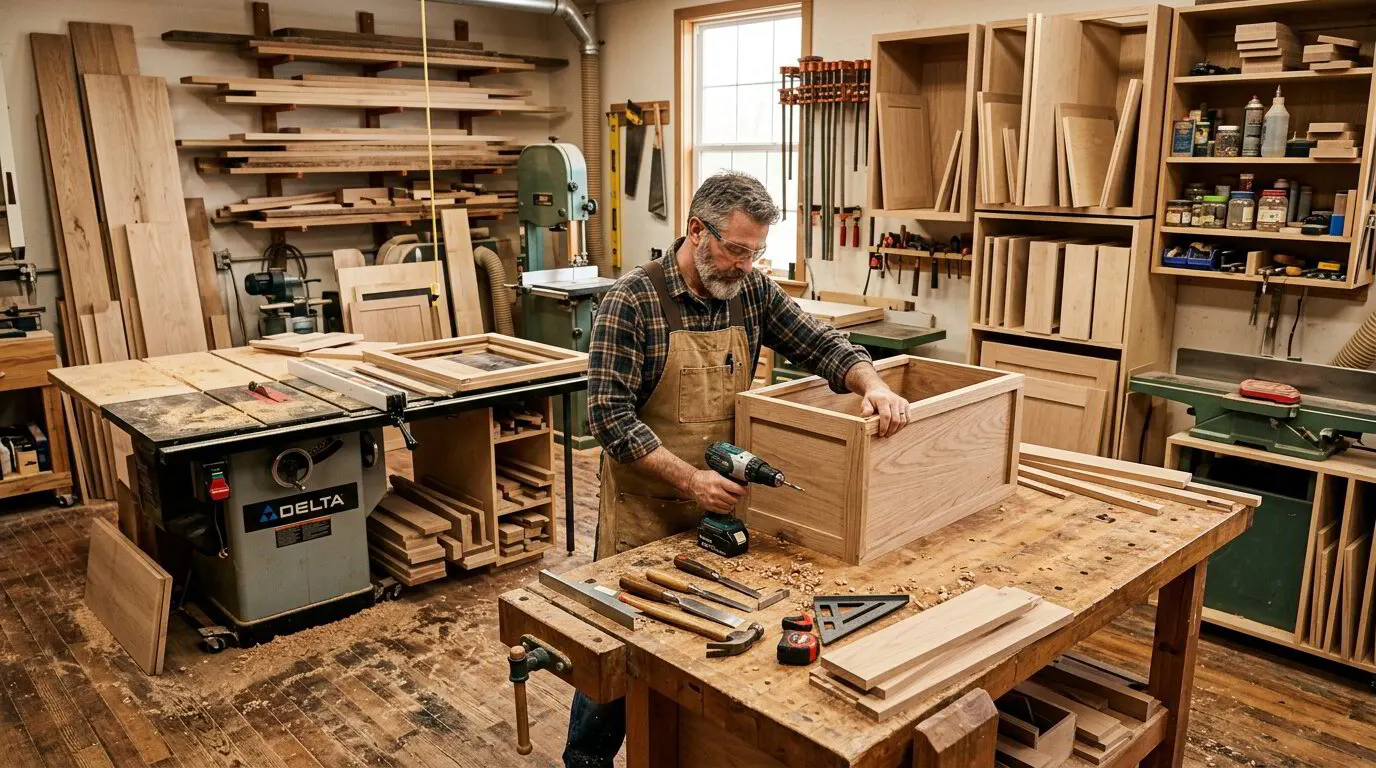
A company that builds locally should be comfortable showing you where and how. A shop visit, or at least photos and video of current work, tells you a lot:
- Whether the work is actually done in-house.
- The equipment and organization of the shop.
- How projects are labeled and tracked.
- Construction quality on pieces in progress, before finish hides anything.
Our own about page describes how we run our Houston shop, and our gallery shows finished work. Any company you are considering should offer something similar so you can judge for yourself.
Confirm Insurance, Installers and Accountability
Insurance
Ask for proof of liability insurance, and if the company has employees on your property, ask about workers' compensation coverage or how injuries are handled. A reputable company provides a certificate without hesitation.
Licensing and permits
Requirements vary by the type of work and by city. Cabinet installation alone often does not need a permit, but plumbing, electrical and structural changes during a remodel usually do. Ask who pulls any needed permits and who performs licensed trades such as plumbing and electrical.
Who installs
This is one of the most important questions. If the shop builds the cabinets but a separate crew installs them, who is responsible when a door does not align or a filler is missing? With one team handling design, building and installation, as we do, there is a single point of accountability. With multiple companies, get clarity in writing on who fixes what.
Compare Written Estimates Line by Line
A good estimate is detailed enough that you could hand it to another cabinetmaker and get a comparable price. Use this table as a checklist when comparing estimates.
| Item | What a clear estimate includes |
|---|---|
| Scope | Rooms, cabinet runs, islands, built-ins included |
| Materials | Box material, door species, drawer box construction |
| Door style and finish | Profile, paint or stain, sheen |
| Hardware | Hinges, slides, knobs and pulls, or an allowance |
| Accessories | Pullouts, organizers, trash units, lighting |
| Installation | Included or separate; removal and disposal of old cabinets |
| Countertops | Included, coordinated or excluded |
| Schedule | Estimated design, fabrication and install timeframes |
| Payment schedule | Deposit, progress payments, final payment |
| Warranty | What is covered, for how long, and how claims work |
If one estimate is far lower than the others, look for what is missing. Common gaps include installation, hardware, crown molding, fillers and end panels, disposal of old cabinets and countertop coordination.
As a general planning range in Greater Houston, custom kitchen cabinetry often falls somewhere between roughly $500 and $1,200 or more per linear foot depending on materials, door style, finish and complexity. Use that only to sanity-check estimates; the written estimate based on your actual kitchen is what counts.
Ask About Process, Communication and Warranty
How a company runs a project affects your experience as much as how it builds cabinets.
- Design process: Will you get drawings to approve? How many revisions are included?
- Samples: Will you see real door and finish samples in your home's light?
- Change orders: How are changes priced and documented after approval?
- Schedule updates: Who is your contact, and how will you be updated?
- Final walkthrough: Is there a walkthrough to catch adjustments before final payment?
- Warranty: What does the craftsmanship warranty cover, such as joinery and finish, and what is excluded, such as water damage from plumbing leaks?
Our article on choosing a local custom cabinetmaker with nine checks covers additional questions about communication and project management.
Red flags worth slowing down for
Not every red flag means a bad company, but each one deserves a direct question:
- A one-line estimate with no materials or scope listed.
- Pressure to sign the same day for a special discount.
- A large payment demanded before any design work is approved.
- Reluctance to provide proof of insurance.
- No physical shop address, or vague answers about where cabinets are built.
- No clear answer about who installs.
- Unwillingness to put warranty terms in writing.
- Dismissive answers about site conditions like uneven floors or old plumbing.
What a Custom Cabinet Maker in Houston Should Know
A cabinetmaker working in Greater Houston should understand local conditions. Ask how they handle:
- Humidity: wood movement, finishes and sealing all surfaces.
- Slab foundations: leveling and shimming on floors that have settled, common in older ranch homes.
- Coastal locations: hardware and finish choices for homes in Galveston and Brazoria counties.
- New-construction upgrades: replacing builder-grade cabinets in newer subdivisions without damaging floors and countertops.
A company that has worked across Houston and the surrounding counties for years will have clear, specific answers.
Questions that test local experience
Try asking a few scenario questions during the estimate visit and listen to how specific the answers are:
- "My kitchen floor drops about half an inch toward the back door. How would you handle that?" A good answer covers finding the high point, shimming, toe kick adjustments and how the countertop line stays level.
- "The sink base in my current kitchen is swollen from a leak. What would you do differently?" Listen for plywood construction, a finished interior and possibly a liner.
- "We are near the water. What hardware would you recommend?" Expect a discussion of stainless or solid brass and corrosion-resistant fasteners.
- "Our builder cabinets stop a foot below the ceiling. Can you run new ones up?" Look for an answer that covers soffits, ductwork, crown and ceiling flatness.
- "How will you protect my floors and the rest of the house during install?" Expect specifics about floor protection, dust control and daily cleanup.
Vague or rushed answers to practical questions like these tell you more than any sales brochure.
Scheduling and availability
Ask how far out the company is booking design appointments and installation. A realistic schedule is a good sign. A promise to start immediately on a fully custom kitchen may mean corners will be cut, or that the "custom" cabinets are actually coming from stock inventory. For a sense of the range of work a full-service shop handles, see our kitchen and bath remodels and custom kitchen cabinets pages.
Start the Conversation With an In-Home Estimate
Vetting a custom cabinet maker in Houston comes down to clear answers: who builds, with what materials, who installs, what is included and what happens if something needs fixing. Get those answers in writing, compare estimates on equal terms and trust companies that welcome the questions.
We are happy to be one of the companies you compare. Request a free in-home estimate or call (281) 660-3903 during business hours, Monday through Friday, 8am to 5pm. We will measure your space, bring real samples and give you a detailed written estimate you can hold up against any other.
Frequently asked questions
What questions should I ask a custom cabinet maker?
Should I visit a cabinet maker's shop?
How many estimates should I get for custom cabinets?
What are red flags when hiring a cabinet maker?
Planning a project like this?
Get a free in-home estimate from the team that builds and installs the work.