Choosing a Local Custom Cabinetmaker: 9 Checks
Choosing a local custom cabinetmaker is one of the bigger decisions in a Houston remodel, and it is easy to get wrong. Cabinets are the most visible, most handled part of a kitchen or bath, and they are expected to last decades in a climate that is hard on wood. Yet many homeowners pick a shop from a few photos and a price, then find out later what was missing from the quote.
This guide is for homeowners in Greater Houston who are comparing cabinet shops for a kitchen, bath, closet or built-in project. It walks through nine checks you can run before signing anything. None of them require you to know woodworking. They just require asking direct questions and reading the answers carefully.
We build cabinets for a living, so we have an obvious stake in this. The checks below are the same ones we would want a family member to use on any shop, including ours.
Why Choosing a Local Custom Cabinetmaker Matters More in Houston
Houston is not a gentle environment for cabinetry. Summer humidity, air conditioning that runs most of the year, and slab foundations that move a little with wet and dry seasons all put stress on wood and joints. Near the coast in Galveston and Brazoria counties, salt air adds corrosion risk for hinges and slides.
A good shop designs around those conditions. A shop that mostly assembles flat-pack boxes or reorders whatever a supplier stocks may not. The differences show up in year three or year eight, not on install day, which is why the checks below focus on how things are built and who is accountable later.
Checks 1-3: Materials and Construction
1. What are the cabinet boxes made of?
Ask this first and ask for a straight answer. Box material is the single biggest factor in how cabinets handle moisture under a sink or beside a dishwasher.
- Furniture-grade plywood holds screws well, resists sagging and tolerates incidental moisture far better than particleboard.
- Solid hardwood (maple, oak, walnut and others) is typical for face frames, doors and drawer fronts.
- Particleboard or low-density fiberboard boxes are common in budget lines. Once they get wet, they swell and do not recover.
Our own shop builds boxes from furniture-grade plywood and uses solid hardwoods for faces, with no particleboard boxes. Whoever you hire, get the box material written into the quote. For a deeper look at species and sheet goods, see our guide on how to choose wood for custom cabinets.
2. How are drawers and joints built?
Pull out a drawer in the showroom or ask to see a sample. Look at the corners. Dovetail or doweled joints, a captured bottom panel and full-extension slides rated for real weight are signs of a shop that expects drawers to carry cast iron and stacks of plates.
Ask what hinges and slides they use and whether soft-close is standard. Hardware is replaceable, but cheap hardware on a heavy door will sag sooner. Our cabinet hardware guide covers what to look for.
3. What finish system do they use, and where is it applied?
Finish protects wood from humidity swings, cooking grease and cleaning. Ask whether finishing happens in the shop or on site, how many coats go on, and how the finish handles moisture. Shop-applied finishes cure in a controlled space and tend to be more consistent than finish brushed on in a dusty, half-finished kitchen.
Checks 4-6: The Shop, the Crew and the Process
4. Do they actually build the cabinets locally?
"Custom" is used loosely. Some companies take measurements and order semi-custom boxes from a factory several states away. That is not wrong, but it is a different product. A local custom cabinetmaker with a working shop can adjust a cabinet by a quarter inch to fit an out-of-square wall, build a filler that matches exactly, or rebuild a door without waiting on a freight shipment.
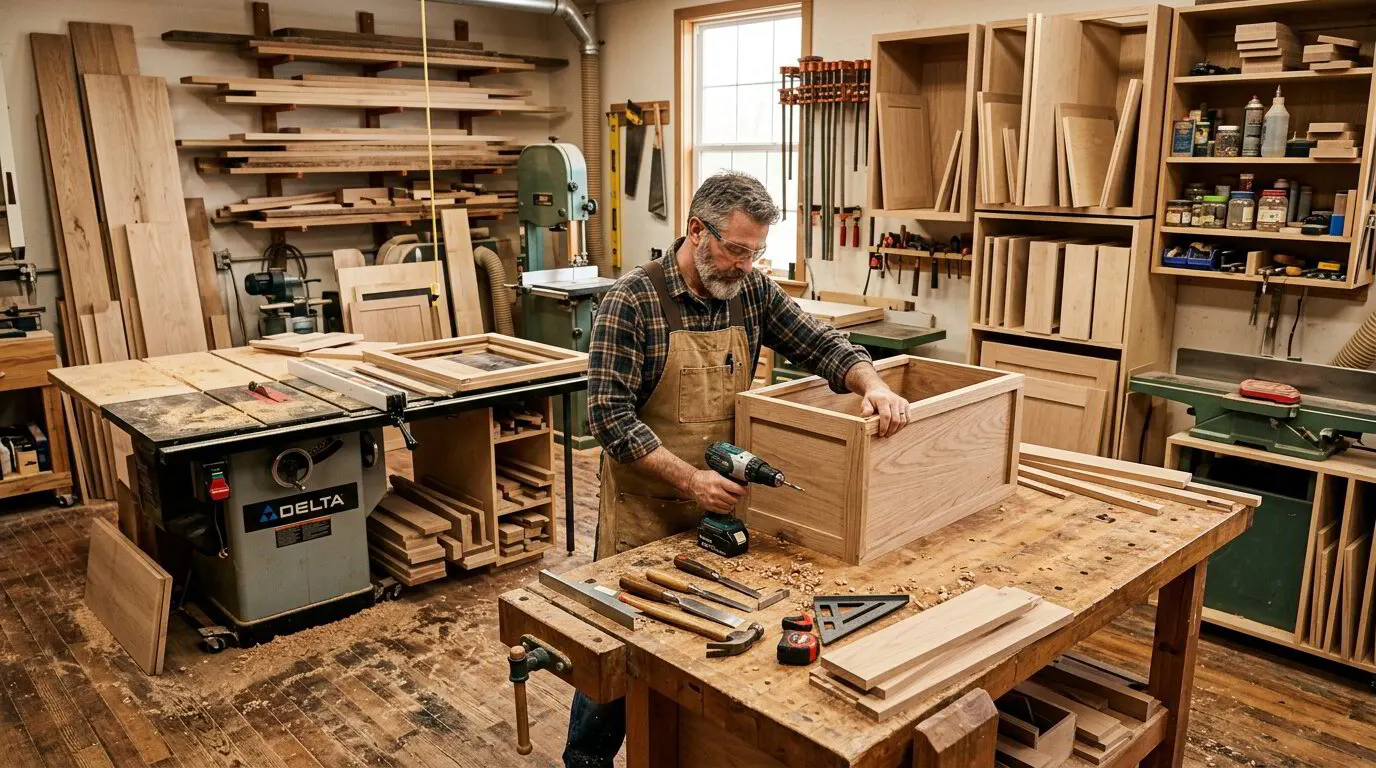
Ask where the shop is and whether you can see it. A shop visit tells you a lot: the condition of the equipment, how lumber is stored, whether finished pieces are protected from dust.
5. Who installs, and are they the same people who built it?
Installation is where good cabinets succeed or fail. Older ranch homes from the 1950s through 1970s often have walls that are not plumb and floors that slope toward a corner. Newer homes on slabs can have their own quirks. An installer who knows how the boxes were built will shim, scribe and fasten them correctly.
At Ace Kustoms, one in-house team designs, builds and installs, with no subcontracted install crews. That is a choice, not the only valid model, but you should know which model you are buying.
6. What does their process look like from first visit to walkthrough?
A clear process is a sign of a shop that has done this many times. A typical sequence looks like this:
- Consultation and in-home measure
- Design and layout drawings you can review and revise
- Material and finish selection with real samples, not just screen images
- Shop fabrication
- Installation
- Final walkthrough and punch list
If a shop cannot describe its process plainly, expect surprises. Our post on the custom cabinet design and installation process lays out each step in more detail.
Checks 7-9: Paperwork, Pricing and Warranty
7. Are they licensed and insured?
Ask for proof of insurance and keep a copy. If someone gets hurt in your home or a cabinet is damaged during delivery, you want that handled by the contractor's coverage, not yours. Also ask whether permits are needed for your scope, especially if plumbing, electrical or wall changes are involved.
8. Is the quote detailed enough to compare?
A one-line quote that says "kitchen cabinets, $X" cannot be compared to anything. A good written estimate spells out:
| Line item | What it should say |
|---|---|
| Box material | Plywood type and thickness |
| Door and drawer fronts | Species, style (shaker, flat panel, raised panel) |
| Finish | Paint or stain, sheen, number of coats |
| Hardware | Hinge and slide brand or type, soft-close or not |
| Interior accessories | Pullouts, dividers, trash bins, lighting |
| Installation | Included or separate, removal and haul-off of old cabinets |
| Exclusions | Countertops, plumbing, electrical, drywall repair |
When two quotes differ by thousands of dollars, the gap is usually hiding in one of these rows. Ask each shop to fill in the blanks.
9. What does the warranty actually cover?
Ask for the warranty in writing. A meaningful warranty covers joinery and finish for a stated period under normal use. Read the exclusions, too. Water damage from a leaking supply line is usually excluded, which is fair, but you should know where the line is drawn.
Red Flags That Should Slow You Down
Most cabinet shops are honest. Still, a few patterns are worth pausing on:
- Large deposits demanded before any drawings are produced
- Reluctance to name box materials or hardware
- No address for a shop, only a phone number and a website
- Pressure to sign the same day to "lock in" a price
- Vague answers about who installs
- A timeline that sounds much faster than everyone else's without a clear reason
A reasonable deposit to begin design and order materials is normal. Paying most of the contract before anything is built is not.
Questions to Ask During the In-Home Visit
The in-home visit is your best chance to judge how a cabinetmaker thinks. Good questions to ask include:
- How will you handle the slope in this floor or the bow in this wall?
- Where would you add filler strips, and how wide?
- What would you change about my current layout, and why?
- How will you protect my floors and the rest of the house during install?
- What happens if a door arrives with a finish flaw?
Pay attention to whether the answers are specific to your house. A craftsman who notices the window trim will collide with an upper cabinet, or that the range wall is out of square, is already doing the job.
If you are deciding between product levels as well as between shops, our comparison of stock vs. semi-custom vs. fully custom cabinets can help frame the choice.
How Local Knowledge Shows Up in the Work
A cabinetmaker who works across Harris, Fort Bend, Montgomery and the coastal counties sees the same conditions over and over. That experience shows up in small decisions:
- Leaving room for wood movement in solid panels during humid months
- Specifying stainless or coated hardware for homes close to the water in Galveston County
- Raising sink base toe kicks or sealing cut edges in laundry rooms and baths
- Planning for the oversized refrigerators and wall ovens common in new-construction upgrades
- Working around the low soffits and furr-downs in older ranch kitchens
You can browse our custom kitchen cabinets and custom bathroom vanities pages to see the types of work we take on across the region.
Ready to Talk Through Your Project?
Running these nine checks takes an afternoon of reading quotes and asking questions, and it can save you years of living with the wrong decision. Write down the answers, compare them side by side, and choose the shop whose answers are clear, specific and in writing.
If you would like to put Ace Kustoms through the same checks, we are happy to walk you through our shop, our materials and our process. Request a free in-home estimate or call (281) 660-3903 Monday through Friday, 8am to 5pm, and we will set up a time to measure and talk through your plans.
Frequently asked questions
How many quotes should I get for custom cabinets?
Is it a red flag if a cabinetmaker uses subcontracted installers?
What should a custom cabinet warranty cover?
How far ahead should I book a custom cabinetmaker in Houston?
Planning a project like this?
Get a free in-home estimate from the team that builds and installs the work.