Cabinet Hardware Guide: Hinges, Slides, Knobs and Pulls
Hardware is the part of a cabinet you touch every day. The hinges carry the doors, the slides carry the drawers, and the knobs and pulls are what your hands actually grab. This cabinet hardware guide walks through each piece, what the options mean, and how to choose hardware that still works smoothly ten or twenty years from now.
It is written for Houston homeowners planning new cabinets, a remodel, or a hardware upgrade on existing cabinets. We cover hinge types, drawer slide ratings, knob and pull sizing, finishes that resist humidity, and the details installers pay attention to that most people never think about.
We install hardware on every set of cabinets we build, from kitchens to vanities to built-ins. On our custom kitchen cabinets, the hardware is chosen alongside the door style and finish rather than added as an afterthought.
Why a Cabinet Hardware Guide Starts With Function
Cabinet boxes can last decades. Hardware is usually what wears first. A cheap hinge loses adjustment and the door sags. A light-duty drawer slide starts to grind under a stack of plates. A plated pull starts to flake near the sink.
Good hardware does three jobs:
- It carries weight without sagging or binding.
- It stays adjusted so doors and drawers line up over time.
- It holds up to use and environment, including Houston humidity and, near the coast, salt air.
Upgrading hardware is one of the most cost-effective ways to improve how cabinets feel. Choosing the right hardware from the start is even better.
Hinges: Types and How to Choose
Concealed (European) hinges
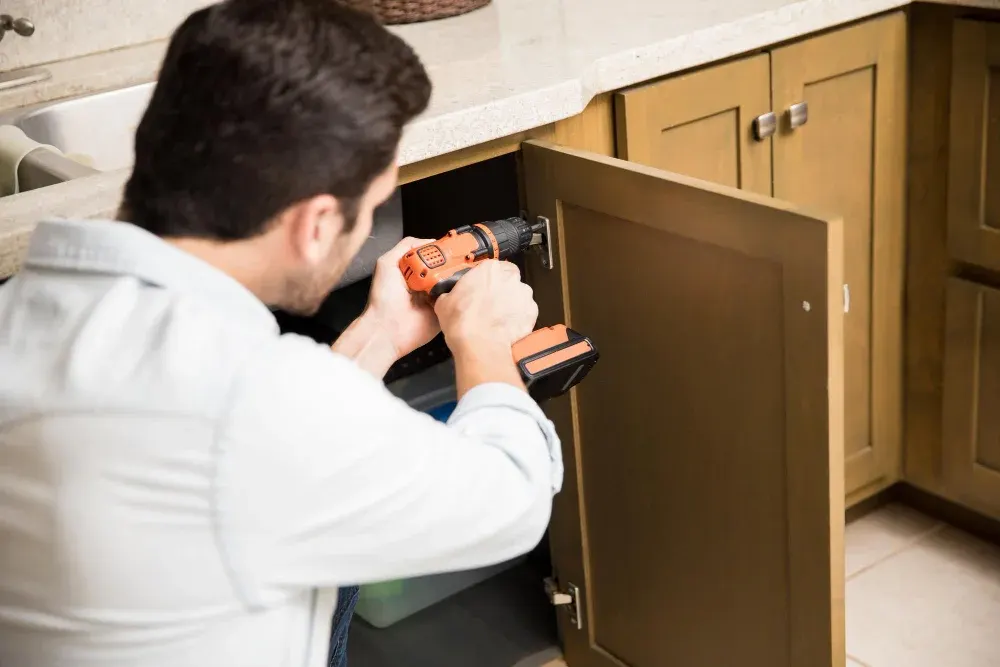
Most modern cabinets use concealed cup hinges, often called European hinges. They mount in a round bore in the back of the door and are invisible when the door is closed. They adjust in three directions, side to side, up and down, and in and out, so an installer can fine-tune the gaps between doors.
Soft-close versus self-close
Self-close hinges snap the door shut. Soft-close hinges include a damper that slows the door in its last few inches so it closes quietly. Soft-close is now expected on quality cabinets and is worth the modest extra cost.
Overlay and inset
Hinge type depends on how the door sits relative to the face frame or box:
- Full overlay: The door covers most of the cabinet face. Common in modern and transitional kitchens.
- Partial overlay: The door covers part of the frame, leaving more frame visible. Common in older and traditional cabinets.
- Inset: The door sits flush inside the frame. Inset needs precise construction and often uses specialized concealed hinges or exposed butt hinges for a traditional look.
Opening angle and specialty hinges
Standard hinges open about 105 to 110 degrees. Wide-angle hinges open 155 to 170 degrees, useful for corner cabinets or when a roll-out needs clearance. Blind-corner hinges, bifold hinges and lift systems for upper cabinets solve specific problems.
Drawer Slides: What the Ratings Mean
Drawer slides matter most in a kitchen, where deep drawers hold heavy pots, plates and pantry goods.
Undermount versus side-mount
Undermount slides mount under the drawer box and are hidden when the drawer is open. They usually include soft-close and are standard on higher-end cabinets. Side-mount ball-bearing slides attach to the sides of the drawer and are visible when open. They are strong and serviceable but take up about half an inch on each side.
Extension
- Three-quarter extension: The drawer opens most of the way. The back stays hidden.
- Full extension: The drawer opens completely. Best for kitchens and baths.
- Over-travel: The drawer opens slightly past full, helpful under overhanging countertops.
Load ratings
Slides are rated by the weight they can carry. Light-duty slides around 75 pounds work for small bathroom drawers. Kitchen drawers holding pots, plates or small appliances benefit from 100 pounds or more. Heavy-duty slides of 150 pounds or higher suit wide pot drawers, pantry pull-outs and file drawers.
| Use | Recommended slide | Typical load rating |
|---|---|---|
| Bathroom vanity drawers | Undermount, soft-close, full extension | 75 to 100 lb |
| Kitchen utensil drawers | Undermount, soft-close, full extension | 100 lb |
| Pot and pan drawers | Undermount or heavy side-mount, full extension | 100 to 150 lb |
| Pantry pull-outs | Heavy-duty full extension | 150 lb+ |
| File drawers in office built-ins | Heavy-duty full extension | 100 to 150 lb |
Knobs and Pulls: Sizing and Placement
Knobs versus pulls
Knobs are small, inexpensive and work well on doors. Pulls are easier to grab, especially on drawers and for anyone with limited grip strength. Many kitchens use knobs on doors and pulls on drawers, or pulls throughout for a cleaner look.
Sizing guidelines
Pull lengths are measured center to center, meaning the distance between the two screw holes. A few common guidelines:
- Doors: 3 to 5 inch pulls or 1 to 1.5 inch knobs.
- Standard drawers up to 24 inches wide: 3 to 6 inch pulls, or one knob.
- Wide drawers 24 to 36 inches: 6 to 12 inch pulls, or two knobs.
- Tall pantry doors and appliance panels: 12 to 24 inch appliance pulls.
A useful rule is that a drawer pull looks balanced at roughly one-third the width of the drawer front.
Placement
On upper cabinet doors, hardware usually sits on the bottom corner opposite the hinge. On base cabinet doors, it sits on the top corner opposite the hinge. Drawer hardware is typically centered on the drawer front, or centered on the top rail of a Shaker-style drawer. Consistency matters more than any specific rule, which is why we use drilling templates to keep every piece lined up.
Handle-free options
Some modern kitchens skip visible hardware entirely. Push-to-open mechanisms let a light press pop a door or drawer open, though they do not pair well with soft-close on every system and can be triggered accidentally by kids or pets. Integrated finger pulls, routed into the top edge of a drawer front, or edge pulls that mount to the top of the door give a clean look while still giving your fingers something to hold.
Budgeting for hardware
Hardware costs vary widely. Basic knobs and pulls may cost a few dollars each, while solid brass or designer pulls can run $20 to $60 or more per piece. A mid-size kitchen may need 30 to 50 pieces, so it adds up quickly. As a general planning approach, decide where to splurge, such as the most visible drawers and the island, and keep the rest simpler. Hinges and slides are usually included in a custom cabinet estimate, so ask what brand and rating are specified.
For more design-focused advice, see how to choose cabinet knobs, pulls and hardware.
Finishes and Materials for Houston Homes
Hardware finish affects both looks and longevity. In Houston's humidity, and especially near Galveston, cheap plating can fail.
- Solid brass: Durable and long-lasting. Unlacquered brass develops a patina; lacquered brass stays bright longer.
- Stainless steel: Excellent corrosion resistance. A smart choice for coastal homes and outdoor kitchens.
- Plated zinc: Inexpensive and common. Quality varies widely; thin plating can pit or peel.
- Matte black: Popular, but the coating can wear at touch points on lower-quality pieces.
- Polished or brushed nickel: Classic and forgiving of fingerprints when brushed.
For outdoor kitchens or homes close to salt air, stainless steel hinges, slides and pulls are worth the upgrade. Our custom outdoor kitchen cabinets are built with that in mind. For a sense of how hardware finishes pair with cabinet styles, our post on cabinet color psychology touches on how metals change the look of a color.
Upgrading Hardware on Existing Cabinets
You do not always need new cabinets to get better hardware.
- Knobs and pulls are the easiest swap. Measure existing hole spacing so new pulls cover old holes, or plan to fill and refinish.
- Hinges can often be upgraded to soft-close if the cabinets already use concealed hinges. Older face-frame cabinets with exposed hinges may need doors re-bored.
- Drawer slides can sometimes be upgraded, but older drawer boxes may need rebuilding to fit modern undermount slides.
If the boxes themselves are swollen or failing, new hardware will not fix the problem. Our guide on cabinet refacing vs replacement helps you decide whether your cabinets are worth upgrading.
Installation Details That Make a Difference
Quality hardware still needs careful installation. A few details separate a good install from a mediocre one:
- Consistent reveals. Gaps between doors and drawers should be even, usually around 1/8 inch.
- Level and plumb boxes. Hinges can only correct so much. On Houston slab floors that are rarely perfectly level, the boxes must be shimmed correctly first.
- Proper screw length. Pull screws that are too long scratch drawer contents; too short and the pull loosens.
- Templates and jigs. Every pull should sit in exactly the same spot on matching doors and drawers.
- Final adjustment. Hinges and slides should be adjusted after countertops go on, since the weight can shift things slightly.
Because the same crew that builds our cabinets also installs them, hardware placement and adjustment are part of the job, not a separate trade.
Plan Your Hardware With Your Cabinets
Good hardware is a small part of a cabinet budget and a big part of how cabinets feel every day. Choose soft-close hinges, full-extension slides rated for the load, pulls sized to the drawer, and finishes that suit your climate.
If you are planning new cabinets or want an opinion on whether your current cabinets are worth upgrading, schedule a free in-home estimate or call (281) 660-3903. We will bring hardware samples, look at your cabinets, and give you a written estimate. You can also see how we approach custom bathroom vanities, where the same hardware decisions apply on a smaller scale.
Frequently asked questions
What is the difference between soft-close and self-close hinges?
Are full-extension drawer slides worth it?
What size cabinet pulls should I choose?
Which hardware finishes hold up best in humid Houston homes?
Planning a project like this?
Get a free in-home estimate from the team that builds and installs the work.