Custom Cabinetry Ideas for Pet Owners
Pets live in every room of the house, but most cabinets are designed as if they do not. Food bags end up on the laundry floor, the water bowl sits in the walkway, leashes hang on a doorknob and the crate takes over a corner of the living room. Custom cabinetry for pet owners solves those problems by giving every piece of pet gear a dedicated, easy-to-clean home.
This post is for Houston-area homeowners with dogs, cats or both who are planning a kitchen, laundry, mudroom or built-in project and want the pets to be part of the plan from the start. Adding pet features during a cabinet project usually costs far less than retrofitting them later.
Below are practical ideas we see homeowners ask for, the materials that hold up to claws and spills, and the details that separate a pet station that works from one that just looks cute in a photo.
Custom Cabinetry for Pet Owners Starts With Routines
Before choosing features, spend a week noticing where the pet routines happen. Where do you feed them? Where do the dogs come in after a walk? Where does the cat food get stashed so the dog cannot reach it? Where do you store the 40-pound bag of kibble?
Most households find that pet activity clusters around two or three spots: the kitchen, the back entry and the laundry room. Those are the places where custom cabinets make the biggest difference. A few questions to answer before design:
- How many pets, and how big are they now (and how big will they get)?
- Do you buy food in large bags or small ones?
- Do the dogs come in muddy or wet on a regular basis?
- Do you crate during the day or overnight?
- Is a cat litter box currently in a bathroom or laundry room?
- Does anyone in the house have trouble bending down to floor-level bowls?
Built-In Feeding Stations
A built-in feeding station keeps bowls out of the walkway and makes cleanup easier. The most common version is a low drawer or open toe-kick bay at the end of a cabinet run or island.
Toe-kick and drawer bowls
A pull-out drawer at the bottom of a base cabinet can hold stainless bowls set into a cutout tray. You slide it out at mealtime and push it back afterward. For large dogs, an open bay roughly 6 to 12 inches off the floor with a recessed tray is more practical, since big dogs eat more comfortably with the bowl raised.
Food storage right above
Put the food directly above or beside the feeding spot. A tall pull-out with a lined bin can hold a large bag of kibble, and a drawer above it can hold scoops, treats, medications and the feeding schedule. Line any bin that holds food with a removable, washable liner. In Houston humidity, open food bags go stale and attract ants quickly, so a sealed container inside the cabinet is better than the bag alone.
Water without the mess
Water bowls get splashed. If the station includes water, use a waterproof tray and finish the cabinet floor with a durable, sealed surface. Some homeowners add a pot filler or a small faucet nearby, though that is a plumbing upgrade and only makes sense during a larger remodel.
Crate Cabinets and Pet Beds
A dog crate is one of the hardest things to make look good in a room. Building it into cabinetry turns it into furniture.
A crate cabinet is a base or end-of-run cabinet with a ventilated door, either a wood grille or a metal mesh insert, and slatted side panels for airflow. Inside, a removable floor tray or washable mat makes cleaning simple. The top becomes usable counter space, which is helpful in a mudroom or laundry.
A few rules for crate cabinets:
- Ventilation on at least two sides. A closed box gets hot and stuffy, especially in a Houston summer.
- Keep it away from heat. Do not place it next to the range, dryer vent or a west-facing window.
- Size for the full-grown dog. The dog should be able to stand, turn and lie down comfortably.
- Use a solid wood or plywood frame. Particleboard swells from accidents and spills and will fail quickly.
Pet beds can also be tucked under a window seat or into an open cubby at the base of a bookcase. Our post on living room built-ins shows how a cubby can be worked into a larger wall unit without looking like an afterthought.
The Mudroom and Laundry: Pet Central
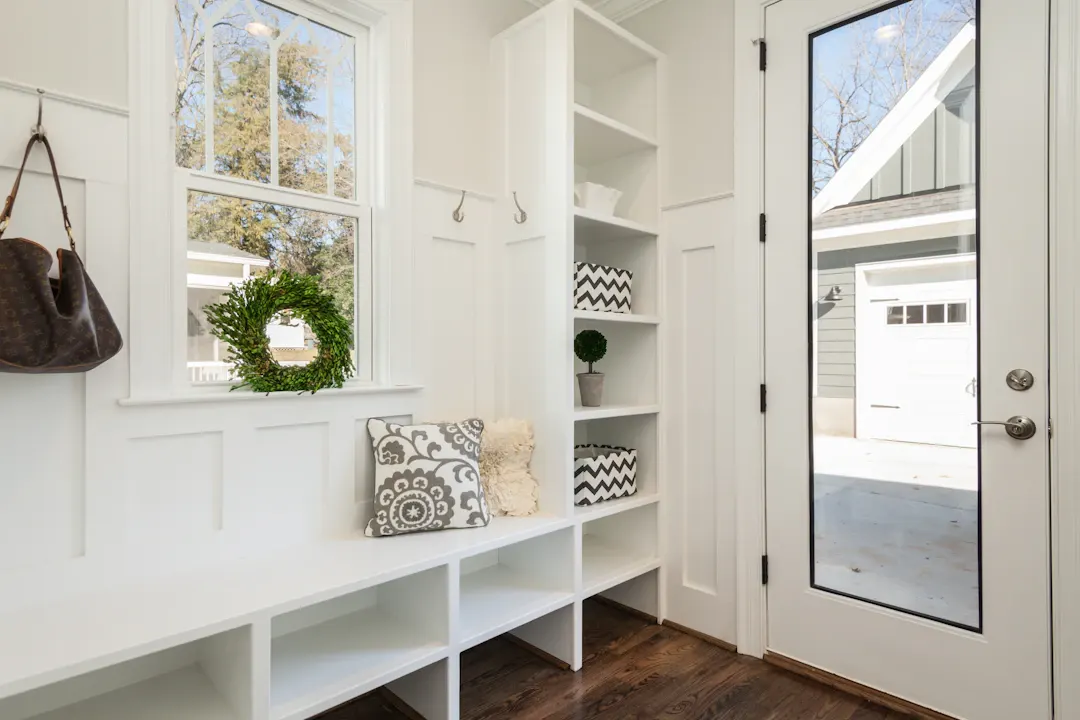
For most dog owners, the back entry is where the real work happens. A custom mudroom can be designed around the walk routine.
Leash and gear storage
Hooks for leashes and harnesses at adult height, a drawer for poop bags and flashlights, and a cubby for rain jackets or cooling vests keep everything together. A bench with open space below gives the dog a spot to wait while you towel off paws.
Dog wash stations
A raised dog wash bay in the laundry or mudroom is one of the most requested pet upgrades. It typically includes a tiled or solid-surface shower pan set 18 to 30 inches off the floor, a handheld sprayer, and cabinetry on either side for towels and shampoo. Ramps or pull-out steps help older or larger dogs climb in.
This feature requires plumbing, a drain and proper waterproofing, so it fits best into a laundry room cabinet project or full remodel rather than a quick update. On slab-foundation homes common across Greater Houston, adding a new drain may mean cutting the slab, which affects cost.
Litter box enclosures
A base cabinet with a cat-sized opening on the side and a vented interior can hide a litter box in a laundry or bathroom. Include a small exhaust path or position it near the room's exhaust fan. A pull-out tray makes scooping easier, and a drawer above holds litter and bags.
Materials and Finishes That Survive Claws, Fur and Accidents
Pets are hard on cabinets, especially the lower third. Choose materials with that in mind.
| Component | Pet-friendly choice | Why |
|---|---|---|
| Cabinet boxes | Furniture-grade plywood | Resists swelling from spills and accidents |
| Doors and frames | Hard maple, white oak | Dense grain resists dents and scratches |
| Finish | Catalyzed or conversion varnish | Hard, wipeable, chemical resistant |
| Lower cabinet color | Mid-tone stain or textured paint | Hides scuffs and hair better than bright white or black |
| Toe kicks | Recessed, sealed, or metal-faced | Takes the brunt of nails and mop splashes |
| Hardware | Long bar pulls | Harder for a dog to nose open than small knobs |
Avoid push-to-open hardware on lower cabinets in pet homes. Curious dogs and cats figure out quickly that bumping a door opens it. If you have a determined food thief, hidden magnetic locks or child-safety latches on the trash and pantry cabinets solve the problem without visible hardware.
Pet hair also clings to textured or open-grain finishes. Smooth, closed-grain finishes are easier to wipe clean. For more on species and finishes, see how to choose wood for custom cabinets.
Humidity adds one more wrinkle. In homes across Houston and the surrounding suburbs, a damp towel or wet dog bed tucked into a closed cabinet will sour quickly. Any cabinet that holds wet gear, towels or bedding should have vent slots, a slatted floor or an open back so air can move through it. A small gap behind a toe kick or a grille panel on the door is often enough to keep things from getting musty between washes.
Trash and Recycling Pull-Outs
If your dog has ever raided the kitchen trash, you already know why this matters. A pull-out trash cabinet with a closed door keeps the bin out of reach and out of sight. Pair it with a hidden latch for persistent dogs.
Place it near the sink and prep area so you are not walking scraps across the kitchen. A double-bin pull-out handles trash and recycling, and a third small bin can collect compost or pet waste bags before they go out.
Planning Ranges for Pet Features
Prices vary widely by size, material, finish and whether plumbing or electrical work is involved. These are general planning ranges for Greater Houston, not quotes. Get a written estimate after an in-home measure.
- Feeding drawer or open feeding bay added to a cabinet run: often a few hundred to around $1,500 above a standard base cabinet.
- Crate cabinet: roughly $1,500 to $4,000 depending on size and door style.
- Mudroom bench with gear storage: commonly $3,000 to $10,000.
- Dog wash station with cabinetry: typically $5,000 to $15,000 or more, largely driven by plumbing and tile.
Folding these features into a larger kitchen, laundry or mudroom project is usually more cost-effective than adding them one at a time. Our mudroom and drop-zone design guide covers how to plan the whole entry around daily routines.
Make Room for the Whole Family
Pets are part of daily life, and cabinetry that ignores them ends up surrounded by bins, bowls and crates that never quite fit. A few well-planned features, built from plywood and hardwood with a tough finish, keep the house cleaner and the routines simpler for years.
If you are planning a kitchen, laundry, mudroom or built-in project and want to include your pets in the design, we would be glad to help. Schedule a free in-home estimate or call (281) 660-3903 to talk with our team about the layout, materials and features that make sense for your household.
Frequently asked questions
What cabinet finish holds up best to dog claws and cat scratching?
Can a dog crate be built into a kitchen or mudroom cabinet?
Is a built-in dog wash station worth it?
How do I keep pets out of lower cabinets?
Planning a project like this?
Get a free in-home estimate from the team that builds and installs the work.