Eco-Friendly Custom Cabinetry Planning Guide
Eco-friendly custom cabinetry is less about a single green label and more about a series of practical decisions: what the boxes are made of, how the finish is applied, how long the cabinets will last, and how much material ends up in a dumpster along the way. Most homeowners who ask about sustainable cabinets want two things at once. They want a healthier home, and they want to avoid buying something that will need replacing in a decade.
This guide is for Houston-area homeowners who care about those goals and want a realistic plan, not marketing language. We will look at material choices, finishes and indoor air, design decisions that reduce waste, when reusing existing cabinets makes sense, and how Houston's humidity changes the math on what counts as a responsible choice.
At Ace Kustoms we build in our own Houston shop with solid hardwoods and furniture-grade plywood, and we install with our own crew. You can see the range of work on our custom kitchen cabinets page.
Durability Is the Foundation of Eco-Friendly Custom Cabinetry
The greenest cabinet is usually the one you never have to replace. A kitchen torn out after 12 years because the sink base swelled and the drawer bottoms fell out represents a full second round of harvesting, manufacturing, shipping and disposal. Building once and building well is the single biggest lever homeowners have.
That is why the box material matters so much in a Gulf Coast home. Particleboard is made from wood waste and resin, and it absorbs water quickly at cut edges and screw holes. A small leak under a sink or steam from a dishwasher can make it swell and crumble. Once that happens, there is no real repair.
Furniture-grade plywood and solid hardwood behave differently. They hold fasteners, resist swelling, and can be repaired, refinished and adjusted over the years. Here is how the common options compare:
| Material | Moisture resistance | Repairability | Typical lifespan in a Houston kitchen |
|---|---|---|---|
| Particleboard with laminate | Low; swells at edges | Very limited | Often 10-15 years |
| MDF (painted doors) | Moderate if fully sealed | Limited | Varies; sensitive to chips and water |
| Furniture-grade plywood | Good | Good | Decades with proper care |
| Solid hardwood (frames, doors) | Good when finished on all sides | Excellent; can be sanded and refinished | Decades |
Lifespans vary with care, ventilation and installation quality, but the pattern holds: materials that tolerate moisture and accept repair stay in service longer.
Choosing Wood Responsibly
Solid hardwood is a renewable material when it comes from managed forests. A few practical ways to make a more responsible wood choice:
- Favor domestic species. Maple, red and white oak, cherry, walnut, ash and hickory all grow in North America. They travel shorter distances than tropical imports and are widely available.
- Ask about sourcing. Third-party certification programs exist for forest management. If certified lumber matters to you, ask your cabinetmaker what is available for your project and whether it changes cost or lead time.
- Embrace natural variation. Choosing a grade that allows some color variation, mineral streaks or small knots uses more of each board and reduces waste.
- Match the species to the job. A painted finish does not need a premium hardwood face. Paint-grade maple or poplar can be a sensible choice there, saving more figured wood for stained pieces.
Rustic or character-grade white oak, for example, has become a popular look and makes good use of boards that might otherwise be rejected for clear-grade work.
What about bamboo and reclaimed wood?
Bamboo panels grow quickly and can look sharp in modern kitchens, but they are typically imported and glued from strips, so the adhesive and shipping distance are worth asking about. Reclaimed wood can be beautiful for open shelves, island panels or a feature piece, though it often needs extra milling and inspection for nails, and it is not always stable enough for doors in a humid climate. Both can work in the right place.
Finishes, Adhesives and Indoor Air
Indoor air quality is often the reason homeowners start asking about eco-friendly cabinets. Houses in Greater Houston are closed up and air-conditioned for much of the year, so whatever off-gasses from new cabinets stays inside longer.
Points to raise with any cabinet builder:
- Panel adhesives. Plywood and MDF are bonded with adhesives, and some panels are made with no added formaldehyde or ultra-low emitting formaldehyde resins. Federal rules already limit formaldehyde emissions from composite wood products, but you can ask about lower-emitting options.
- Finish type. Water-based finishes generally have lower VOC content than older solvent-based lacquers. Many are now durable enough for kitchens and baths.
- Cure time. Finishes cure fully in the shop before cabinets reach your home. Shop finishing also keeps overspray and fumes out of your house, which is a real advantage over site finishing.
- Sealing every surface. Fully sealing all faces and edges helps with durability and limits any raw composite surfaces exposed to room air.
If anyone in the household has sensitivities, ask to smell a finished sample or keep a door in your home for a few days before committing.
Design Choices That Reduce Waste
Good design does a lot of quiet environmental work. Every cabinet built and then removed because it did not fit how you live is waste.
- Right-size the kitchen. More cabinets is not always better. A well-organized smaller kitchen with deep drawers can store as much as a larger one with poorly used corners.
- Use drawers in base cabinets. Drawers make the full depth of a cabinet usable, so you need fewer cabinets overall.
- Choose timeless door styles. A simple Shaker or flat panel door tends to age better than a trend-driven profile, which reduces the urge to replace. Our article on sustainable cabinet color schemes that age well covers color choices with the same goal.
- Plan for change. Adjustable shelves, removable dividers, and standard hinge and slide hardware make cabinets easier to adapt and repair later.
- Optimize cut lists. Building in a local shop allows panels to be nested efficiently, and offcuts can become drawer parts, shelves or blocking.
Built-ins throughout the house follow the same logic. A well-planned closet, office or mudroom unit replaces several pieces of freestanding furniture that might otherwise be bought and discarded. See our custom cabinetry and built-ins page for examples of where that works.
Reuse, Refinish or Replace
Sometimes the most eco-friendly custom cabinetry project is a partial one. If your existing cabinets have solid wood face frames and plywood boxes, they may be worth keeping. Many 1960s and 1970s Houston ranch homes, for instance, still have sturdy site-built or early factory cabinets that only need new doors, hardware and a finish.
Signs the existing boxes may be worth keeping:
- Boxes are plywood or solid wood, not particleboard
- No swelling, rot or water damage at the sink base
- The layout works, or only needs small changes
- Face frames are square and securely attached
Signs replacement is the better long-term choice:
- Particleboard boxes that are swelling or sagging
- Water damage, mold, or pest damage
- A layout that does not suit how you cook or store things
- Cabinets that block a needed change, like moving a wall or appliance
Our cabinet refacing vs. replacement condition guide goes into these signs in more detail. When cabinets do come out, salvageable pieces can often find a second life in a garage, shop or laundry room rather than going straight to the landfill.
Houston Humidity Changes the Equation
A product that performs well in a dry climate may not last here. Houston's long humid summers, frequent storms and occasional flooding put stress on cabinetry, especially near sinks, dishwashers and exterior doors. In Galveston and Brazoria County, salt air adds corrosion risk for hardware.
Choices that make the most sense locally:
- Plywood sink bases and toe kicks, which are the first places to see water
- Finishes applied to all sides of doors and panels to limit seasonal movement
- Quality stainless or coated hinges and slides that resist corrosion
- A vented range hood and bathroom fans that remove moisture at the source
These details are not glamorous, but they are what let cabinets last long enough to be a responsible investment.
Care and Maintenance Extend the Life
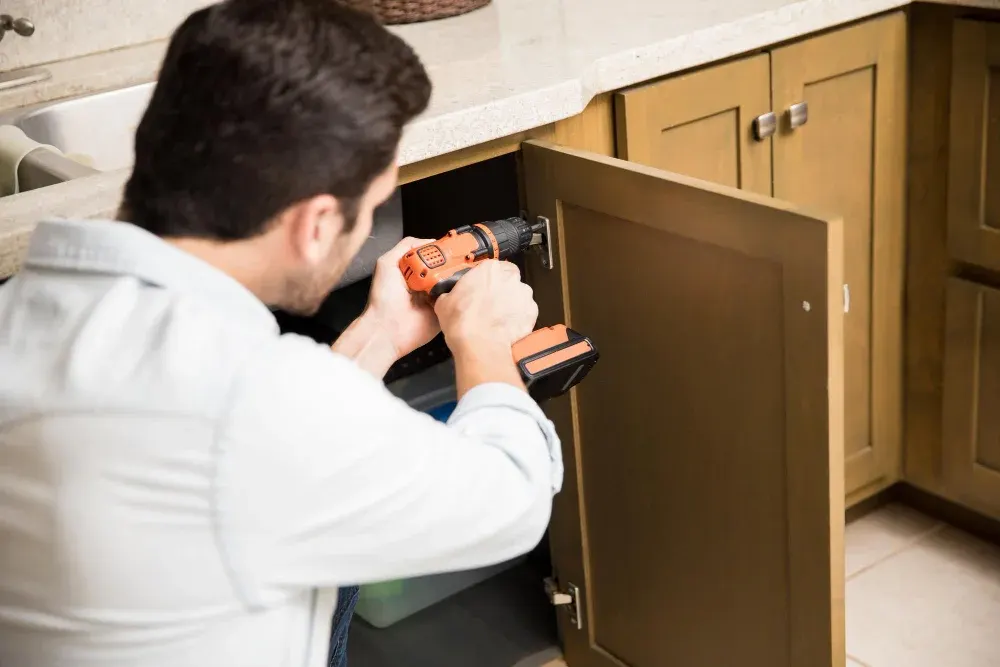
Even the best-built cabinets benefit from basic care. Wipe spills quickly, avoid harsh cleaners that break down the finish, keep wet towels off door fronts, and check under sinks a few times a year for slow leaks. Adjusting hinges as they settle keeps doors aligned and prevents wear on edges. Our custom cabinet maintenance guide lays out a simple routine.
Solid wood also gives you options down the road that composite cabinets do not. A worn stained finish can be cleaned, scuffed and recoated. A painted door with chips can be touched up or refinished. Drawer slides and hinges can be swapped for new ones without replacing the box. Fifteen or twenty years from now, a fresh finish and new hardware can make well-built cabinets feel current again, which is a far smaller footprint than starting over.
Plan Your Eco-Friendly Cabinets With a Free Estimate
Eco-friendly custom cabinetry comes down to building with materials that last, finishing them in a way that respects indoor air, designing without waste, and reusing what is still sound. We are happy to talk through each of those choices during a visit anywhere in Houston and the surrounding counties, and to show you real wood and finish samples in your own home.
Schedule your free in-home estimate, or call (281) 660-3903 Monday through Friday, 8am to 5pm.
Frequently asked questions
What is the most eco-friendly thing about custom cabinets?
Is plywood more eco-friendly than particleboard?
Can I keep my existing cabinets and still update the kitchen?
Are low-VOC finishes durable enough for kitchen cabinets?
Planning a project like this?
Get a free in-home estimate from the team that builds and installs the work.