Shaker vs Flat-Panel vs Raised-Panel Cabinets
The cabinet door is the part of your kitchen you see every day, and the door style sets the tone for the room more than almost anything else. Most choices fall into three families: Shaker, flat-panel (slab) and raised-panel. If you are deciding between Shaker vs flat-panel vs raised-panel cabinets, you are really choosing a look, a cleaning routine and a construction method that each behave a little differently in a humid Houston home.
This guide is for homeowners planning new cabinets for a kitchen, bathroom or built-in project who want more than a photo comparison. We will explain how each door is built, how it ages, how it handles humidity and paint, what it costs relative to the others, and which home styles it suits.
There is no wrong answer here, only a better or worse fit for your house and the way you use it.
How Each Door Style Is Built
Understanding construction helps explain why the styles differ in price, durability and appearance.
Shaker doors
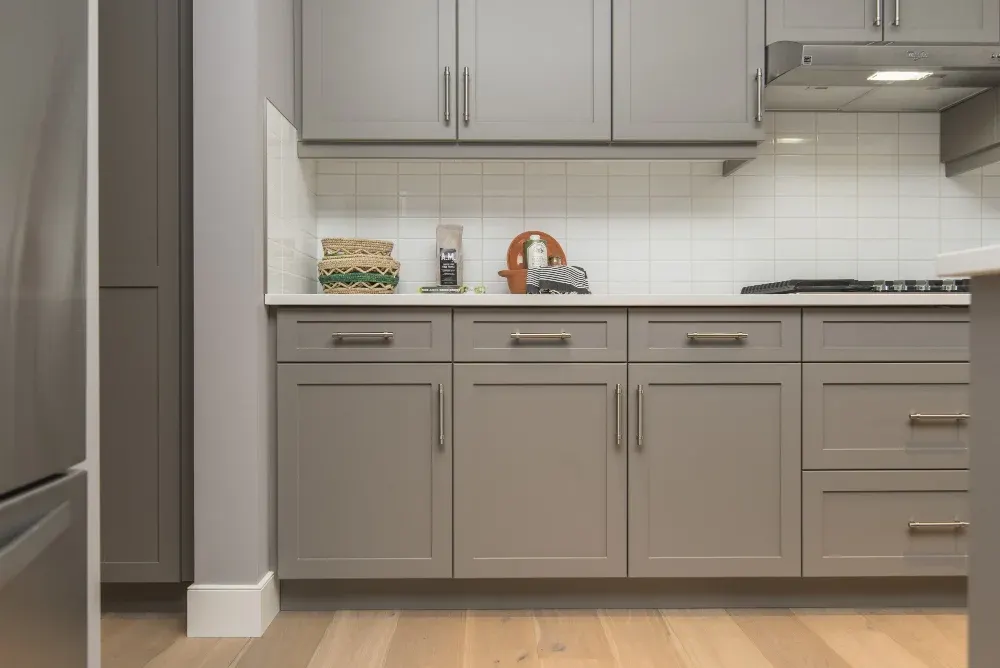
A Shaker door is a five-piece door: two vertical stiles, two horizontal rails and a flat recessed center panel. The frame pieces have square inside edges with no decorative profile. The result is clean and simple, with just enough depth to cast a shadow line.
In solid wood, the center panel floats in a groove so it can expand and contract with humidity. For painted Shaker, a stable MDF center panel is sometimes used inside a hardwood frame to reduce movement.
Flat-panel (slab) doors
A slab door is a single flat piece with no frame. It can be made from veneered plywood, MDF for paint, or edge-glued solid wood, although wide solid wood slabs are prone to warping and are less common. Slab doors give a clean, modern face and pair well with full-overlay or frameless construction.
Raised-panel doors
A raised-panel door is also a five-piece door, but the center panel is thicker and shaped so the middle sits higher than the edges, often with a beveled or ogee profile. The frame usually has a decorative inside edge too. Raised panel is the most traditional of the three and the most detailed.
There are variations within each family, such as cathedral-arch raised panels, beaded-inset Shaker or slim-rail "skinny Shaker," but the basic construction stays the same.
Overlay and inset: the other half of the decision
Door style is only part of the look. How the door sits on the cabinet changes it just as much. With full overlay, the door covers nearly all of the face frame, leaving small even gaps between doors. This is the most common choice today and works with all three styles. Partial overlay leaves more of the face frame visible and is typical of older kitchens, including many original cabinets in 1970s Houston homes. Inset doors sit flush inside the face frame, which gives a furniture-like, precise look, especially with Shaker.
Inset requires tighter tolerances because the gap around each door is visible and must stay even. Humidity swings can make an inset door rub if the fit is too tight, so it takes careful building and installation. It also costs more and gives up a little interior space. When you compare door samples, ask to see them in the overlay you plan to use, since the same Shaker door can look quite different in full overlay versus inset.
Shaker vs Flat-Panel vs Raised-Panel Cabinets at a Glance
Here is a quick comparison of the traits homeowners ask about most.
| Trait | Shaker | Flat-panel (slab) | Raised-panel |
|---|---|---|---|
| Look | Simple, transitional | Clean, modern | Traditional, detailed |
| Construction | Five-piece frame and panel | One piece | Five-piece with shaped panel |
| Cleaning | Easy, one shallow corner | Easiest | Most effort |
| Hides minor dings | Fairly well | Least | Well |
| Best finishes | Paint or stain | Veneer, paint, high gloss | Stain or paint |
| Relative cost | Moderate | Low to high, depends on material | Moderate to higher |
| Fits house styles | Most | Modern, contemporary, mid-century | Traditional, colonial, older ranch |
The relative cost row is general. A walnut-veneer slab door with book-matched grain can easily cost more than a painted Shaker door, while a simple painted slab is often the least expensive option.
Living With Each Style Day to Day
Looks get the attention at the design stage, but how the door behaves after five years of daily use is what you will notice most.
Cleaning. Slab doors wipe down in one pass. Shaker doors collect a little grime in the inside corner of the frame, especially near the range and trash pull-out, but a damp cloth gets it. Raised-panel doors have more grooves and profiles where grease and dust settle, so they take more time to clean thoroughly.
Wear and dings. A flat slab shows every scratch and dent because there is nothing to break up the surface, especially in high gloss. Shaker and raised-panel doors hide small marks better thanks to their shadow lines. For busy family kitchens, mudrooms and kids' bathrooms, that matters.
Hardware. Slab doors often use long bar pulls, edge pulls or push-to-open hardware. Shaker works with almost any knob or pull. Raised-panel doors tend to look best with traditional knobs, cup pulls or bail pulls. Our post on choosing cabinet knobs, pulls and hardware covers sizing and placement.
Humidity, Paint and Houston Conditions
Houston's humid summers and air-conditioned interiors mean wood is always gaining and losing a little moisture. Door construction affects how that shows up.
- Five-piece painted doors (Shaker and raised panel) can show a fine hairline crack in the paint where the rails meet the stiles. This is normal wood movement, not a defect, and it tends to be more visible in the drier winter months.
- Solid wood center panels need room to move. A well-built door lets the panel float. If it is glued tight, it can crack.
- Slab doors made from MDF or veneered plywood are very stable and are a strong choice for a painted modern look with no joint lines.
- Wide solid wood slabs are risky in Houston humidity because they can cup or twist. Most quality slab doors use a stable core instead.
- Coastal homes in Galveston and Brazoria County see more humidity swings and salt air. Stable door cores and durable finishes matter even more there.
Good construction and a quality finish handle these conditions well. We build doors in our Houston shop with that climate in mind, and our custom kitchen cabinets page explains our materials.
Matching Door Style to Your House
The best door style usually echoes the architecture around it. For a deeper look, see matching cabinet style to your home's architecture.
Older ranch homes (1950s-1970s). Many Houston-area ranch houses have simple trim and low ceilings. Shaker is a natural fit, and raised panel can work if you want a more traditional look. Mid-century ranch homes can carry slab doors well, especially in wood veneer. If you own one in Brazoria County, cabinet styles for Angleton ranch homes has more specific ideas.
Traditional two-story homes. Raised panel matches crown molding, wainscoting and formal trim. Shaker gives a lighter, transitional take if you want to update without clashing.
New construction and modern builds. Slab doors in matte paint or wood veneer suit clean lines and large windows. Shaker remains the most common choice in new subdivisions because it reads as fresh without being stark.
Bathrooms. The same logic applies to custom bathroom vanities. A slab-front floating vanity suits a modern bath, while a Shaker vanity fits almost any style.
Mixing Styles the Right Way
You do not have to pick only one. Mixing door styles is a common way to add interest without making the kitchen feel busy.
Popular combinations include:
- Shaker perimeter, slab island. The island becomes a modern focal point while the walls stay classic.
- Shaker doors with slab drawer fronts. Narrow drawer fronts under about 6 inches tall often look better as slabs, since a five-piece frame gets very thin.
- Raised-panel uppers, Shaker lowers. This softens a traditional kitchen without losing character.
- Slab cabinets with glass-front uppers. Thin-frame glass doors break up a long run of plain slabs.
Keep at least one element consistent across the room, such as the finish color, wood species or hardware finish, so the combination looks planned.
Cost and Trend Considerations
In general, door style is a smaller part of total cabinet cost than box material, drawer count and finish. But it still affects the budget.
Simple painted slab doors are often the most affordable. Shaker sits in the middle and is the most widely produced style, which keeps it competitive. Raised panel requires more machining and sanding, which usually adds cost. Premium wood veneers, inset construction or specialty profiles raise the price for any style.
On trends, Shaker has held steady for many years because it adapts so easily. Slab doors in natural wood have grown more popular, while raised panel has become less common in new kitchens but still suits traditional homes. If you are curious about current directions, see Houston kitchen cabinet trends worth testing at home. Choose the style that suits your house first and the trend second.
See Real Door Samples at a Free Estimate
Door styles look different in your light, next to your floors and countertops, than they do in a photo. During a free in-home estimate, Ace Kustoms brings real samples so you can see and feel the difference between Shaker, slab and raised-panel doors in your own space. Our in-house team designs, builds in our Houston shop and installs, using solid hardwoods and furniture-grade plywood.
Contact us to schedule your visit, or call (281) 660-3903 Monday through Friday, 8am to 5pm.
Frequently asked questions
Which cabinet door style is easiest to clean?
Is Shaker still a safe choice for resale?
Why do painted cabinet doors show a line at the joints?
Can I mix door styles in one kitchen?
Planning a project like this?
Get a free in-home estimate from the team that builds and installs the work.